Journalism of Courage
 3 min read


Till recently,we were told that the number of poor people in India in the financial year 2004-05 was 30.17 crore,or 27.5 per cent of the population. Now we are told that the number was actually 37.2 per cent,a jump of 10 per cent of the population. And,incredibly,that is actually good news.
Why? Because the jump comes not from a revision of the previous figure,not from news that 10 per cent more of the population suffered from unspeakable levels of poverty than we had known till now,but from a redefinition of what it means to be poor. And the nature of that redefinition of the poverty line demarcates also an old conception of India from the new. A committee headed by economist Suresh Tendulkar critically examined the old Dandekar-Rath poverty-line formula,drawn up in 1971. That formula looked exclusively at the calorie content of an Indians diet; and,if it was lower than 2250 calories per person per day an arbitrary figure,placed that person below the poverty line. Remember: this was before the green revolution,well before liberalisation. The committee recommended scrapping the focus on calorie intake alone; it should be replaced,according to the report,by a cost-of-living index that took into account other expenditure.
This is a long-overdue recognition that Indias poor are no longer seen as just more mouths to feed. As in any growing economy,the aspirations and demands of Indias poor are increasing,as are the opportunities open to them. It reflects,too,Indias growing aspirations: throughout history,as any society prospers,the standards it has set for an acceptable level of poverty in its midst have altered. And,finally,it drives home an important point about Indias rural areas. For too long left-leaning economists have relied on an anomalous fact: as liberalisations gains have filtered through to Indias villages,calorie intake there has fallen. From this they have made the fallacious argument that Indias development hurts its rural poor. In actual fact,of course,the rural-urban divide is blurring,and people who once worked for hours in the fields now do more sedentary work and consequently eat less. Updating the definition helps skewer that malicious fallacy. For all these reasons,this is an idea we should welcome.

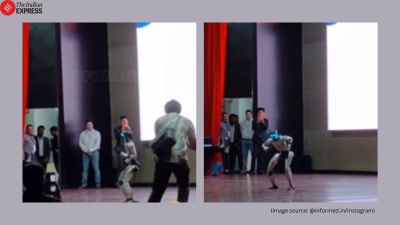
Techfest 2025 at IIT Bombay witnessed an unexpected star turn when a humanoid robot took centre stage and delivered a live dance performance to the hit track ‘Fa9la’. What began as a typical tech showcase quickly turned into a spectacle as the robot matched the Arabic song’s beats with fluid, confident movements.