Journalism of Courage
 6 min read



As the countdown to August 15, 1997 begins, there seems to be unprecedented interest in plotting the history of India8217;s Partition. Why this nostalgia, the revival of individual and collective memories, the celebration of the dead? Why print Manto8217;s Toba Tek Singh repeatedly in scores of newspapers and magazines? Is it because there is not much to celebrate after 50 years of Independence? Or has the occasion itself finally sensitised us to the painful legacy of Partition?
Sure enough, a common refrain in recent writings is that Partition was a colossal tragedy, a catastrophe brought about by politicians who lacked the will and foresight to resolve their disputes over power-sharing and who failed to grasp the implications of dividing the country on religious lines.
As a result, there is much less preoccupation with political parties, their statements and resolutions, and their mutual wrangling in Lutyen8217;s Delhi. For a change, the focus is on the impact of Partition on the common people, and the meanings they attached to happenings in and around their homes, fields and factories.
Such concerns are probably not echoed in Pakistan, where the creation of a Muslim state is seen as a legitimate act, the culmination of a logical historical process. Obviously, Partition does not convey the same meanings in Lahore or Islamabad as it does to some of us in Delhi and Calcutta. It is celebrated as a spectacular triumph of Islamic nationalism and not bemoaned as an epic tragedy. True, Manto, Rajinder Singh Bedi and Krishna Chander strike a chord among the beleaguered muhajirs of Karachi. But why should those living in Punjab or the Frontier region mourn the breakup of India8217;s unity or lament the collapse of a common cultural and intellectual inheritance?
The differences in approaches should not, however, stand in the way of developing a common reference point for rewriting the histories , and not just the history, of Partition. It is possible, despite years of mutual antipathy, for the peoples of India and Pakistan to make sense of Bedi, Kamleshwar, Intizar Husain and Josh Malihabadi, and to reflect on the trauma of a generation caught in the crossfire of religious sectarianism.
For this to happen, we must first revive the old-fashioned theories on India8217;s syncretic-composite cultural ethos and highlight the shared values and traditions in the making of a subcontinental culture. The urgency must be felt in India as well as Pakistan, where ethnic, linguistic and regional tensions reveal the limits of an Islamic agenda developed around the imaginary notion of Muslim solidarity.
Along with this, scholars and generalists must uncover the complex nature of the Muslim League movement, question its representation as a unified entity, and assess afresh its ideology and mobilisation.
By now, the liberal intelligentsia in Pakistan must know that not everyone who rallied round the green flag was uniformly wedded to, and inspired by, a shared ideal of an Islamic society. Many were pushed into religious/Islamic positions; many others used the League platform to promote their material interests. No wonder people hitched their fortunes to the League bandwagon at different points of time and for different reasons. This needs to be underlined to question the exaggerated claims made in the name of Islam by protagonists of the two-nation theory, and to explore the contradictions in the political and economic trajectory plotted by the rulers of Pakistan.
Consider, too, the intensity of jealousies and internal discord in the League. Are these commensurate with the 8220;pure8221; intentions attributed to the League or the romanticised image of its followers? In 1941, M. A. Jinnah was told about 8220;the influx of undesirable and dubious persons,8221; including those who just a few years ago had treated his workers with 8220;amused contempt,8221; the regional groupings in the organisation, the Ajlaf-Ashraj low and high-born divide, and Shia-Sunni schisms in several areas.
To put such impressions in perspective and grasp the dynamics of power-politics, those critical areas must be probed where the faithful8217; themselves were so hopelessly split. Such an exercise would not reduce the reputation of historic figures or belittle the Pakistan movement but enlarge our understanding of them. If we know our leaders better and question their reading of our shared heritage, we may avoid their errors of judgment.
Finally, even by conventional standards of 8220;success8221; and 8220;failure8221; we must not ignore the role of those Muslims who championed secular nationalism and rejected Jinnah8217;s Pakistan demand. Their perspectives, combined with the activism of several organised formations, disproved the notion that the Pakistan campaign was ideologically cohesive, or that its progress was unimpeded. At the same, their commitments and orientation communicate forcefully that Muslims had strong secular and nationalist traditions as well which should not be forgotten, and their positions not submerged beneath the rationalisation of the 8220;victors8221;, the founders of Pakistan.
Even if these themes make little sense to some readers, we can still turn to creative writers to reveal the other face of freedom. After all they encapsulate the mood and sensitivity of those aggrieved men and women who had no say in the transfer of power in August 1947. They portray a fragmented and wounded society 8212; even if cynical and self-seeking politicians, impervious to the consequences of their recklessness, ignored their warnings to sign united India8217;s death-warrant.
Creative writers expose the inadequacy of numerous narratives on Independence and Partition, compelling us to consider new themes and approaches, and providing a foundation for an alternative to current expositions of a general theory on inter-community relations in India. Their strength lies in representing a grim and sordid contemporary reality without drawing religion or a denominational group as the principal reference point. If they can stir the individual and collective imagination of sensitive readers in the subcontinent, there is no reason why people on both sides of the Wagah border cannot share the anguish of the poet, Faiz Ahmad Faiz:
This is not that long-looked-for break of that day
Not that clear dawn in quest of which those comrades
Set out, believing that in heaven8217;s wide void
Somewhere must be the star8217;s last halting place
Somewhere the verge of night8217;s slow-washing tide,
Somewhere an anchorage for the ship of heartache.

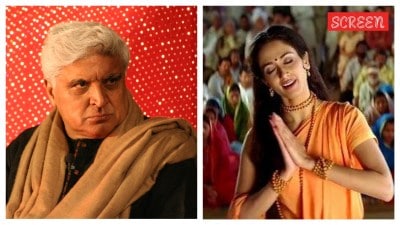
Veteran poet, screenwriter and lyricist Javed Akhtar recently expressed his disagreement with longtime collaborator and music composer AR Rahman over the latter’s claims that the Hindi film industry has become more communal in the past eight years. Akhtar claimed that the film industry has always been religion-agnostic and has picked the best person for the job.