Journalism of Courage
 3 min read



For the first time in the Australian Open8217;s 100-year history the men8217;s final will be a night match played under the sodium-white lights of the Rod Laver Arena. The idea is to add a little dramatic tension to the occasion, not that Lleyton Hewitt, whose spirit and determination sometimes border on the psychotic, needs more tension.
Hewitt would become the first Australian man since Mark Edmondson in 1976 to win this Grand Slam tournament, and he sees the centenary celebrations as the neatest of fits. The clamour for history is a little deafening here, and his attitude and competitive urge are such that Marat Safin, the Russian who ended Roger Federer8217;s run and aura of invincibility in the semi-finals, does not start as the clear favourite.
Although Hewitt has never advanced beyond the fourth round until this year and is the first Australian in the final for 17 years, a win for Safin, the great under-achiever of men8217;s tennis, would register far higher in global terms. The Russian probably feels it is a little strange that, having beaten Federer in such a sensational manner, he does not have the trophy in his kit bag already.
Safin dislikes the word 8216;8216;comeback8217;8217; but he knows more than enough about a tennis player8217;s cycle of decay and renewal, and a win for him would mark his return as a Grand Slam force. For too long he has been stuck on one major, the 2000 US Open he won as a 20-year-old when he destroyed Pete Sampras in New York.
It will be Safin8217;s third Australian Open final. He underestimated the Swede, Thomas Johansson, in 2002 8212; there had been the strong suspicion that he had been up partying the night before 8212; and last year, after the loss of the first-set tiebreak to Federer, the match then accelerated to its inevitable conclusion. But this year, with the help of coach Peter Lundgren, Safin has a harder, more disciplined edge.
Hewitt will ignore the protests from his body, as he did against Roddick, who had spent about half the hours on court. 8216;8216;No pain, no pain8217;8217;, Hewitt likes to scream to himself. He worked incredibly hard on his conditioning over the off-season, adding several pounds of muscle, and he is confident that his physique will hold up for a third Grand Slam title after the 2001 US Open and Wimbledon a year later.
His mannerisms and siege mentality are incredibly divisive in Australia, and much has been made of the fact that local television networks have been running for-and-against polls. Still, what the Australian psyche respects above all else is being a winner. If Hewitt wins, the effect on his popularity will be fascinating to track.
He has been distracted by the 8216;8216;speed wars8217;8217; of Melbourne Park, an argument with Tennis Australia over the pace of the rubberised surface, suggesting that the alleged slower pace this year would harm his chances, because he prefers the ball coming quickly on to his racket. He can only prove his point by losing to Safin.
The Daily Telegraph

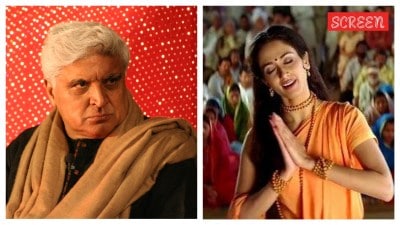
Veteran poet, screenwriter and lyricist Javed Akhtar recently expressed his disagreement with longtime collaborator and music composer AR Rahman over the latter’s claims that the Hindi film industry has become more communal in the past eight years. Akhtar claimed that the film industry has always been religion-agnostic and has picked the best person for the job.