Journalism of Courage
 6 min read



King Gyanendra of Nepal is paying the price for misreading the purpose of democracy. Instead of seeing it as a way to isolate extremism and increase the space for moderate political actors, he viewed the call for democracy as an attempt to usurp his powers. Echoing Bush8217;s statement after 9/11, he outlined the options for the moderates as: 8220;either with the monarchy or with the Maoists8221;. The moderates chose the Maoists, thus creating an improbable anti-monarchy alliance, which has called for early elections and even an end to the monarchy. In September 2005, the Nepali Congress Party dropped its 60-year-old pledge to retain a constitutional monarchy.
With his 8220;divine right8221; mindset, Gyanendra failed to recognise that procedural democracy offers plenty of room for authoritarianism. All he had to do was pop over to India to see our Laloos and Jayalalithaas in action. If he had continued his brother8217;s project of transforming Nepal into a democracy with a constitutional monarchy, he would have generated goodwill among the people. He could have backed a pro-monarchy party and continued to exert considerable influence on Nepal8217;s policies. Instead, he was greedy. Hence his response was to declare a state of emergency. He suspended all freedoms, including those of speech and expression, blacked out the media, and used the army to quash large pro-democracy demonstrations. These actions have increased the resistance to his rule, leading the chain of events inexorably towards Gyanendra8217;s worst nightmare: of being forced into exile.
Gyanendra misread what democracy actually does. First, it provides a way for people to voice their discontent and aspirations by electing their representatives. Election to institutions of democracy like parliament provides an alternative model to violent revolution. He could have continued down the path of democratising Nepal with a constitutional monarchy, initiated by his brother, Birendra, who introduced multi-party democracy in 1991. The Maoists are powerful because they provide answers and an alternative model to the woes of the predominantly rural and poor population. Instead of sacking the elected government in February 2005, the king could have allowed the democratic process to continue, and initiated moves to bring the Maoists into the fold. After all, the mainstream political parties had accepted 36 of the 40 demands of the Maoists.
Second, democracy brings all actors to a level playing field. Studies have shown that democracy has a moderating influence even on strongly ideological movements because political parties have to appeal to larger groups of voters to win elections. In their transformation from a Maoist movement into a political party, the cadres would have been forced to adopt strikes, demonstrations and rallies, followed by negotiations and compromises.
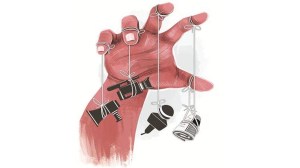
Third, it is possible to have a democracy and still be illiberal. As Fareed Zakaria writes in his article 8220;Illiberal Democracy8221;: 8220;If a country holds multiparty elections, we call it democracy. Constitutional liberalism, on the other hand, is not about the procedures for selecting government, but rather government8217;s goals. It refers to the tradition, deep in western history, that seeks to protect an individual8217;s autonomy and dignity against coercion, whatever the source 8212; state, church, or society.8221; Constitutional liberalism, which rests on the rule of law, has led to democracy, but democracy may not bring constitutional liberalism. Zakaria refers to several newly democratic states in Central Asia and Africa which have powerful executives, weak legislatures and judiciaries, and few economic and civil liberties. By introducing democracy in Nepal, the king could have still remained the main power. He could have played on the habitual internecine battles afflicting Nepal8217;s parliamentary parties to emerge as the puppet master. After all, in the past, irreconcilable differences between the politicians and their inability to contain the Maoists had made them appeal to the monarch. Ironically, today the king8217;s actions united the fragmented parties and the Maoists under an anti-Gyanendra umbrella.
Gyanendra also misinterpreted international sentiments. Perhaps he thought he could get away with a repeat of his 2002 performance when he dismissed the government and seized all power, claiming the elected leaders had failed to bring peace. The shock of 9/11 and international intolerance for violent non-state actors helped Gyanendra8217;s case. The preoccupation with hunting down Al-Qaeda terrorists created a space for neoconservatism and strong-arm tactics of the state. Authoritarianism was tolerated as long as it put an end to terrorism. Gyanendra8217;s actions were not unpopular since the Maoists were persona non grata for powerful global players like the US. Today, the call for democracy outweighs the emphasis on containing terrorism.
In such a situation, Gyanendra made all the wrong moves when he forcibly tried to quell pro-democracy demonstrations. Pictures, splashed worldwide, of young men and women being dragged away by armed police have not helped. Gyanendra, unlike his brother, was and remains very unpopular with his people. The manner of his ascension to the throne in the aftermath of a bloody regicide and his subsequent absolutism alienated even his traditional supporters. In the revived calls for democracy, even the US has said he may have to abdicate, even if it leaves the space open for Maoists.
India8217;s attitude, which will set the tone for others like the US and China, has been reactive rather than pro-active. Until recently, India maintained a 8220;hands off8221; approach because it did not want to get involved in regional conflicts. However, the rapid escalation of the conflict threatens India8217;s security and forced it to send an envoy, Karan Singh. Even now, Gyanendra may be hoping that India will salvage the situation and keep him in power. But it may be too little, too late. India8217;s traditional commitment in Nepal to the twin planks of constitutional monarchy and multiparty democracy may not be feasible in the face of Gyanendra8217;s intransigent attitude and the pro-democracy fervour. India may have to dump the monarch. Gyanendra could have averted his fate if only he had stopped imitating Machiavelli8217;s 8220;Prince8221; and followed the African and Central Asian illiberal route.
The writer is a fellow at the Centre for Policy Research, New Delhi shylashrishotmail.com