Journalism of Courage
 3 min read



Time and again, the Ayodhya issue grips national headlines. No longer just a 8216;dispute8217;, it represents an ideological clash over two ideas of India 8212; a multicultural and secular nation based on the idea of individual citizenship versus one that regards itself as essentially Hindu in terms of ethnic identity dominating and taking precedence over other cultural identities.
Here the term 8216;Hindu8217; has come to be associated with what the sangh parivar stands for, what the VHP advocates, what the BJP affirms and what has lent itself to the legitimisation of violence against Muslims and Christians. Its visible consequence has been the emergence of BJP as a political force. Less visibly, it has fostered a certain cultural and political imagination.
The tremendous durability of this issue and the terms in which it is generally represented in media has anesthetised the masses to this redefinition of Hinduism. The demand for a temple is made in the name of all the Hindus. The symbol of Ram is taken out from its religio-cultural domain and charged overwhelmingly with political overtones. For the votaries of Hindutva, the birth of Ram and the existence of the temple are 8216;historical8217; facts. The Ayodhya campaign harps on a 8216;chronology8217; of events such as the birth of Ram, the advent of Babar and the construction of the masjid as also the landmarks of governmental action and the day it was demolished by karsevaks. Ramkatha in such narratives no longer remains a 8216;katha8217;. It becomes a 8216;rakt ranjit itihas8217; as one sangh pamphlet has it.
Identity becomes a surrogate for power. The 8216;Hindu8217; of the sangh vintage is one who is self conscious of his glorious Hindu past, who revels in that past and who wants it affirmed publicly by 8216;others8217; who are non-Hindu. Hindu identity is translated into Hindu power.
The intermittent efforts at finding an extra judicial 8216;solution8217; reinforces the cultural logic of redefined Hinduism. Rather than an issue between individuals and bodies who are actually involved, the negotiations are invariably seen as being between 8216;Hindus8217; and 8216;Muslims8217;. The overwhelming concern by the sangh parivar has been to get the consent of the 8216;Muslims8217; to satisfy the needs of 8216;Hindu8217; faith. The involvement of a religious figure as the Shankaracharya, who claims a legacy to a certain cultural charisma, subtly expands the geographical and cultural space to draw the attention of a larger Hindu public. The failure of such negotiations is represented as resistance of 8216;Muslims8217; to 8216;Hindu8217; will.
Whereas identities have multiple axes, the terms 8216;Hindu8217; and 8216;Muslim8217; as they gain representation through an issue like Ayodhya produce cultural straitjackets through which a manufactured identity is easily marketed.
Wider awareness of this process is needed to counter a campaign that seriously undermines the idea of a nation based on individual citizenship.

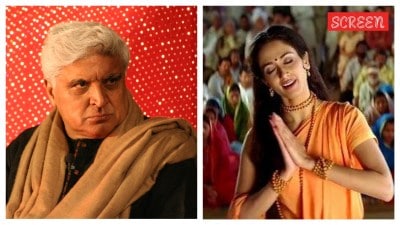
Veteran poet, screenwriter and lyricist Javed Akhtar recently expressed his disagreement with longtime collaborator and music composer AR Rahman over the latter’s claims that the Hindi film industry has become more communal in the past eight years. Akhtar claimed that the film industry has always been religion-agnostic and has picked the best person for the job.