Journalism of Courage
 3 min read



Stories are told of a sign on the access road to Bekoji in central Ethiopia: 8220;Welcome to the village of athletes.8221; Today, one of its inhabitants completed Bekoji8217;s sweep of the men8217;s and women8217;s gold medals in the two distance races, 5000m and 10,000m.
Tonight, Kenenisa Bekele clinched the distance double by, again, setting an Olympic record in the 5000m 8212; 12:57.82, about twenty seconds short of his own world record. Distance races have a romance not present in the off-you-go-and-don8217;t-look-back sprints, they require strategy and outplaying the competition on tactics of how to pace oneself and when to go for the finishing kick. They also breed stories of character and team-play, with pace-makers taking the responsibility to get their mate fastest to the finish line.
So it was here at Beijing, with Bekele8217;s brother, Tariku, and another Ethiopian runner, Abreham Cherkos, pacing the pack to set it up nicely for Bekele.
Sometimes it works the other way. A lone individual can survive the designs of a team of runners, as Morocco8217;s Hicham El Guerrouj did at Athens to take gold in the 5000m. In Beijing, Bekele had already won gold in the 10,000m last Sunday. And this week, on Friday, another runner from Bekoji, Tirunesh Dibaba, took gold in the 5000m to complete her double, having won the 10,000m on August 15.
The Ethiopian and Kenyan women are now so dominant in distance running that it is easy to forget that it was just in 1992 that Derartu Tulu, who is related to Dibaba, took gold in the 10,000m to become the first African woman to win a medal at the Olympics.
Running in tradition
But the Bekeles and Dibabas run in a tradition that goes back to the bare-footed Abebe Bikila who clipped a second off the world record to win the marathon gold at the 1960 Rome Olympics. He defended it with another world record in the 1964 Olympics in Tokyo.
The men8217;s marathon is, in fact, the last track and field event at the Olympics. But on Sunday, it will miss the presence of Haile Gebrselassie. He had decided not to participate in the marathon at Beijing, because of his asthma.
But in Beijing Gebrselassie, from a town just about 50 km from Bekoji, did run the race that is no longer his, the 10,000m. He placed sixth, but as it the tradition the Ethiopians, he ran the full victory lap with Bekele and Sileshi Sihine, who had taken silver.
It was apt. Gebrselassie is now 35, and there is no guarantee he8217;ll be competing in London in 2012. In the legend that has built around him, 10,000m is a special number. That8217;s the distance he8217;d run to school every morning, his books so cradled in his arm a particular way, that he still runs as if bearing an invisible weight of schoolbooks.
And 10,000 too is the altitude in feet of Bekoji.

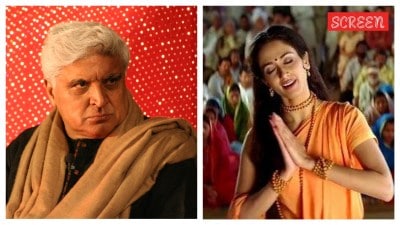
Veteran poet, screenwriter and lyricist Javed Akhtar recently expressed his disagreement with longtime collaborator and music composer AR Rahman over the latter’s claims that the Hindi film industry has become more communal in the past eight years. Akhtar claimed that the film industry has always been religion-agnostic and has picked the best person for the job.