Journalism of Courage
 5 min read


BrahMos,the world8217;s only supersonic cruise missile and a symbol of the India8217;s military prowess has been billed to be 8220;uninterceptable8221; for the 8220;next 20 years8221;,by none other than the 8220;father of BrahMos8221; himself.
8220;The equivalent of BrahMos is yet to be built. And,in the next 20 years,it cannot be intercepted by an enemy,8221; says A Sivathanu Pillai,scientist,and CEO and MD of BrahMos Aerospace sharing the vision for the future trajectory of growth for the iconic missile technology developed jointly by India and Russia.
Pillai,also Chief Controller R and D,DRDO and hailed largely as the 8220;father of BrahMos8221; mentions 8220;missile technology8221; as one of the 10 key and 8220;unique leap-frog technologies8221; for building a securer and greater future of India,8221;driven by youth power8221; in a new book which he has co-authored with the former President A P J Kalam.
Titled 8220;Thoughts for Change: We can Do It8221;,by two renowned scientific minds aims to be a clarion call to the youth of India to 8220;reclaim its ancient scientific wisdom8221; even as it exhorts them to embrace and work towards building a future where 8220;multiple technologies will intersect and interoperate8221;.
8220;We take pride in the fact that BrahMos,world8217;s only supersonic cruise missile,a symbol of Indo-Russian co- operation,where India provided the guidance,avionics,software and airframe components,etc,has been successfully delivered to both the Indian Navy and the Indian Army and the aerial version for the Indian Air Force too shall be ready in few years time,8221; Pillai said in an interview.
BrahMos,developed jointly in a strategic partnership between Indian DRDO Defence Research and Development Organisation and Russian NPO Mashinostroyeniya,is a stealth cruise missile with a range of 290 km and travels at a speed of Mach 2.8 to 3.
The name BrahMos is a portmanteau formed from the names of two rivers,the Brahmaputra of India and the Moskva of Russia.
Among other technologies that the authors believe will lay the roadmap for the future of war theatres and health care,etc,in India is the convergence of Information,Biotechnology and Nanotechnology nano-info-bio.
Other technologies in the list include Robotics,Artificial Intelligence and Cognitive Sciences; Sensor Technology; Materials Technology; High Energetics; Fusion Technology; Space Technology; Hypersonics and Green Technology.
8220;Nano-info-bio and their convergence will redefine the future as we know it,whether in changing the dynamics of the war theatre where information technology will be coupled with the existing biotechnology and the new and emerging field of nanotechnology or health care. A simple looking bird flying in the air could be a surveillance and reconnaissance device.
8220;As per health,drug delivery through nano tech has been tried on Parkinson8217;s Syndrome and Epilepsy patients outside India and has shown to stop their symptoms like shaking of limbs and has even allowed them to walk,not possible otherwise. And,it is definitely a future India is looking to,given its huge youth bank,8221; says Pillai.
Divided into five sections,the book in fact lays a special emphasis on the youth power,especially in the final section titled 8216;Future India8217; where it asks the young India to 8220;think big8221; and to 8220;assume the leadership role8221; in building a 8220;knowledge society8221; for the world.
8220;India has currently 580 million youth population. And,every one among the youth of India must prepare himself or herself to do remarkable work,which will create a place for him or her in the history of the world. History is not written for cowards and one who thinks small,8221; he said.
Fending off worries that the Indian youth has been diverted by a current phase of commercialism,the 8216;father of BrahMos8217; urges them to remain positive and 8220;believe in the power of India8221;.
8220;This current phase of commercialism luring the youth is only a temporary phase. After ten years,you will see,the youth of India will change. And,I and Mr Kalam,himself a popular force among the youth of the country,we both believe that the future of India is great. And,we have to be a positive force and not a negative one,and tackle the problems of the nation,8221; he says.
Commenting on the lack of research culture in Indian universities and organisations,Pillai emphasised the need for government8217;s greater attention and allocation of resources towards building a 8220;research-based paradigm8221; in educational and research institutions.
8220;Government is spending 1.7 crore to make one IIT graduate. And,after graduation,the best brains go for either corporate jobs or to US universities,among others. And,then that country becomes a great country.
They leave because they don8217;t have research opportunities back home and that8217;s why we need to focus more on research based paradigm. Because,when science grows,country grows,8221; he said.
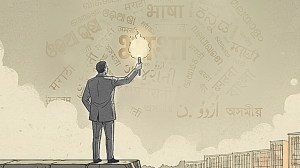
The book has been brought out by Pentagon Press and also contains illustrations accompanying the text.