Journalism of Courage
 7 min read



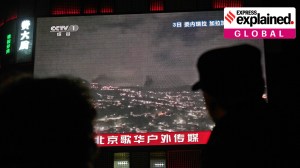
Imagine this scene outside Tiananmen Square, where the fiftieth birthday bash of the People8217;s Republic is progressing to the drumbeats of revolutionary memories. Where ghosts are withdrawing to the periphery of celebrations.
Imagine this scene in a cafe where cappuccino and tea are served in the same cultural cup. Four men are having a very special, very private, party, away from the main event, away from slogans and red stars. Chairman Mao, in tattered clothes, is in a poetic mood. How distant are my rhymes today, how distant are they from the prosaic prosperity of the republic, he sighs. Still he hums: 8220;The waves on Lake Dongting boil up like snow reaching to the heavens,/The people of Long Island sing earth-shaking songs./Inspired by all this, I would dream a dream equally vast,/And see the Land of the Hibiscus wholly illuminated by the light of dawn.8221; The Land of the Hibiscus is the poetic name for Hunan, the Mao province, and the Chairman is dreaming a vast dream of communist heaven in thecountryside.
8220;Chairman, a peasant is always a peasant, permanently poetic and never pragmatic,8221; says Deng Xiaoping, without looking at Mao. He orders a Diet Coke and returns to the game of bridge on his laptop. I think, Chairman, you need a walk in the market.8221;
8220;The market! But the Party should control the queue,8221; says Lenin. 8220;The Party controls the supermarket, the prison, the mind, the revolution.8221; He takes out an yellowing issue of the People8217;s Daily and reads aloud from the editorial:
8220;The thought of Mao Zedong is one which, in an era moving toward the collapse of imperialism and the victory of socialism, in the great revolutionary struggle of the Chinese people, united the universal truths of Marxism-Leninism with the practice of revolution and construction in China and creatively developed Marxism-Leninism.8221;
Mao nods approvingly. Deng continues with the game as if nothing has been spoken. Lenin continues in disillusion, 8220;Today only the communists who read The Wealth of Nationscare for my wisdom on Marx8217;s prophecies.8221;
8220;Marx? Did you say Big Mac?8221; Deng asks the computer screen.
8220;And did you say wisdom?8221; Confucius asks Lenin. 8220;Let the party keep the hierarchy intact. Let the patriarchs of higher wisdom keep the order in this antique land.8221;
Outside, the revellers are now swarming McDonald8217;s. In the market, the salesman of fiftieth-year slogans is insisting on dollar payment. In the prison, the calligraphy of democracy is multiplying on secret walls. The ghosts are making a wax statue of the Goddess of Democracy, a bad parody of the Statue of Liberty. And the stability-speak of Jiang Zemin sounds so predictable.
This can only be an imaginary scene, for in this age of Romancing China, the market is so overwhelming a motif that nobody is interested in the mausoleum. For Mao, the revolution was a romance spreading across the countryside. Fifty years ago on that October 1st, when Mao declared the People8217;s Republic, 8220;the people8221; were animated abstractions subordinated tohis salvation fantasy. Central to that fantasy was the eternity of the Enemy The enemy has never ceased to exist in China ever since Mao8217;s guerrilla days in the Yanan caves. Through the many variations of the revolution, particularly the atrocious Cultural Revolution, Mao sought to preserve the republic in the ideology of permanent revolution. He explained: 8220;Do not mistake this for Trotsky8217;s theory of permanent revolution. In making revolution one must strike while the iron is not 8212; one revolution must follow another, the revolution must continually advance. The Hunanese often say, Straw sandals have no pattern 8212; they shape themselves in the making8217;.8221;
Every revolution is a progression from romance to terror. When Mao romanced, history was busy counting the dead. But it is a historical truism that the revolutionary redeemer, the chosen one, assumes a copyright over the conscience of the people. Every communist ruler in history has kept them, the people, in supreme contempt. This from Mao more thanforty years ago: 8220;China8217;s 600 million people have two remarkable peculiarities, they are first of all, poor, and secondly, blank. They may seem like a bad thing, but it is really a good thing 8230; a clean sheet of paper has no blotches and so the newest and most beautiful pictures can be painted on it.8221; Mao sought to paint the 8220;morning deluge8221; of revolution. and the man who survived Mao8217;s cultural revolution painted the most complex work in the history of communism. Deng Xiaoping matched the market with the gulag, Karl Marx with Big Mac. The survivor of Cultural Revolution, the former 8220;counter-revolutionary revisionist, a bad egg of the Khrushchev type and a time bomb within the party8221;, Deng not only wrote the biggest Marx-mocking market revolution but inaugurated his own version of the Cultural Revolution according to which the silicon intelligence was superior to the human mind.
In the Dengist market everything was free except the mind. The Tiananmen massacre of June 4, 1989 was the high point ofDengism. Its legacy is more lasting than all those special economic zones. 8220;To get rich is no sin8221;, he sang. The collective sin of China is a marvellous essay on capitalism with Chinese characteristics. But Deng answered with tanks when the student sinned by taking the definition of freedom beyond the market. At Tiananmen ten years ago, the oriental wisdom of Chinese gerontocracy revealed its beastly side to the world camera. It was Cultural Revolution II, scripted by the former victim. Perhaps, there is no Cultural Revolution without cannibalism. As Nicholas D. Kristof writes with documentary evidence in China Wakes, 8220;at least 137 people, and probably hundreds more, were eaten in the towns and villages of Guangxi Province in the late 1960s8230; and the compulsion was ideological: The cannibalism took place in public, often organised by Communist Party officials, and people indulged communally to prove their revolutionary ardour.8221; The public martyrdom at Tiananmen was an act of cannibalism by theparanoid old men of Zhongnanhai. The swelling prisons of the People8217;s Republic only illustrate the never-ending paranoia of the Chinese ruler.
Jiang Zemin, the new chairman of China Inc., has not disowned that legacy. China still has its own invisible Bukharin like Zhao Ziyang and its own visible Sakharov like Wei Jingsheng. His idea of stability8217; is the continuation of the deadly dialectic of Dengism: free market and fettered citizen. In the world8217;s richest tyranny, the progress of fifty years has to be seen not in the market alone. Count the ghosts also, please. They are still there, lurking outside the Forbidden City.