Journalism of Courage
 6 min read



Dr Pankaj Shah is a young diabetologist on the fast track. Till a year ago, he was at the All India Institute of Medical Sciences AIIMS, New Delhi, which was heartening news for the country as it prepared to enter the new millennium with the dubious distinction of having the largest population of diabetics in the world. But today, he8217;s at the Mayo Clinic, Rochester USA, taking home a paycheck that would make even the AIIMS Director look as if he were working in Sub-Saharan Africa everyone8217;s benchmark for everything gone wrong, commanding a status his ex-colleagues can hope to get only in their wildest dreams.
Today, Shah could have been revolutionising diabetes care in the country, in the same way as his ex-colleague, Maharaj Krishen Bhan, has changed the face of diarrhoea management, in the footsteps of his senior, V. Ramalingaswami, who scripted the national policy on iodine deficiency diseases, or initiate, like Badri Tandon, the Integrated Child Develop-ment Scheme, a brave new solution to the oldand vexed problem of population control. Yet, Shah8217;s in Rochester, a loss to the country8217;s premier medical institute established by an Act of Parliament.
And Shah isn8217;t alone 8212; in the last couple of years, AIIMS has lost at least 40 super-specialists to greener pastures, both at home and abroad. I was surprised, therefore, at the restraint shown by the AIIMS faculty agitating to safeguard the status that rightly belongs to them. On January 25, they chose to work, though, officially, they were on mass casual leave. And all that they were demanding was that professors be given the status of additional secretaries not of joint secretaries, as the political-bureaucratic machine insists they have.
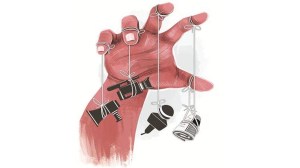
I can understand the anxiety of the bureaucracy to safeguard its position of primacy, but their logic would have made sense only in Con-fucian China or Curz-on8217;s India. This self-obsession, however, must not be propitiated at the cost of nurseries of excellence, like AIIMS, or PGI, Chandigarh, where the faculty,too, is up in arms. The political-bureaucratic machine8217;s reluctance to treat professionals as equals, in fact, stems from an insecurity that originates from our Constitution.
Health is a State Subject, so, like the poor Bahadur Shah Zafar in 1857, Nirman Bhawan finds its authority not extending beyond the Central Government Health Scheme and institutions like AIIMS and PGI. Naturally, it is not a posting that gets our bureaucrats all starry-eyed, and for politicians, it is like punishment, for it offers very few avenues to keep friends and admirers happy. No wonder, Renuka Chow-dhury was so unhappy when I. K. Gujral asked her to head the Health Ministry, and Salim Sherwani kept lobbying for the MEA during his short stint at Nirman Bhawan. And if you don8217;t know who the current incumbent is, don8217;t blame Dalit Ezhilmalai, blame the Founding Fathers.
Nirman Bhawan, not surprisingly, has been subverting the autonomy of AIIMS with religious regularity, treating it the way a district collector treats a districthospital, killing Rajkumari Amrit Ka-ur8217;s dream along the way. And it8217;s been going about it systematically, first diluting the quality of the governing body8217;s scientific component, packing it with pliable professionals with questionable track records, and then junking the principle of autonomy by allowing MPs to be on the selection committee.
The tragi-comedy of AIIMS was nowhere more ludicrously brought home than in the then health minister B. Shankaranand8217;s insistence that the file on the selection of a contractor for the institute8217;s STD/ISD booth be sent up to him! It is not surprising, then, that with the selection and promotion process being hijacked by the political-bureaucratic machine, an element of mediocrity has been introduced in what was earlier an undisputed centre of excellence.
A recent elevation that didn8217;t go down well with the faculty, in fact, was that of Rasik Bihari Vajpaye, the Prime Minister8217;s nephew, for whom a professorial position was created in the Department of Ophthalmo-logyoverlooking the claims of quite a few seniors. There was a time when an AIIMS appointment or promotion was above suspicion; today, there are few that are not mired in controversies.
The fall was inevitable, what with the AIIMS faculty being compelled to look for political-bureaucratic guardian angels, even as their institution is reduced to a district hospital for South Delhi, a general hospital for the rest of Delhi, and a referral hospital for a country where good health is unaffordable for the majority.
Unfortunately for AIIMS, despite the political-bureaucratic machine, it continues to provide high-quality medical care at affordable prices to ordinary citizens. It is the people8217;s faith in the quality of its care that makes people with the right connections put pressure on its faculty to provide them out-of-turn services. Any specialist at AIIMS, therefore, see anywhere between 40 and 60 patients a day, at least three days a week. On top of this clinical load created by a system outside that does notwork, the AIIMS faculty is expected to teach, to draft answers to parliamentary questions, and to produce world-class research as well.
The irony is self-evident the very people who are considered to be experts when the minister8217;s answers need to be written, aren8217;t given the status they deserve by the users of their expertise. For an ideal, you don8217;t even have to look at the US National Institutes of Health, but just check out the equation between the Department of Science and Technology and the Sree Chitra Tirunal Institute at Thiruvananthapuram. Good things are possible in this country, too, but only if the political-bureaucratic machine stays out.