5 min read

Journalism of Courage




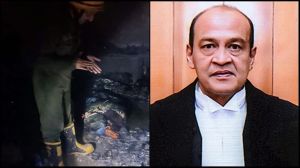
Rubble best symbolises life after an earthquake. It transforms vibrant landscapes into monochromatic moonscapes and radically alters the familiar signposts of life. The inchoate destruction that an earthquake wreaks creates many kinds of victims, but it is on the lives of children that its impact is most manifest.
Even if their unformed, vulnerable bodies survive the immediate and horrific avalanche of boulders and the collapse of buildings, the effects of the event linger on in their lives, long after rescue to the extent possible is effected, long after a measure of relief and rehabilitation has been achieved, long after the rubble itself has been bulldozed out of sight.
Adults in calamitous situations are better equipped to pick up the pieces of their broken lives. For children, in contrast, they signify nothing short of the destruction of the web of life, because their only support structure 8212; the family 8212; no longer exists as an integrated unit. Typically, a disaster of this kind leaves parents deprived of their children, and children deprived of their parents. It constitutes a tipping point at which lives 8212; often already made fragile by circumstances like poverty, lack of access to information and little control over resources 8212; descend rapidly into the abyss.
Children, by their very nature, are ill-equipped to handle such crises. They are sometimes no more than babies, their cognitive abilities are inadequate, their bodies are susceptible to illness, they have little or no education, they lack the capacity to express themselves adequately or take the necessary decisions about their lives. They are, besides, pitted against the dangers and uncertainties of the adult world, already marked by great abuse, cruelty and exploitation.
While there may be some attention paid to children8217;s immediate needs in the aftermath of a tragedy, very often the real disaster for them begins the moment media and administrative attention shifts to another crisis, as it invariably will. Studies done a year after Iran8217;s Bam earthquake indicated a sharp rise of drug abuse among children. It was also noted that there were now more children at waste disposal sites outside the town because parents, even if they had survived the earthquake, were robbed of their ability to achieve sustainable livelihoods. In fact, most of the homeless children on the streets of any Indian town today, are actually survivors of disasters of various kinds, albeit on smaller scales 8212; a local drought here, a flood or epidemic there.
As the International Pediatric Association noted in a May 2005 report of the tsunami, a disaster leaves behind not just individual child victims but whole communities of child victims: 8220;It has been our experience as pediatricians that there is too often a relative lack of attention to the needs of children in disaster and crisis situations, and a corresponding lack of planning and action in meeting children8217;s needs.8221; It went on to observe that apart from ensuring that children are provided with basics like water, food, shelter and clothing 8212; all of which, incidentally, are extremely crucial for the children of the October 8 earthquake at a time when winter is setting in 8212; they need to be part of a living situation which sustains them. The report also underlined the need to consider child health in a holistic manner in such situations. It includes not just physical health, but psycho-social health and the health of the mother and family.
At a recent lecture event hosted by an organisation working with street children, experts spoke about the need to make relief and rehabilitation in India a more consultative process generated by the affected communities themselves. The general sense was that the best rehabilitation was community rehabilitation; that children should be better informed about the calamity and its effect on their lives; that they should not be shifted arbitrarily or locked up in the name of 8220;care8221;. Governments 8212; invariably overburdened by the enormity of the task of bringing some semblance of normalcy to disaster-affected communities 8212; cannot or don8217;t bother with such details and end up compounding the injuries perpetrated by a calamity through their insensitive and clumsy interventions.
This is where civil society should step in, these are areas where our medical personnel and social activists can contribute greatly, while reaching out to the homeless, injured and traumatised communities trapped today in a jagged, inhospitable terrain. There is a strong argument for putting children at the centre of post-disaster planning for the simple reason that it is they who are going to bear the brunt of the disaster long after the nation has forgotten the present suffering and moved on.