6 min read

Journalism of Courage




Practically every day brings evidence of America8217;s bias against India. The latest is that President Clinton wants Beijing to be South Asia8217;s policeman. New Delhi is right to describe it as a reflection of a 8220;hegemonistic mentality of a bygone era8221;. More than that the suggestion challenges our sovereignty. How can we be supervised by a country which attacked us in 1962 and still occupies a large part of our territory? And the trouble with China had deeper reasons than a dispute over some territory.
Two of the largest countries in Asia confronted each other over a vast border. They differed in many ways. The test was of whether one of them would have a more dominating position on the border and in Asia. As Jawaharlal Nehru explained before hostilities, 8220;We do not desire to dominate any country and we are content to live peacefully with other countries provided they do not interfere with us or commit aggression.
China, on the other hand, clearly did not like the idea of such peaceful existence and wantsto have a dominating position in Asia8221;. This is as true today as it was then.
The Chinese historically had the notion that any territory which they had occupied at one time necessarily belonged to them subsequently. If they were weak they could not enforce their claim, but they did not give it up. If they were strong, they tried to enforce it and seize territory in the conviction that they were only taking back what belonged to them. The past view has now perhaps been confirmed by the present Chinese government. A sense of growing strength has given them an additional measure of arrogance.That Clinton does not understand, much less appreciate, the danger from China is not surprising. He does not mind even the China-Pakistan axis. After all, Beijing has helped Islamabad acquire a nuclear device. What is distressing is that the arrogance of power that has made President Clinton enunciate a dictum for South Asia will put pressure on free societies which have pledged to stay open. For Washington, it is blackand white. Those it likes China is its obsession these days can literally get away with murder. Those it dislikes have to be in the doghouse.
New Delhi and Beijing represent two different systems. Both started more or less at the same time. We may have been a soft state but we did not sacrifice the individual at the altar of the state. We preferred a slow rate of growth and gradual social and economic change based on constitution or government to economic revolution based on the police state. Success may be all that matters. But letting millions die for the miracle of change would not have been possible in India, which is still particular about its pluralism and the spiritual side of life.
Most Indians have themselves regretted the irrelevance and irresponsibility of New Delhi8217;s nuclear tests. Washington8217;s indignation is understandable. But the continuing spate of abuse only reflects prejudice. One could give America leeway for being a brash, arrogant country but words to the effect that India is lying,mouthed over and over again by Madeleine Albright, can be forgiven, not forgotten. They are directed against the country, not the BJP-led government.
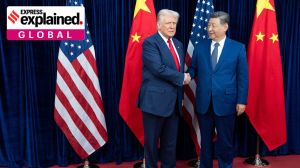
America8217;s bias cannot obliterate certain basics. India is a democracy where people change the government. China is a dictatorship where government changes people. The powerful Congress party was defeated at the polls when Indira Gandhi wronged the country during the Emergency. The BJP-led coalition will pay dearly at the next election for landing the nation into a situation which has hurt it militarily, economically and politically.But compare this with China, President Clinton8217;s new-found love. The communist party responsible for the Tiananmen Square massacre remains in power. No one has been held accountable or punished. It is business as usual and America8217;s President gives the massacre a stamp of justification by visiting Tiananmen Square. It is not that the Chinese love personal freedom less or that they are insensitive to injustice. They have beensuppressed by dictatorship and have lost their voice. Dissenters are detained or beaten up without the law coming to their help. People know of no free polls whereby they can throw out their rulers. The system has no freedom of expression. There is no free press and the judiciary is a tool of government. Yet Clinton considers China the best country to supervise peace in the region.In the past the thaw in Sino-US relations did not necessarily mean that Peking was in favour of peace. it was an indication that both the US and China wanted to foreclose their commitment in Vietnam, the former because of domestic pressure and the latter because it feared Soviet 8220;aggression8221;. This time, with Russia stuck in the quagmire of economic disaster, the two want to divide the world into spheres of tutelage to themselves. Democracy and dictatorship are being yoked together. Clinton is adumbrating a thesis which is difficult to accept.
By joining hands with China, the strongest dictatorship, America, the strongestdemocracy, is betraying liberty and individualism. A country with the traditions of Thomas Jefferson. George Washington and Abraham Lincoln has been forced by the US administration to the opportunism of economics. But then Clinton has always assessed the concept of freedom in terms of the market. During his entire trip to China, he talked about the growing purchasing power of the Chinese, not about the tyranny which has made them a machine. He has given a new definition to democracy which will ignore the individual and sacrifice him for what is considered the good of society. America will take long to rub off the prints Clinton will leave behind.
Should India await the visit of such a President? Maybe he will cancel the trip on his own. The prejudice in which he wallows will not allow him to see any good point in India. We would rather have a person like John Kennedy who, soon after Nehru8217;s arrival in Washington in 1961, asked him again and again about India8217;s plan and needs. Nehru remained reticent.Democracies probably have to feel, not ask each other what they need. America has been taking hostile positions against democracies. This has been the biggest loss at the end of the Cold War.