Journalism of Courage
 6 min read



As a somewhat intellectually challenged bibliophile with not a lot of time on my hands, the gap between my ideal reading list and the stuff I have actually read is vast. I want to read Shakespeare. I want to read Tolstoy. I want to read Kant. But mostly I want to read Karat.
Prakash Karat revisiting the Volcker controversy in the light of the interview Aneil Matherani says he never quite gave should beat Shakespeare for drama, Tolstoy for grand scale and Kant for philosophical insights. I say this because the context of Karat8217;s second look at Volcker has been set by the first. I had found the time to read Karat8217;s signed piece in The Hindu on November 9. And I had enough brains to sense Karat was saying something fascinating. 8220;He Natwar Singh is being targeted for leading a Congress party delegation to Iraq in 2002 and for opposing the sanctions and the invasion of Iraq,8221; Karat had argued. 8220;The UPA government,8221; he had warned us, 8220;may now find uncomfortable Mr Natwar Singh8217;s assertion that the US is intent on targeting individuals and organisations that do not share its hegemonic views.8221;
Dense readers may have still missed the larger point. So Karat had, while leading up to his peroration, laid it all out simply: 8220;There is in India a strong pro-US lobby that hopes the exit of Natwar Singh will help consolidate the pro-US direction in foreign policy.8221; He had also posed a question that almost gave away the answer: 8220;Was it the connection between trading houses and alleged 8216;non-contractual beneficiaries8217; in the oil for food deal a case of an illegal deal through political patronage or a business transaction like other contracts entered into by Indian business enterprises?8221; Karat had ended by saying, 8220;In the coming days, the CPI-M will give highest priority to this Volcker issue.8221;
The day has come for according the issue maximum priority. Matherani8217;s India Today interview tells us that Natwar Singh, along with son and Sehgal, 8220;were looking for trade8221; when they visited Iraq. But Karat had said Natwar was being targeted, by the US among others, for the very fact of visiting Iraq, and for opposing US 8220;hegemony8221;. Matherani says one of the oil voucher allottees was Natwar and the other, the Congress but that both were meant for the ex-foreign minister.
He also says the vouchers were for Natwar8217;s 8220;personal services8221;, for 8220;espousing the Iraqi cause all along8221;. Karat, however, had said that the Volcker controversy was in part an exercise in getting Natwar out of the foreign ministry. As for Karat hinting that the Natwar oil contracts could have been business transactions and might not have involved patronage or illegality, we have Matherani saying that Natwar had wanted his son, Jagat, to accompany him and that the cousin, Sehgal, was visiting Iraq at the same time, 8220;by coincidence8221;. He is firm in his insistence that 8220;they Jagat and Sehgal were not part of the official four member Congress delegation8221;.
Can what Karat had said about Natwar/Volcker fit into what Matherani has said about it?
Karat and the CPI-M can say they don8217;t believe a word of what Matherani has said.
Surely, the bigger Marxist party is not going to cop out like the smaller one 8212; the CPI has already asked for Natwar8217;s resignation from the cabinet? Natwar has to be defended again, this time even more robustly. We do not expect the CPI-M to abandon Natwar now. We do not expect Karat to not critique the pro-US, Volcker-believing lobbies in this country. We do not expect him to conveniently sacrifice ideology at the altar of convenience. Karat told us in that November 9 piece what the Volcker issue is really all about. Now, he must show us what he8217;s really all about.
So, I wait, Shakepeare, Tolstoy and Kant forgotten, for Karat-on-Volcker, the sequel. I have, in fact, the temerity to offer a few suggestions.
Let8217;s begin by acknowledging the fact that Prakash Karat has enough MPs to bring down the government of the world8217;s largest democracy with a few phone calls. That makes him a very important public figure. Let8217;s also acknowledge that especially for those of us who disagree with Leftist politics and economics, the Left is very important. Anyone who subscribes to a set of political-economic axioms is likely to make errors. Those who oppose us can correct us, by pointing out that we overlooked facts because we were blinded by faith. When we are thus shown to be wrong, the right thing to do is to issue a mea culpa.
Hence this humble suggestion to Prakash Karat: say you were, at the least, somewhat hasty in your conclusions. That to have looked at the Volcker issue through the prism of anti-American ideology was not terribly smart, because one of the refracted rays lit up Natwar as a friend of the oppressed. Say while you continue to firmly believe in the existence of an America-backed fifth column in India8217;s public debating sphere, your near-wholesale attribution of anti-Natwar media coverage to those subversives was somewhat off the mark. Say your views on the inhumanity of Iraq sanctions haven8217;t changed, but your views on Natwar8217;s moral infallibility has. Say you are proud to be Left but, on Volcker, you may not have been right.
If you say all that Mr Karat, we can take you seriously as a thinking politician, a politician of conviction. But if you don8217;t say it or, equally worse, give us another thesis on CIA dirty tricks, we have serious cause for worry.
You are, as we said, a very important politician. You can block official policy, sometimes even help set it. We have to ask: do you go about that crucial political task by ignoring facts, evidence, logic, common sense and the strong stench of wrongdoing?
If, as you say, economic liberalism and a pro-US foreign policy are threatening to become the dominant public discourse, will you fight that by supporting patronage and pelf-dispensing, rent-a-quote public figures? I don8217;t know whether you will answer these questions and the larger one underlining them. But I do know that if you don8217;t, the greatest danger to our system won8217;t be from outside.
As for my reading list, I suppose I have to then start reading Kant.

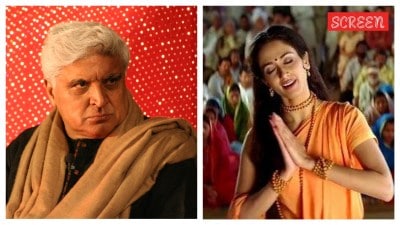
Veteran poet, screenwriter and lyricist Javed Akhtar recently expressed his disagreement with longtime collaborator and music composer AR Rahman over the latter’s claims that the Hindi film industry has become more communal in the past eight years. Akhtar claimed that the film industry has always been religion-agnostic and has picked the best person for the job.