12 min read


© The Indian Express Pvt Ltd



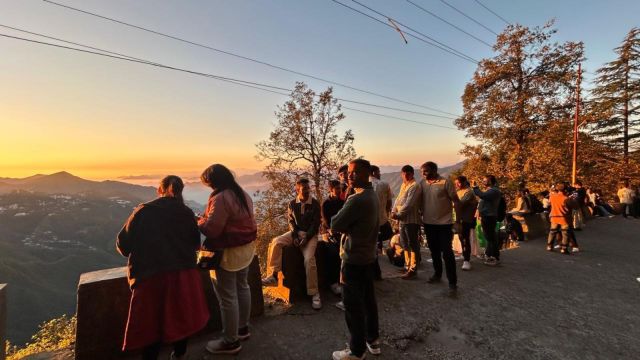 Tourists catch the sunset near the popular Lal Tibba point in Landour. (Express Photo)
“It used to be a walkable town,” says Martand Saili as he squeezes himself into the space between two SUVs to get to the packed Landour Bakehouse.
Saili, 26, grew up in Landour before moving to Bengaluru for his law degree. He recalls how when he returned home after the pandemic, the hill town seemed different — there was construction everywhere, the Common Hoopoe was not all that common anymore, and the quiet roads through the pine and oak belt of the Lesser Himalayas were now clogged with tourist vehicles. The transformation of the quaint, small town seemed total.
Last week, the government announced that the Delhi-Dehradun Expressway, which is expected to shorten travel time from six hours to 2.5 hours, would open to the public in 10-15 days. Many in the hill town that’s already grappling with surging tourist inflows and unregulated construction wonder where that road will take them. “Once the road comes, more cars will travel down this road to Dehradun and then onwards to Mussoorie and Landour. Our town is already so crowded; I don’t think we can take any more,” says Saili.
It’s a common concern in these parts, made more urgent by recent headlines of land subsidence — a portion of the road in Landour Bazaar had caved in, raising concerns of a “Joshimath-like disaster”.
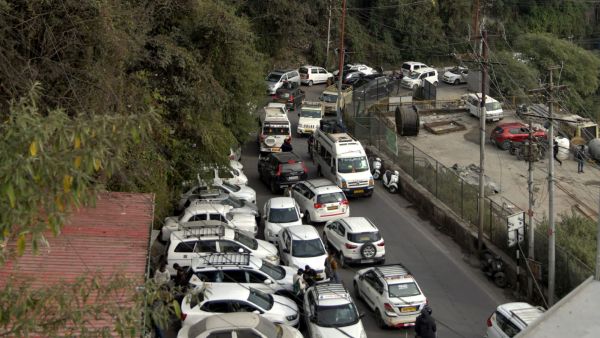 On the road to Landour, taxis and private vehicles take up much of the space. (Express Photo)
Landour, a 3-km uphill trek from Mussoorie, was built by the British Indian Army. The establishment of a sanatorium in 1827 turned it into a military station, bringing much of the town under the Cantonment.
Landour’s cloud-set hills and picturesque pine trails made it a perfect outpost for American missionaries and a holiday home for British and Irish soldiers. The events of 1857 led to a number of European families moving to Mussoorie-Landour, among them the parents of author-conservationist Jim Corbett, who married at St Paul’s Church in Landour. Over the years, the hillside became home to many others, including writer Stephen Alter and actor Victor Banerjee. But its most famous resident remains author Ruskin Bond, outside whose Ivy Cottage home children and their parents turn up for autographs.
Since then, many more people have discovered the hill town, making Mussoorie-Landour the second most visited destination in Uttarakhand after Haridwar. In 2019, Mussoorie had 30 lakh tourists, almost all of whom would have made their way up to Landour. After a slump following the Covid-19 pandemic, the numbers rose to 21 lakh in 2014, up from 14 lakh in 2023, according to the state tourism department.
In Landour, the tourists mostly flock to Lal Tibba for a peak of the snow-clad Himalayas on a clear day and to Landour Bakehouse, an Instagram favourite. Many of them are day-trippers from Dehradun and neighbouring towns.
Old Landour’s charming cluster of ‘Char Dukan’ now has more than four shops and the narrow road leading to it and the adjoining Sisters Bazaar is almost always choked with SUVs and two-wheelers.
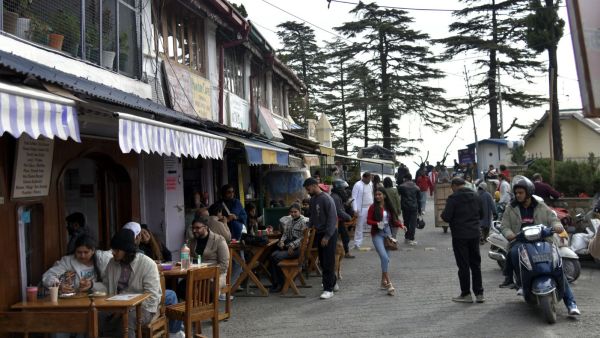 Old Landour’s charming cluster of ‘Char Dukan’ now has more than four shops. (Express photo)
The numbers are expected to grow further with three, big infrastructure projects set to take off. Apart from the Delhi-Dehradun Expressway, the state government has announced a Rispana-Bindal Corridor project to “decongest” Dehradun and help facilitate traffic to Mussoorie. Construction is underway on a third project, a 5.5-km ropeway from Dehradun to Mussoorie that is expected to cut travel time from the current 1-2 hours to 15 minutes.
The tourism numbers and the government’s push for “more” have raised concerns of whether the hills are saturated by overconstruction and overtourism, especially in Mussoorie and the parts of Landour governed by the Mussoorie Municipal Council.
While the crowds flock to Old Landour, spread over a mere 3 sq km, this part has largely been spared of unchecked construction due to strict Cantonment Board regulations that classify all non-military and non-government buildings after 1924 as illegal.
But in the part of Landour that comes under the Municipal Council and the rest of Mussoorie, a number of establishments have come up over the years, largely to cater to the needs of the tourists and the hill station’s growing population, which stood at 30,118, according to the 2011 Census.
A 2023 report by a nine-member joint committee, set up on the orders of the National Green Tribunal, identified 303 hotels and 201 homestays in Mussoorie-Landour.
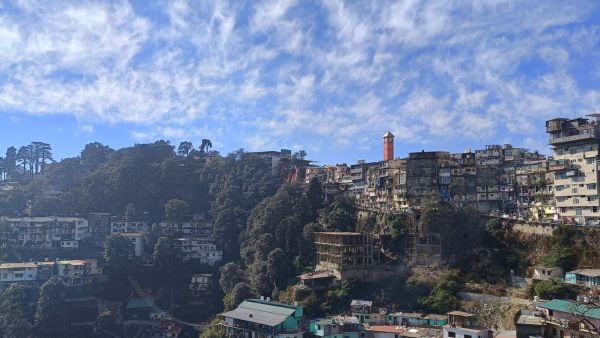 Once the Delhi-Dehradun Expressway is opened, more cars will travel to Dehradun and then onwards to Mussoorie and Landour. (Express photo by Aiswarya Raj)
The relentless construction has come at a price. When floods hit Dehradun on September 15 this year, the road to Mussoorie was among the casualties. The incessant rain flushed out gravel and debris that had earlier been dug up and dumped on natural springs and streams, causing further devastation.
Experts have urged caution, citing the ecological fragility of the region.
Located in the Lesser Himalayas, Mussoorie is to the north of the Main Boundary Thrust, a major geological faultline.
Yogendra Singh, a professor at the Department of Earthquake Engineering at IIT Roorkee, says there are two urgent issues that need to be addressed in the region — land stability, and design and construction quality.
“Mussoorie was recently classified as Seismic Zone VI, signifying the highest level of danger. Many of the slopes are unstable. There are hardly any structures following national building codes. But then, these codes and the Bureau of Indian Standards’ design norms are guidelines for construction on flat land, not in hilly areas. There should be a Master Plan based on what is suitable for the region,” he says.
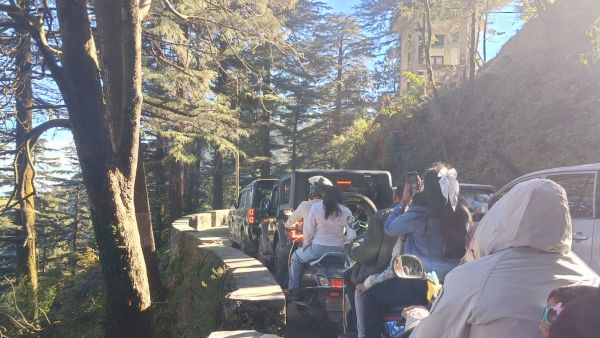 Tourists driving up the quiet belt of the Lesser Himalayas is a common sight all year now. (Express photo by Aiswarya Raj)
Singh was part of a 2022 study published by IIT Roorkee, Seismic Risk Assessment of a Himalayan Town: A Case Study of Queen of Hills, Mussoorie, Uttarakhand, India, which found that Mussoorie faced a 10% chance of “suffering more than Rs 159 crore in earthquake losses over the next 50 years, and that this could rise to Rs 229 crore once slope-amplification effects are included”.
According to the National Building Code, 2016, areas above 600 metres in elevation or with an average slope of 30 degrees are considered hilly. In places where most land is steeper than 30 degrees, the code recommends construction to be carefully regulated, using appropriate technology. The 2023 report before the NGT found that nearly 79% of Mussoorie lies in a “slope category of 30 degrees and more”.
The Uttarakhand Building Construction and Development Bye-laws Regulations, 2011, set the maximum permissible height of buildings at 11 metres, or ground floor plus three upper floors (G+3), whichever is less. Yet, as is evident in Mussoorie and parts of Landour, these rules are routinely flouted.
“The built environment of Mussoorie varies, with some wards having densely packed buildings with up to four floors, while (some) wards feature… apartments with eight stories,” said the 2023 report.
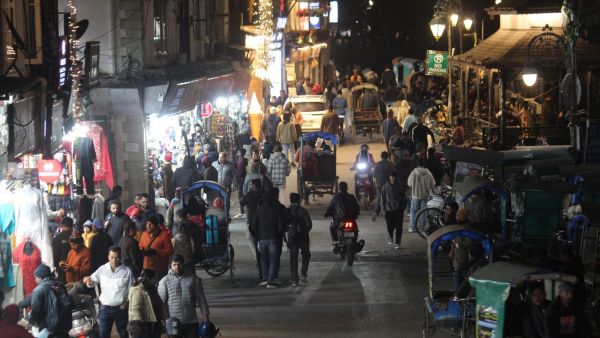 In 2019, Mussoorie had 30 lakh tourists, almost all of whom would have made their way up to Landour. (Express photo)
Mussoorie-based environmentalist Vipin Kumar says the way forward is to conduct a geomorphology study and implement a topography plan. “Tourists will keep coming in, and the only way to absorb the rush is through proper planning. We need to have an environmentally friendly infrastructure to address tourism,” he says.
Mussoorie Municipal Council chairperson Meera Saklani, however, says the checks are stringent. “We have ensured that the rules are not violated. We do not allow the conversion of a residential property to commercial. Since the new council was elected (in January), we have issued nine plinth certificates,” she says.
Mussoorie Dehradun Development Authority vice-chairperson Bansidhar Tiwari did not respond to questions on construction violations.
At Sisters Bazaar, a family from Kolkata asks for directions to Landour Bakehouse. “We saw it on Instagram and the guides here mentioned it as a place we must visit,” says one of the men in the group.
At Bakehouse, tourists, mostly young, pose in front of its famous pine-green doors as they wait for their orders.
Dhairye Prakash, whose family runs a store next door, eyes the crowd warily. “Bakehouse was opened in 2016, but no one had heard of it until after the pandemic. Somebody put a few videos on Instagram, then (filmmaker) Vishal Bhardwaj spoke about the town and now people come here in their cars, get down in front of the bakery, take a few pictures for their social media, and leave. There is little respect for the environment, culture and residents of the town. We are all angry,” he says.
Author Ganesh Saili is among those who are angry about the “hordes that have taken over” his home town. “We are refugees in our own homes. This is where I was born, grew up… I have watched our hills turn from shades of green to the present grey mess of today.”
He talks of how tourists flock to the verandah of the Mussoorie Library, established in 1843, for a view of the hills, leaving behind a trail of waste. “On most days, the veranda looks like it has been hit by a hurricane: plastic bags, styrofoam cups, paper napkins, used sanitary pads, soiled diapers, and shattered glass. With not a soul in sight, our despoilers leave, leaving behind the remains of the day and the stench of urine. It will be a crying shame if, 50 years from now, this is all we leave behind for our children,” he says.
In an earlier interview to The Indian Express, Ruskin Bond had spoken of how he had witnessed the hill station change. “Today we get tourists pouring in but they are day-trippers or weekend-trippers whereas, say, 50 years ago, people would come up for a summer holiday… Everyone wants to be in their car now. Some of the people come up, take a round in their cars and don’t even get out of the car. It’s very funny. So, people are forgetting to walk. Earlier we had very few roads in the hills,” he said.
Prakash, the shopkeeper near Bakehouse, says that instead of investing in flyovers, parking lots and ropeways, there needs to be a push for walking and cycling tracks. “Parking lots and newer roads won’t solve this issue; they will only bring in more vehicles,” he says.
But if the roads brought in tourists, it also helped small businesses. They now fear the attention that has come with the road cave-in. At a shop near the caved-in road in Landour Bazaar, the owner says, “This (the cave-in) didn’t happen overnight. What was the administration doing all these years? Now they will seal our properties citing safety issues and we will have to shut shop.”
The Bazaar, with its crowded streets and rampant construction, is outside the Cantonment limits.
Dilys Nath, a teacher at Wynberg Allen, one of Mussoorie’s oldest boarding schools, is out shopping at the Bazaar. “The extent of deforestation in the hillside is shocking. One monsoon, you see a patch hit by a landslide, and after six months, there is a hotel there. I have nothing against people making a living, but it has to be sustainable,” she says, adding that the traffic raises safety concerns, especially for children.
“Earlier, we used to take the children for outings on Saturdays. Now, you can’t imagine doing that. We do take the children out, but not as often. It has been getting progressively worse over the last eight years,” she says.
On the mention of the Delhi-Dehradun Highway that’s expected to open in February 2026, Nath lets out a sigh. “They are already here. Now, they will reach faster and stay for longer,” she says.