Journalism of Courage



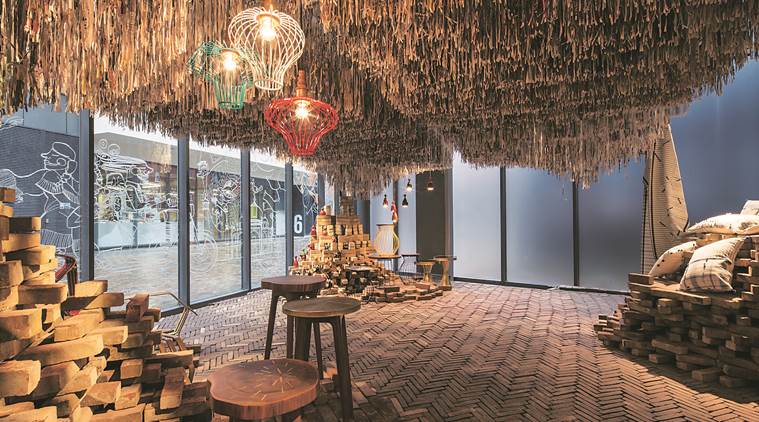 Inside “INfluence”, the exhibition at LDF; designs by Sandeep Sangaru; Ranjan Bordoloi and Karthik Vaidyanathan. (Source: Sophie Mutevelian)
Karthik Vaidyanathan’s “Kurvi” is an ode to the 200-year-old toy craft of Channapatna, and inspired by the sparrows around his house while Sandeep Sangaru’s “Truss Me” relooks at a rocking horse and asks why can’t it be a rocking elephant, which can become a stool and then a bookshelf? Manasa Prithvi’s “Madras Trays” are inspired by the checkered patterns on traditional Madras textiles and Ranjan Bordoloi’s “Bota Tables” salute Assam’s bell metal object, bota, used for offering betal nuts to guests.They are part of the six designers, whose designs are being presented at the Indian Design Platform during the London Design Festival (LDF).
For the first time in 12 years of the festival, a platform dedicated to contemporary Indian design will explore how the nation’s culture informs the world. Called “INfluence”, the week-long exhibition, which began on September 22 and will go till September 27, honours everyday life in India. Curated by design curator Arpna Gupta of Create Culture, a London-based company with Studio Egret West, the exhibition brings together design studios from India and five architectural practices from London.
[related-post]
Inspired by the chaos and beauty of Indian street life, the London firms — ACME, Studio (D) Tale, Project Orange, Haptic and Studio Egret West — have designed five installations, which house designs by India-based Bombay Atelier, Ira Studio, Injiri, Sangaru Studio, Ranjan Bordoloi and Varnam.
Christophe Egret, co-founder of Studio Egret West, says, “The tyranny of perfection combined with regulations and copycat solutions mean our streets are becoming more generic. We have a lot to learn from the spontaneity and delight found in Indian street culture.” And true enough, as Vaidyanathan says of his Varnam products, “Many of my designs are inspired by my growing up years — a time where the internet had not taken over our lives and summer holidays were spent reading books, playing games and in idyllic settings.” His “Kurvi” series has wooden Channapatna birds in primary colours of red, green and yellow, hanging from the ceiling in open cages, almost saying they could fly away any time. “We are presenting the objects in a context inspired from the world in which they were created. There is a certain un-selfconsciousness about design which is very different to the design in the West,” says Gupta, whose decade-long experience of following Indian design informs her choices. So while Sangaru is a well-established designer, Bordoloi has recently graduated from IIT Guwahati. Yet their design sensibilities haven’t left their roots. For Sangaru, his rocking elephant takes on a sculptural form, and, out of context, can be used as a table if one were to place a glass on it or as a seat. Privthi of Ira Studio says, “With the Tekku stools, the visual design was inspired by something simple like the natural pattern of tree rings.”
Chinar Farooqui of Injiri affirms that simplicity is the way ahead, with her “Asmaani” collection, made in collaboration with weavers from Bhujodi, Kutch. “An unstitched garment such as a sari, a dhoti, a gamchha or an odhanu is beautiful because of the woven details on the edges and its cross borders. I like to use these elements in my garments and home furnishing. The story and beauty lie in the process of making,” says the Delhi-based designer.
The installations explore this process of making. Haptic takes India’s recycling practices into a London context by using strips of newspapers discarded on buses and trains. They have created a layered “paper chandelier” that crowds the ceiling, while Acme’s choice of material is brick. Their installation has used over 13,000 bricks to make a “moving” floor and structures, which form the stage for Indian designer products. Studio Egret West has made a wall from everyday steel utensils, found in Indian homes. “My philosophy on aesthetics is complexity through simplicity. I’m particularly interested in combining craftsmanship with engineering. It is pretty much what Indian design should be aiming for right now,” says Farzin Adenwalla of Bombay Atelier, who will present her Lattu Lights for the first time at LDF.

 4 min read