Journalism of Courage



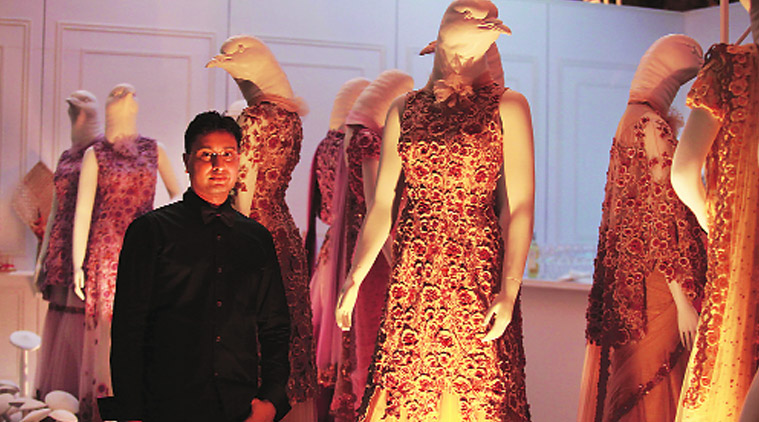 Shantanu Goenka with his designs.
Hours before the opening of his first-ever couture exposition in his hometown Kolkata on Thursday, designer Shantanu Goenka was dealing with a mice problem. It wasn’t a task that required the services of a pest control expert, but it did need close inspection from Goenka since the 400 fiberglass mice were part of his ambitious display at the city’s landmark store 85 Lansdowne, the venue for his dream project.
“Fashioning Fairy Tales” not only drew upon the Pied Piper of Hamelin reference, but also had a ‘sleeping beauty’ reposing on a four-poster bed, Beauty and the Beast characterisations, a Frog Princess and Queen of Hearts depiction, as well as the Mad Hatter’s Tea Party. The 40 garments, modelled on 40 dress forms playing fantastical characters, was Goenka’s way of giving people a peek into his imaginary world.
To say that Goenka is currently consumed by fairy tales would be an understatement. “At present, I’m enamoured by fairy tale characters, thanks to my six-year-old daughter. The concept has largely gone unexplored in Indian couture. And, coincidentally, our current collection was romantic, tonal and elegant with a British vintage vibe,” says Goenka. On display were garments with sheer overlays and capes, their textures lacey, delicate and soft; with chiffons and tulles in dreamy pastels, all harkening back to storytelling and childhood fancies.
Goenka took over the 5,000 square-feet and two floors that comprise 85 Lansdowne, Calcutta’s popular multi-designer store, housed in a nearly 80-year-old mansion. Apart from the fact that he shares a personal equation with owners Shalini Nopany and Pooja Goenka, the designer wanted to use the room-within-rooms format to lend “mystery and magic” to his narrative style. And hosting the soiree in his hometown was a no-brainer. “This is my comfort zone. I’m working with the best of scenographers, set designers and everything is under my control. Also, I wanted people to get a touch and feel of the garments, something that is lost in translation on the ramp,” says Goenka.
For someone who launched his label nearly 15 years ago, Goenka makes no apologies for being media shy and relatively low-profile as compared to his Calcutta contemporaries like Sabyasachi Mukherjee and Anamika Khanna. “I can’t handle too much publicity. I don’t drink, smoke or party. I’d rather spend quality time with my family,” he shrugs. And he’s equally non-apologetic about his creative oeuvre, with its heavy reliance on embroidery, crystals and surface ornamentation, a far cry from the Calcutta school of design’s penchant for textiles and weaves. “I’m not a handloom person and I can’t do cotton and khadi. I’d rather work with luxurious fabrics, some of which I source from the best textile companies abroad that provide fabrics to international luxury brands like Chanel,” says Goenka.
And the accent on embroideries is as much part of his heritage. He says, “Having been born in a Marwari family, I’ve naturally inherited my aesthetics from them. And embroidery was always a stronger point of focus than textiles. I’ve grown up seeing diamonds and crystals.” And this translates into his trademark couture line, where meticulous age-old embroideries cover lush fabrics. “We’re in the process of reviving needle-point and cross-stitch methods where a sari border can take up to six months to complete,” he explains.
Possibly why Goenka thinks lower price points for online collaborations aren’t his cup of tea. “The moment you diversify and expand, quality suffers. Low cost collaborations are good for people who do pret. Our pieces are high priced with a printed sari with an embroidered border alone costing up to Rs 60,000. Someone else may do it in Rs 20,000 and the end customer won’t understand the difference. When you’re buying online, it’s difficult to gauge the meticulousness ,” he says. Which is why he flew down a contingent of fashion journalists to Calcutta to attend the event and understand the nuances of his craft, where gara embroidery, mukaish and zardozi work met pearl lace and dupion lace embroidery and three-dimensional hand-cut and appliqued flowers. And he’s adamant about not being a slave to trends. “We don’t follow seasonal forecasts. We follow our instincts,” says the designer.

 4 min read