


📣 For more lifestyle news, click here to join our WhatsApp Channel and also follow us on Instagram
Tags:


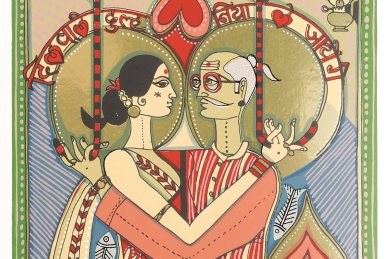
Housed inside Jaipur House in Delhi are a bald man and a kurta-clad woman holding an umbrella above each other in artist Jyoti Bhatt’s screen print 4ever 2gather from 2010. The obsession with Hindi cinema romanticising the idea of a happily ever after becomes more evident as the artist envelops the umbrella with the words “Dilwale Dulhaniya Le Jayenge”. Artist Arpana Caur has made a black-and-white print of a yogi’s silhouette in a gravity-defying pose. The exhibition, “Eminent Printmakers of India,” at NGMA, highlights the less-understood form of printmaking through more than 100 works. It is a part of Lalit Kala Akademi’s first Print Biennale India 2018.
Despite its lofty aim, the biennale shows a lack of professionalism or even the artistic eye. Many of the works on the second floor of the Lalit Kala Akademi remain unframed and appear abandoned on the white walls. A number of the works don’t even have captions. Delhi-based printmaker Anupam Sud, Commissioner for the biennale, says, “I am not satisfied with what has come about. This is one medium which is either not understood or is misunderstood by people who love art.”


The history of printmaking can be traced to the coming of the Portuguese and the British in India to propagate Christianity and to record historical events. Sud, a former Assistant Professor who taught printmaking at College of Art, Delhi, says, “One can make as many prints using the masterplate and also because photography was not there at the time.”


