Journalism of Courage



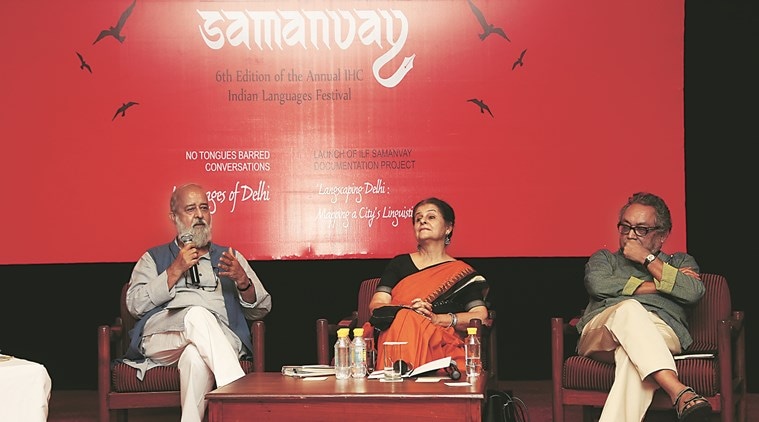 (From left) Sohail Hashmi, Syeda Hameed and Alok Rai during the event in Delhi
Samanvay announces its 2016 edition this November, and launches its documentation project
From dhobans, street vendors and businessmen to the courtyards, mushairas and ghazals, the colours, scents and, significantly, the language, emerged amid a small crowd at Delhi’s India Habitat Centre (IHC) on Wednesday. And at the heart of all this was the city itself. As a precursor to its sixth edition this November (to be held from the 5th to the 7th), ILF Samanvay — the Indian language festival that is held annually in the Capital — held its second of the #notonguesbarred series, on the ‘Languages of Delhi’.
With culture commentator Alok Rai, heritage activist Sohail Hashmi, and educationist Syeda Hameed, the session explored the creative representation of its language over the years — from the invasion of the Mughals to the arrival of the metro.
The verses were aptly punctuated with the recitation of excerpted writings about the city by authors such as Yogeshwar Dayal, Intizar Hussain and Ashraf Subuhi Delhvi, along with readings by dastango Fouzia Dastango. While at it, the festival directors also announced the launch of its audio-visual documentation project that will map the languages used across the city.
“We are a space that is thinking about language as a deeper subject and we thought we should start with the languages of Delhi. We begin this by mapping the linguistic face of Delhi,” says Rizio Yohannan Raj, creative director of the festival, adding, “This is very important, because we don’t want to distinguish between languages. This is also our response to the growing intolerance, to show that the city is a pluri-cultural, multilingual space.”
The project — led by Prof Apoorvanand, programme curator, and a preview of which will be showcased during the main event in November — will collaborate with agencies, schools, universities and language communities. “We want to develop this into a people’s movement,” says Raj.
Hashmi further maps the movement of the language — from the first train that arrived in Delhi in 1865, which led to the establishment of the railway colony, to migrants from Calcutta, Maharashtra and Kerala, to the Punjabis during the Partition.
“If one looks at this city, chronologically, you can map the different cultural hubs, with their own language centres,” says Hashmi, adding, “I don’t think we have tried to study any city like this before. If it begins in Delhi, especially in these days, when we are being told what our culture and language is, how to define ourselves as Indians, I think it is necessary to underscore the diversity.”

 3 min read