Chandrayaan 3: Another payload detects sulphur presence
ISRO released preliminary data from instruments called RAMBHA and ILSA, both installed on the lander module, and another called APXS which is on the rover. It had earlier released data from instruments called ChaSTE and LIBS.
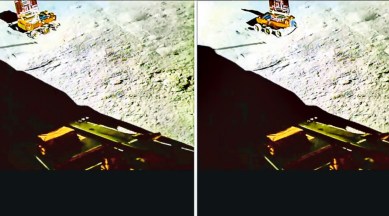
Photographs released by ISRO on Thursday show the Pragyan rover taking a spin while looking for a safe route on the Moon. PTI
Advertisement
Listen to this articleYour browser does not support the audio element.
The Indian Space Research Organisation (ISRO) on Thursday put out samples of data collected from Moon by three more instruments, thus confirming that all the payloads on the Chandrayaan-3 spacecraft were healthy and operating as designed.
ISRO released preliminary data from instruments called RAMBHA and ILSA, both installed on the lander module, and another called APXS which is on the rover. It had earlier released data from instruments called ChaSTE and LIBS.
You’ve Read Your Free Stories For Now
Sign up and keep reading more stories that matter to you.
Chandrayaan-3 is carrying seven scientific payloads, four installed on the lander, two on rover, and one on the propulsion module that is going around the Moon in an orbit. ISRO has till now released data from five of these. It has also mentioned that the instrument onboard the propulsion module — SHAPE or Solar-polarimetry of Habitable Planet Earth — has been functioning normally.
The seventh instrument, called LASER Retroreflector Array is a set of mirrors that will remain on the Moon for much longer duration. It does not collect any data on its own but is meant to reflect laser beams fired from Earth. Scientists use these kinds of experiments to accurately measure the distance of Moon from the Earth, for example.
RAMBHA or Radio Anatomy of Moon Bound Hypersensitive Ionosphere and Atmosphere is meant to measure the plasma density (concentration of ions and electrons) near the lunar surface. ISRO said initial assessment from the data collected by RAMBHA, an instrument developed by Space Physics Laboratory of Vikram Sarabhai Space Centre, indicated that the plasma near the lunar surface was “relatively sparse”.
The Alpha Particle X-ray Spectroscope, or APXS, installed on the rover, detected signals of the presence of Sulphur and other minor elements. Earlier, LIBS had also collected data on the elemental composition of lunar surface, and found “unambiguous” confirmation of presence of Sulphur, through first-of-its-kind experiments.
“APXS developed by PRL, Ahmedabad, is working extremely well on the rover. It is providing unique observations on elemental composition around landing site,” said Anil Bhardwaj, director of Physical Research Laboratory, Ahmedabad.
Anonna Dutt is a Principal Correspondent who writes primarily on health at the Indian Express. She reports on myriad topics ranging from the growing burden of non-communicable diseases such as diabetes and hypertension to the problems with pervasive infectious conditions. She reported on the government’s management of the Covid-19 pandemic and closely followed the vaccination programme.
Her stories have resulted in the city government investing in high-end tests for the poor and acknowledging errors in their official reports.
Dutt also takes a keen interest in the country’s space programme and has written on key missions like Chandrayaan 2 and 3, Aditya L1, and Gaganyaan.
She was among the first batch of eleven media fellows with RBM Partnership to End Malaria. She was also selected to participate in the short-term programme on early childhood reporting at Columbia University’s Dart Centre. Dutt has a Bachelor’s Degree from the Symbiosis Institute of Media and Communication, Pune and a PG Diploma from the Asian College of Journalism, Chennai. She started her reporting career with the Hindustan Times.
When not at work, she tries to appease the Duolingo owl with her French skills and sometimes takes to the dance floor. ... Read More