Journalism of Courage



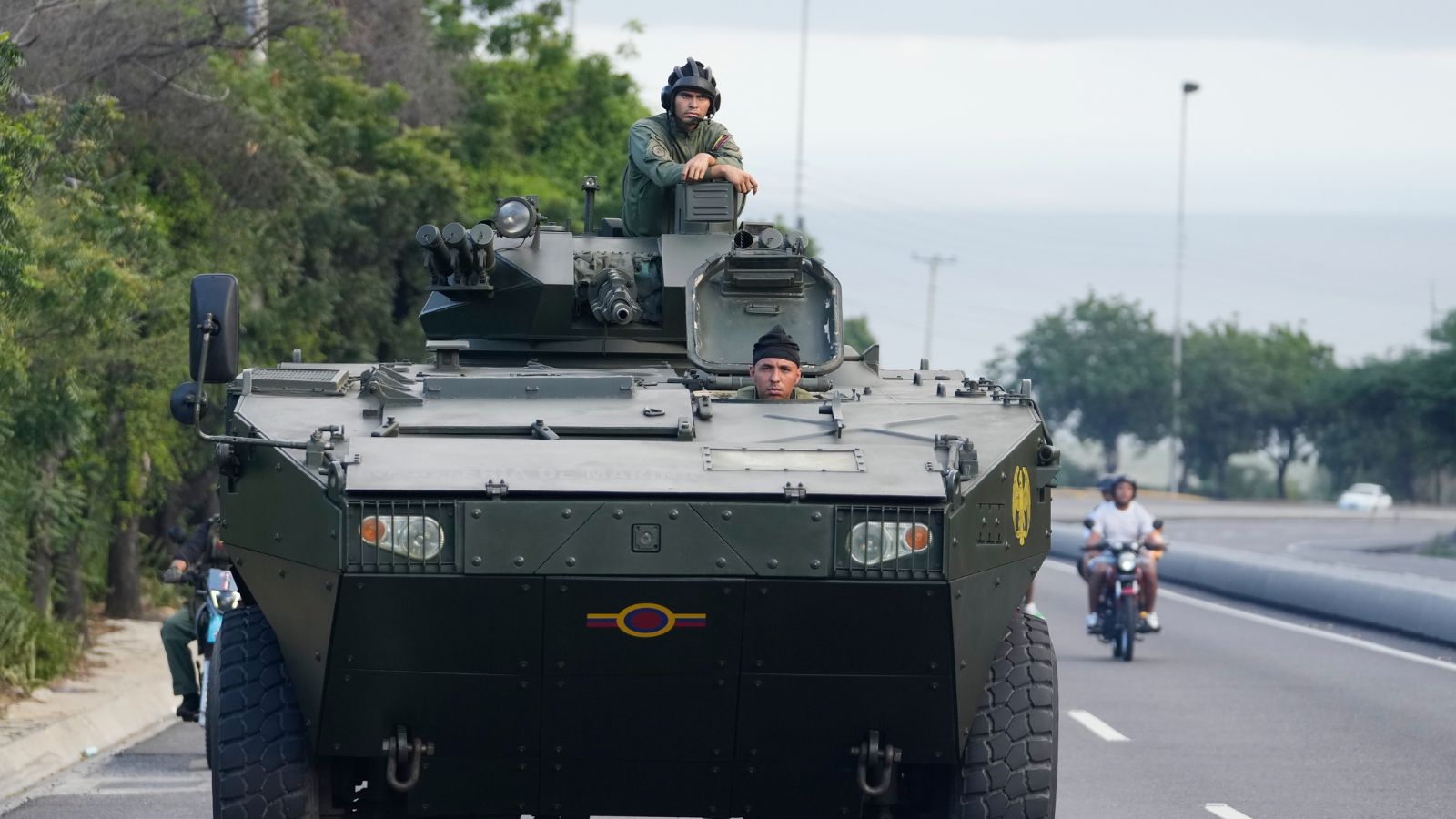 A soldier stands atop an armoured vehicle on the highway leading from the international airport toward Caracas, Venezuela, Sunday, January 4, 2026. (AP Photo)
In a carefully calibrated statement, the day after the US attacked Venezuela and captured its President Nicolas Maduro, India Sunday expressed “deep concern” at the developments and called upon “all concerned to address issues peacefully through dialogue, ensuring peace and stability of the region”.
Neither did it condemn the US action nor invoke the respect for international law or the UN charter.
Without mentioning the US action in Venezuela, it described it as “recent developments in Venezuela:” a more neutral framing of the military intervention by the US.
Broadly, there were four points that the Indian statement issued by the Ministry of External Affairs made.
First, it expressed “deep concern” on the situation, as the MEA said, “Recent developments in Venezuela are a matter of deep concern.” Second, it was careful on the next steps in Venezuela given there’s no clarity on who will run the government in Caracas. “We are closely monitoring the evolving situation,” the MEA statement said.
Press Release on recent developments in Venezuela ⬇️
🔗 https://t.co/PrU0nIRLiQ pic.twitter.com/jVBI5TcGMV
— Randhir Jaiswal (@MEAIndia) January 4, 2026
Third, it expressed its support for the “people of Venezuela” — differentiating it from the government or the regime in Venezuela — and called upon “all concerned” to “address issues peacefully through dialogue, ensuring peace and stability of the region”. This was a nod to the US, where President Trump has said, “We will run the country until such time as we can do a safe, proper and judicious transition.”
And, fourth, was the Indian government’s concern about the Indian community, which is quite small in the South American nation. There are less than 100 Indians in Venezuela – according to the Indian embassy’s records: “50 NRIs (non-resident Indians) and 30 PIOs (Persons of Indian origin)”.
India’s response is different from how China and Russia responded. China Sunday called on the United States to release Maduro and his wife “at once” and “resolve issues through dialogue and negotiation.” “China expresses grave concern over the US forcibly seizing President Nicolas Maduro and his wife and taking them out of the country”, a Chinese Foreign Ministry statement said. The move is in clear violation of international law, basic norms in international relations, and the purposes and principles of the UN Charter, it said.
Russia has been the first country to criticise the US action, calling it an “act of armed aggression” against Venezuela. “This is deeply concerning and condemnable,” Moscow said.
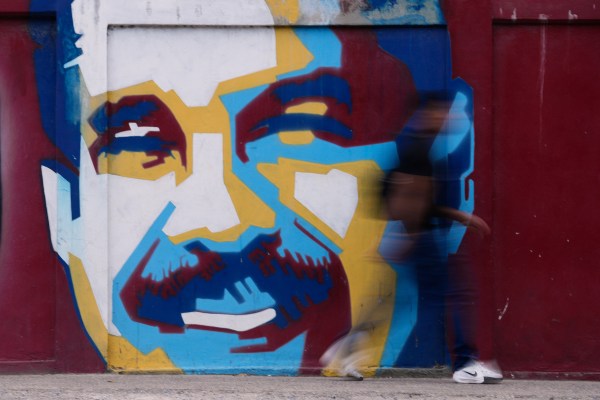 A pedestrian walks past a mural of Venezuelan President Nicolas Maduro Sunday, January 4, 2026. (AP Photo)
While French President Emmanuel Macron has said that “the transition to come must be peaceful, democratic, and respectful of the will of the Venezuelan people” and hoped that “President Edmundo Gonzalez Urrutia, elected in 2024, will be able to ensure this transition as quickly as possible,” German Chancellor Friedrich Merz said that the legal assessment of the US operation is complex and “we will take our time” to evaluate it, adding that principles of international law must apply. He urged that “a transition to a government legitimised by elections must be ensured” and warned that “political instability must not arise in Venezuela”.
British PM Keir Starmer has also avoided any confrontation with the US, as he said, “I want to establish the facts first. I want to speak to President Trump. I want to speak to allies. I can be absolutely clear that we were not involved … and I always say and believe we should all uphold international law.”
India’s statement — as compared to the statement of the P-5 countries — sought to maintain the diplomatic tightrope walk, where it doesn’t criticise the Trump administration but it seeks peace and stability of the region. This is rooted in the diplomatic dilemma it faces: on the one side is Trump’s unilateral move and, on the other, many in the Global South are looking at India for leadership against violations by the US President.
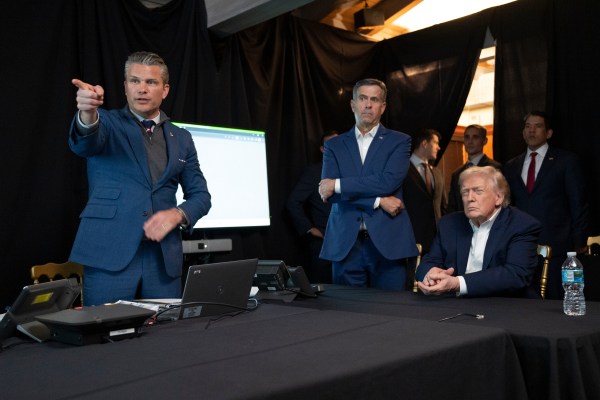 In this photo released by the White House, President Donald Trump monitors US military operations in Venezuela with Defense Secretary Pete Hegseth and CIA Director John Ratcliffe, center, at Mar-a-Lago in Palm Beach, Fla., Saturday, Jan. 3, 2026. (AP/PTI)
But since India and the US are still negotiating a bilateral trade deal, months after Trump imposed 50 per cent tariffs, including a 25 per cent penalty over Delhi’s purchase of Russian oil, Delhi has been careful in its framing against Washington. India has also been tapering off Russian imports although it feels it was singled out by the US President who did not move against China and Europe over their purchase of Russian oil.
India’s closest partner in South America, Brazil, which is part of the BRICS grouping, criticised the US actions. Brazil President Luiz Inacio Lula da Silva said, “The bombings on Venezuelan territory and the capture of its president cross an unacceptable line. These acts represent a grave affront to Venezuela’s sovereignty and yet another extremely dangerous precedent for the entire international community. Attacking countries in flagrant violation of international law is the first step toward a world of violence, chaos, and instability, where the law of the strongest prevails over multilateralism.”
South Africa, another BRICS partner, did not take a position, and said that “South Africa calls on the UN Security Council, the body mandated to maintain international peace and security, to urgently convene to address this situation.” Among those countries which supported the US actions included Israel PM Benjamin Netanyahu and Argentina’s President Javier Milei.

 6 min read