Journalism of Courage



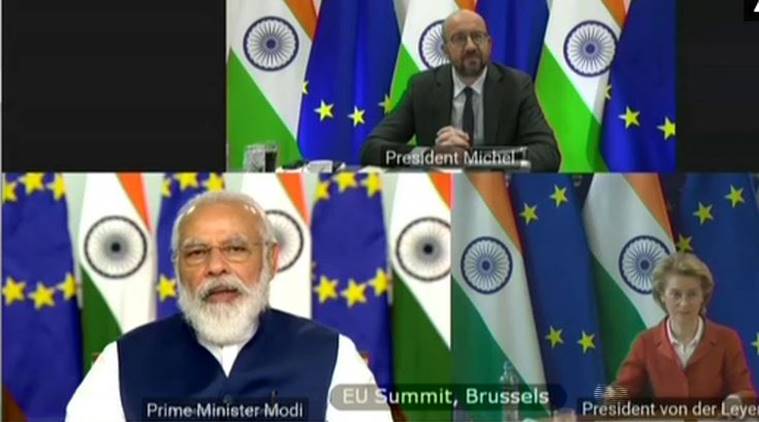 PM Narendra Modi at the 15th India-EU (virtual) summit. (Screen grab)
A day after Indian and Chinese Corps Commanders held extensive talks over disengagement of troops along the Ladakh frontier, Prime Minister Narendra Modi Wednesday briefed European Council president Charles Michel and European Commission president Ursula von der Leyen on the situation at the Line of Actual Control, including the June 15 incident in Galwan Valley in which 20 Indian Army personnel were killed in clashes with PLA troops.
Speaking to reporters after the 15th India-EU summit over video conference, Michel said, “We had the occasion with the Prime Minister to have some information about this incident.”
He said they discussed the developments along the LAC, and “we are in favour of a peaceful solution”. He said the EU supports all efforts to find peaceful solutions through dialogue.
Vikas Swarup, Secretary (West) in the Ministry of External Affairs, said, “As part of a review of global and regional developments, our relations with China did come up. The Prime Minister shared our views on the India-China relationship in general, and the current situation in the border areas.”
India had already briefed key EU partners, including Germany and France, on the LAC standoff via diplomatic channels and Foreign Minister-level conversations.
Cautious in his public remarks since efforts are underway to lower the rhetoric while the disengagement process is on, the Prime Minister, in his opening remarks, said the India-EU partnership is useful for global peace and stability. This, he said, has become clear in the current global situation.
Modi said both sides share universal values such as “democracy, pluralism, inclusivity, respect for international institutions, multilateralism, freedom, transparency” and for this “democratic countries need to strengthen cooperation”.
The joint statement mentioned cooperation on the Covid-19 pandemic, multilateral cooperation at the WHO, UNSC and G-20, 5G, Artificial Intelligence, maritime security and naval cooperation and connectivity projects in third countries in the Indo-Pacific region — all point to China’s presence in these areas, and indicates growing convergence between Delhi and Brussels.
Responding to questions, Michel said they also raised the issue of the Citizenship (Amendment) Act during their conversation with the Prime Minister.
“We trust the Indian institutions. We understand that the Supreme Court will have a role to play in order to assess this legislation, and we took the decision with the Indian authorities to continue a dialogue on the question of human rights, which is so important for us and for India, in order to exchange good practices, and to have the best possible understanding about how we tackle these important issues for India, and for the European Union,” he said.
Asked about this, Swarup said there was a “glancing reference” to the issue.
The joint statement said the two sides agreed to establish regular high-level dialogue at the ministerial level to provide guidance to bilateral trade and investment relations and to address multilateral issues of mutual interest.
The leaders adopted the “EU-India Strategic Partnership: A Roadmap to 2025” to guide cooperation between the EU and India over the next five years.
The Euratom-India Agreement on research and development cooperation in peaceful uses of nuclear energy was also signed.
The joint statement said that a dialogue on maritime security and defence and security consultations was launched.
The statement said the leaders also welcomed the launch of negotiations on a working arrangement between Europol, the EU’s law enforcement agency, and India’s CBI to prevent and combat organised crime and terrorism.
They underlined the need to increase global cyber resilience, including in the health sector. The EU and India will continue to cooperate on international and regional issues of common interest including Iran and Afghanistan, according to the joint statement.
“They will engage on 5G and artificial intelligence including to promote global standards and to foster their safe and ethical deployment,” the joint statement said.

 4 min read