Premium
This is an archive article published on April 20, 2021

In second Covid wave, more need oxygen, death rate almost the same

With 2,73,810 new cases and 1,619 Covid-linked deaths registered in the last 24 hours, and a total active caseload of 19,29,329, Prime Minister Narendra Modi Monday held a meeting with leading doctors and top pharma companies.

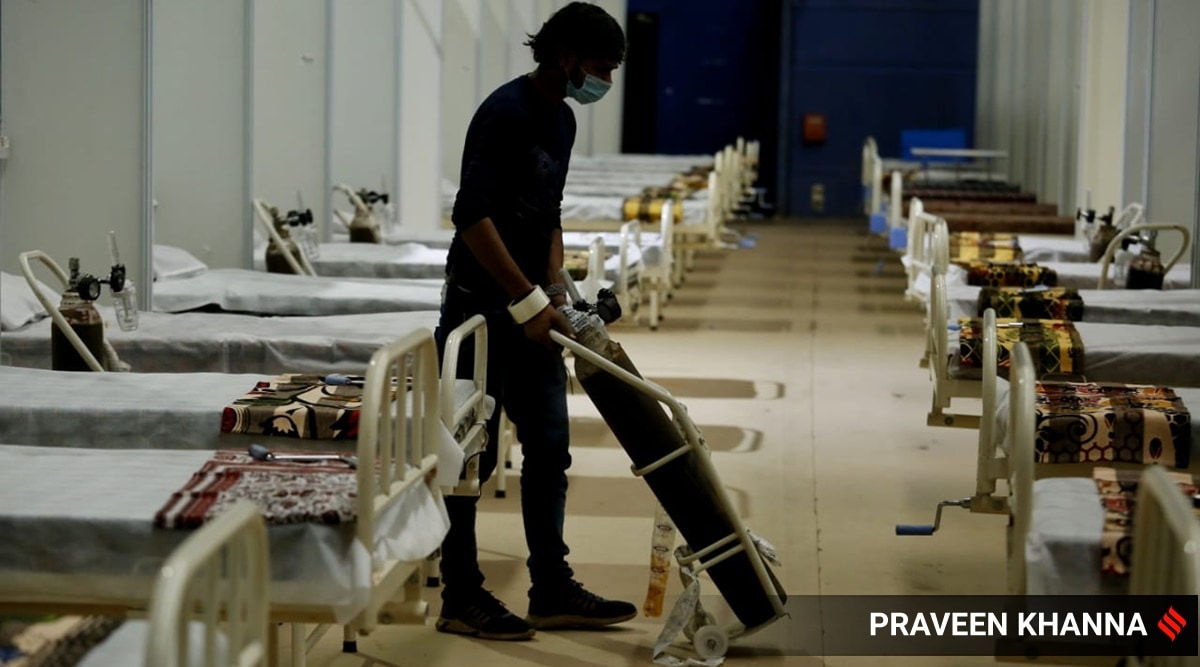
Delhi oxygen supply, Delhi city news, Safdarjung hospital oxygen supply, Indian expressOn Monday morning, the department had issued a notice to the medical superintendent and other heads of the departments of the hospital about the shortage of oxygen supply. (Express photo/Praveen Khanna)

A key government task force on Covid Monday picked important strands from the ongoing second wave in comparison with the first surge late last year: higher requirement of supplemental oxygen, no difference in the percentage of deaths and only marginally higher proportions of younger patients.

With several states reporting a surge in demand for medical oxygen, the task force pointed to national hospital data, which showed that 54.5 per cent of admissions during the second wave required supplemental oxygen during treatment. This marked a 13.4 percentage point increase from the peak during September and November last year, according to data from 40 centres across the country.

With 2,73,810 new cases and 1,619 Covid-linked deaths registered in the last 24 hours, and a total active caseload of 19,29,329, Prime Minister Narendra Modi Monday held a meeting with leading doctors and top pharma companies.

During the meeting, Modi pointed out that the second wave is spreading rapidly in Tier 2 and Tier 3 cities and urged doctors to connect with their colleagues there and provide online consultation to ensure that all protocols are followed correctly.

According to the National Clinical Registry for Covid data, shortness of breath is the most common clinical feature among symptomatic patients in the second wave. It shows that 47.5 per cent of symptomatic hospitalised patients reported shortness of breath in the second wave as compared 41.7 per cent in the first.

“Shortness of breath was found to be slightly higher in the second wave. The deaths did not show any difference: it was 9.6 per cent (first wave) versus 9.7 per cent (second wave) of hospitalised patients. The requirement of oxygen was higher in the second wave at 54.5 per cent compared 41.1 per cent in the first. That was significant,” Balram Bhargava, Director General, ICMR, said.

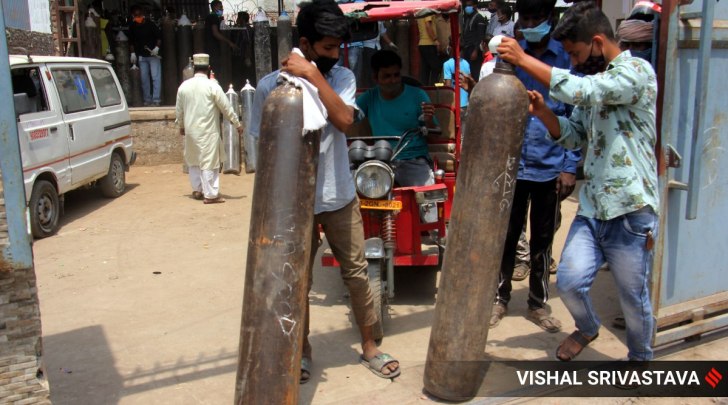
People purchasing oxygen cylinders for serious home-quarantined patients in Lucknow. (Express Photo: Vishal Srivastav)

The data shows that more than 70 per cent of patients were above the age of 40 in both the waves. “Older population continues to be vulnerable because of co-morbidities and other risk factors,” Bhargava said.

Story continues below this ad

He said that only a marginally higher proportion in the younger age group was affected despite the opening up of various activities: the age group of 0-19 formed 5.8 per cent in the second wave against 4.2 per cent in the first; the age group of 20-39 constituted 25.5 per cent in the second wave compared to 23.7 per cent in the first.

The data shows that in the first wave, 54.9 per cent had at least one comorbidity as against 48.6 per cent in the second. “The policy implications are that asymptomatic can be managed at home. Moderately ill patients, if managed as per guideline, can be discharged earlier. Oxygen supply for care needs to be ramped up,” Bhargava said.

Dr V K Paul, who heads the task force, said that Integrated Disease Surveillance Programme (IDSP) data gathered from states reiterate that there is no shift in age prevalence in the second wave.

“The positive cases data from IDSP also clearly shows that during the last year’s pandemic wave, those under 30 years of age contributed 31 per cent of cases as against 31 per cent in this wave. Essentially, there is no difference in the proportion. In the 30-40 year group, it is 21 per cent (in both waves). This demonstrates that there is no overarching excess risk of young people becoming Covid-positive. We don’t see a shift in age prevalence overall,” Paul said.

Story continues below this ad

The registry data also shows that the requirement of mechanical ventilation dropped during the second wave: 27.8 per cent of admitted patients required mechanical ventilation as against 37.3 per cent in the first wave.

Significantly, 74.5 per cent of patients were symptomatic at hospitalisation in the second wave compared to 87.4 per cent in the first.

Besides, there was a significant drop in clinical features in symptomatic hospitalised patients in the first and second waves: dry cough (5.6 per cent vs 1.5 per cent); loss of smell (7.7 per cent vs 2.2 per cent); fatigue (24.2 per cent vs 11.5 per cent); sore throat (16 per cent vs 7.5 per cent); muscle ache (14.8 per cent vs 6.3 per cent).

As City Editor ( Delhi) at the Indian Express, Kaunain Sheriff  leads city reporting with a sharp focus on accountability journalism, data-driven stories, and ground-level impact. As the National Health Editor he leads the newsroom’s in-depth coverage of pressing health issues. He is the author of Johnson & Johnson Files: The Indian Secrets of a Global Giant, a definitive investigation into the accountability of one of the world’s most powerful pharmaceutical corporations. Areas of Expertise Investigative Reporting: Has deep expertise in investigative reporting spanning public health, regulatory affairs, drug safety, and the criminal justice system. His work sits at the intersection of governance, law, and accountability, with a particular focus on how regulatory failures, institutional lapses, and policy decisions affect citizens’ rights and safety. Data Journalism: Has extensively on big data–driven investigations, including analyses of flagship government schemes and large datasets on criminal trials, uncovering systemic gaps. Global Collaborations Kaunain is a key contributor to major international journalistic projects: The Implant Files: Collaborated with the International Consortium of Investigative Journalists (ICIJ) to expose global malpractices in the medical device industry. Chinese Big-Data Investigation: Uncovered how a foreign data firm monitored thousands of prominent Indian institutions and individuals in real-time. Awards & Recognition His commitment to "Journalism of Courage" has been recognized with the industry's highest honors: Ramnath Goenka Award for Excellence in Journalism SOPA Award (Society of Publishers in Asia) Red Ink Award (Mumbai Press Club) Indian Express Excellence Awards (Triple recipient for investigations into the NSA abuse in UP, Vyapam scam, and the anti-Sikh riots). Education: Studied Mechanical Engineering at Visvesvaraya Technological University (VTU), Bangalore, before moving to Delhi to pursue his passion for journalism. His engineering training informs his analytical approach, enabling him to decode technical, legal, and data-heavy systems with precision. Social media LinkedIn:  linkedin.com/in/kaunain-sheriff-3a00ab99 X ( fromerly Twitter): @kaunain_s ... Read More

Stay updated with the latest - Click here to follow us on Instagram

Latest Comment
Post Comment
Read Comments
Advertisement
Advertisement
Loading Taboola...
Advertisement