This is an archive article published on July 25, 2020
Use pandemic lessons well: Centre gives 6-point mantra to surge states
At a high-level review meeting that went on for three hours over a video link on Friday, the Centre emphasised six main issues to the governments of Andhra Pradesh, Bihar, Telangana, Odisha, West Bengal, Assam, Karnataka, Jharkhand, and Uttar Pradesh, top sources told The Indian Express.
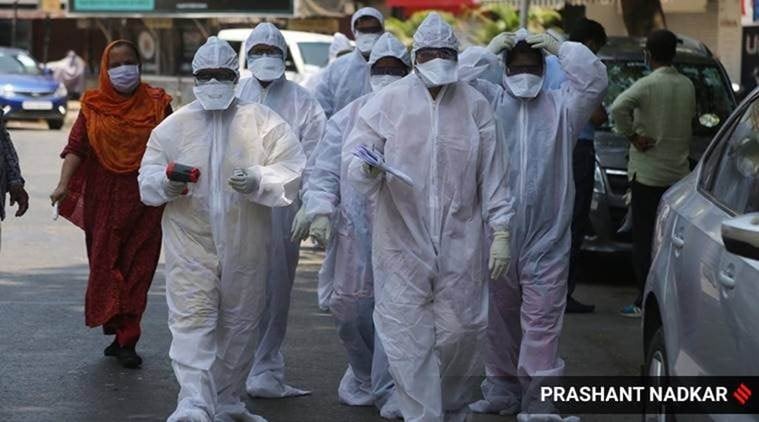
The country has been inching towards 50,000 daily cases.
Rigorous implementation of pandemic lessons, systematic containment, and proper planning and procurement to plug the gaps in health infrastructure are key, the Centre has told nine states that are currently facing a surge in novel coronavirus infections.
At a high-level review meeting that went on for three hours over a video link on Friday, the Centre emphasised six main issues to the governments of Andhra Pradesh, Bihar, Telangana, Odisha, West Bengal, Assam, Karnataka, Jharkhand, and Uttar Pradesh, top sources told The Indian Express.
The meeting, chaired by Cabinet Secretary Rajiv Gauba, was attended by the chief secretaries of these states, senior officials of the Union Health Ministry, and experts from the national task force against Covid-19.
* The cabinet secretary is learnt to have said that six months into the handling of the pandemic, the strategies on containment, surveillance of the infection, breaking the chain of transmission, and bringing down mortality rates were “well understood”.
“Now it is not an issue of lack of understanding of basic concepts. The issue now is of effective implementation or the lack thereof,” the cabinet secretary told the states, sources said. Chief Secretaries must “proactively address the issue of implementation glitches” that may result in very rapid deterioration, the Centre is learnt to have communicated to the states.
* These nine states, which have implemented “sporadic lockdowns or localised lockdowns”, must also implement “systematic containment and effective surveillance”, followed by “strengthening the hospital infrastructure and clinical management”, the Centre said. “We are not judging those decisions but a two-three day lockdown alone is not the solution,” the states were told, according to the sources.
* The surge in cases will lead to fatigue among healthcare workers, the Centre is learnt to have told the states – and stressed that they “must have in place a well thought-out policy of rotating the workforce and utilising people who are available”. The Centre has also asked the states to call in alternative resources — retired doctors, final year MBBS students, and nursing graduates – to tackle high caseloads, the sources said.
Story continues below this ad
* Given the gaps in health infrastructure that some states have historically had, the Centre asked them to implement “rigorous planning” with regard to consumables such as oxygen cylinders, testing kits, and medicines. “Delay in procurement decisions can have grave consequences from the point of view of management of the pandemic. Chief secretaries must ensure that as far as essential medical supplies are concerned there is no delay in procurement decisions,” the Centre is learnt to have told the states.
* While lessons from states like Kerala, Goa, and Delhi show the “situation can be turned around”, the experience in Karnataka has shown that the “situation can rapidly slide downwards”, sources said. “Therefore, what is needed is a steadfast and resolute approach by all state governments,” the Centre told the states, the sources said.
* The states were also told that they “must have a regular mechanism of ensuring prompt and effective communication with the public,” the sources said.
The country has been inching towards 50,000 daily cases. Andhra Pradesh surged to its single-day record high of 7,998 new infections on Thursday. For Bihar, West Bengal, Odisha, Assam, and Uttar Pradesh Friday’s meeting with the Centre was their second in a week; all these states continue to report low testing and large numbers of cases.
Story continues below this ad
On Monday, Prime Minister Narendra Modi will inaugurate three new high-throughput labs of the Indian Council of Medical Research (ICMR) at Noida, Kolkata, and Mumbai over a video link. Chief Ministers Yogi Adityanath, Mamata Banerjee, and Uddhav Thackeray will attend by video links.
As City Editor ( Delhi) at the Indian Express, Kaunain Sheriff leads city reporting with a sharp focus on accountability journalism, data-driven stories, and ground-level impact. As the National Health Editor he leads the newsroom’s in-depth coverage of pressing health issues.
He is the author of Johnson & Johnson Files: The Indian Secrets of a Global Giant, a definitive investigation into the accountability of one of the world’s most powerful pharmaceutical corporations.
Areas of Expertise
Investigative Reporting: Has deep expertise in investigative reporting spanning public health, regulatory affairs, drug safety, and the criminal justice system. His work sits at the intersection of governance, law, and accountability, with a particular focus on how regulatory failures, institutional lapses, and policy decisions affect citizens’ rights and safety.
Data Journalism: Has extensively on big data–driven investigations, including analyses of flagship government schemes and large datasets on criminal trials, uncovering systemic gaps.
Global Collaborations
Kaunain is a key contributor to major international journalistic projects:
The Implant Files: Collaborated with the International Consortium of Investigative Journalists (ICIJ) to expose global malpractices in the medical device industry.
Chinese Big-Data Investigation: Uncovered how a foreign data firm monitored thousands of prominent Indian institutions and individuals in real-time.
Awards & Recognition
His commitment to "Journalism of Courage" has been recognized with the industry's highest honors:
Ramnath Goenka Award for Excellence in Journalism
SOPA Award (Society of Publishers in Asia)
Red Ink Award (Mumbai Press Club)
Indian Express Excellence Awards (Triple recipient for investigations into the NSA abuse in UP, Vyapam scam, and the anti-Sikh riots).
Education: Studied Mechanical Engineering at Visvesvaraya Technological University (VTU), Bangalore, before moving to Delhi to pursue his passion for journalism. His engineering training informs his analytical approach, enabling him to decode technical, legal, and data-heavy systems with precision.
Social media
LinkedIn: linkedin.com/in/kaunain-sheriff-3a00ab99
X ( fromerly Twitter): @kaunain_s ... Read More


 4 min read


 The country has been inching towards 50,000 daily cases.