Journalism of Courage



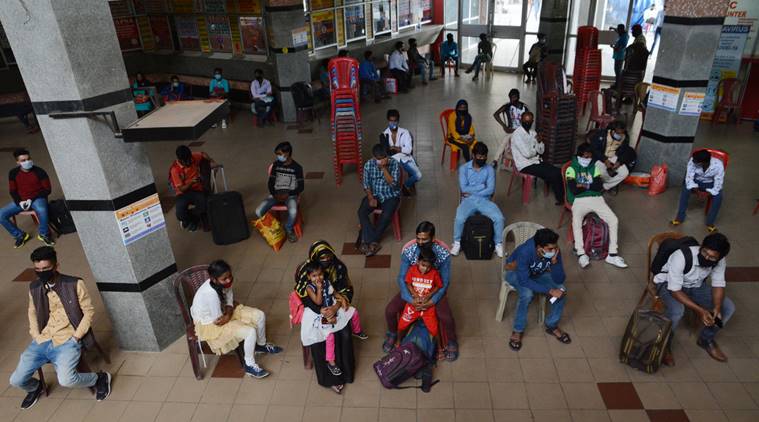 At a bus stand in Guwahati on Saturday, beginning of a three-day window offered by Assam to stranded people to travel across the state on curfew passes. Over 41,000 applied to avail of inter-district bus services. Approximately 5,000 people travelled on the first day, officials said. (Express photo: Dasarath Deka)
After May 3, districts with zero COVID-19 cases should be opened up with strict implementation of social distancing and full systemic preparedness for contact tracing in containment zones, if and when infections are detected.
This appears to be the emerging consensus among policy makers and experts involved in formulating the government’s response to the outbreak as the country enters the last week of a sweeping lockdown that was imposed a month ago.
All eyes are now on the videoconference Monday between Prime Minister Narendra Modi and chief ministers that is expected to shape the broad contours of the roadmap ahead.
“One clear idea that has emerged is that the lockdown should not be extended in districts with no cases. But the states have a very important role to play in the final roadmap. That is why the Monday meeting will bring some clarity,” sources said.
According to district-wise data released by the Health Ministry earlier this week, 429 of the country’s 718 districts have reported positive cases, leaving 289 in the clear.
So far, sources said, two options have emerged from deliberations among various committees involved in the government’s strategy. One of them is to go strictly by a hotspot/ non-hotspot classification, they said. The other is to continue with the present model in which the Centre spells out the guidelines for states, which can to tighten the norms but not dilute them.
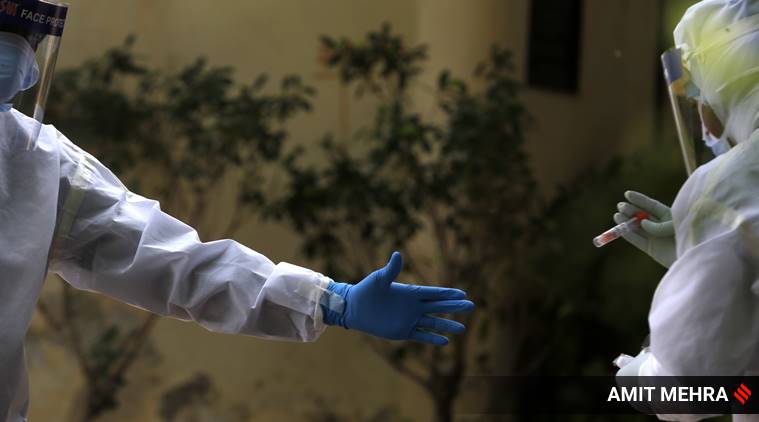 A sample for coronavirus being collected at Jama Masjid police station in Old Delhi.
According to the Health Ministry, hotspots are areas that have a very high number of cases or a case-load doubling time of less than four days against the current national timeframe of about 10.
“There can obviously be no opening up of containment zones. Even for the rest, it has to be done very carefully, balancing disease control and economic aspects. We have the option of going by the red and green zone classification or hotspots or the present model. The important thing is that we cannot let our guard down or let the systemic preparedness slacken,” sources said. Another issue being discussed intensively within the Centre and with states is how to get migrant labourers back to their home states. States like Bihar have suggested special trains so that social distancing during the journey, and screening and surveillance on arrival, can be ensured.
“We are looking at, may be, letting two persons travel in the space that normally accommodates eight people. Also, using trains means they deboard at one point where they can be screened, their details taken for follow-up and arrangements made for the mandatory 14-day quarantine before they can head back to their villages,” said a top government functionary.
Uttar Pradesh has already started bringing back migrants stranded in other states, while Madhya Pradesh has sought permission to do so. Officials said the key is to work out a foolproof modality for transportation.
Over the last few days, the Centre’s messaging has been along the lines that the country has done fairly well and the two lockdowns have had the desired effect in arresting the speed of the disease spread.
READ | Centre revises Centre’s guidelines, states left scrambling to catch up
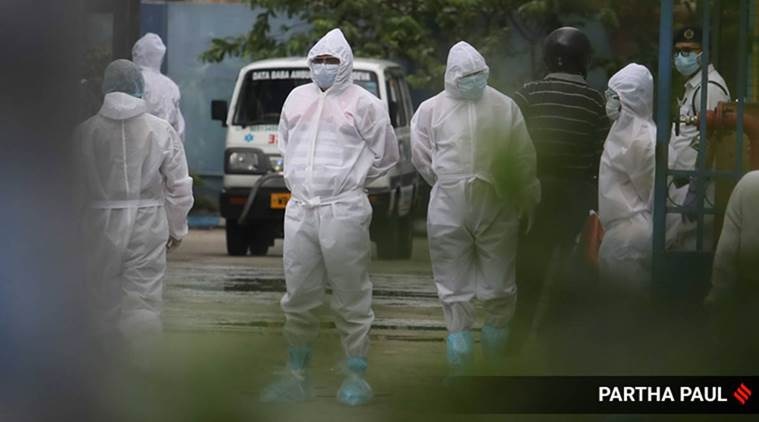 Government sources said the strategy for each region will be tailored according to the disease dynamic there.
Presentations made by chairmen of two empowered groups — environment secretary C K Mishra and Niti Aayog member Dr V K Paul — during the week made the same point as the government’s statement Saturday that at six per cent, the growth rate of the disease is at its lowest.
However, government sources said the strategy for each region will be tailored according to the disease dynamic there.
In this backdrop, they underlined that the situation in Maharashtra, Gujarat, Delhi and Madhya Pradesh remains challenging as these states have accounted for more than half of the positive cases in the country.
The district-wise data also showed that the disease was heavily concentrated in 13 urban centres — Mumbai, Ahmedabad, Indore, Pune, Jaipur, Hyderabad, Thane, Surat, Chennai, Bhopal, Agra, Jodhpur and Delhi.
The fact that rural areas have witnessed subdued incidence of the outbreak will also play on the minds of policy makers in re-starting economy there.
In this context, sources pointed out that the Prime Minister had interacted with the CMs before the first phase of the lockdown ended on April 14 and sought their opinion on a staggered exit plan.
The sources said that even at the time of the last extension, the Centre had been in favour of states taking individual calls but the overwhelming consensus was that the Prime Minister should take the lead to ensure maximum compliance.

 5 min read