Journalism of Courage



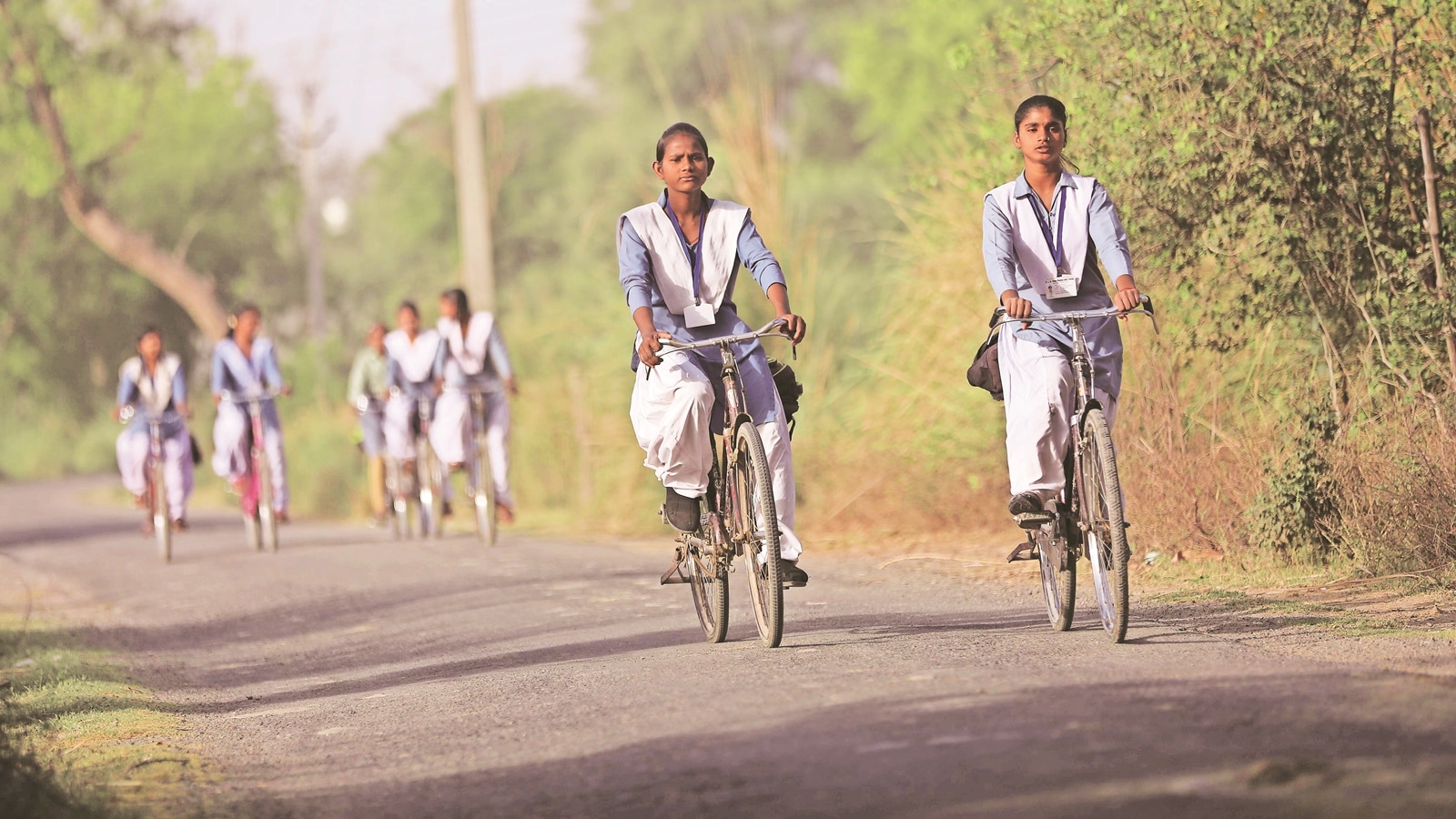 Percentage of children cycling to schools across the country has increased from 6.6% in 2007 to 11.2% in 2017, the largest increase in cycling levels over the decade has been among girls in rural areas — from 4.5% in 2007 to 11% in 2017. (File Photo)
More girls in rural areas are cycling to school, with bicycle distribution schemes helping increase cycling levels in states where they have been implemented, says a recently published paper.
While the percentage of children cycling to schools across the country has increased from 6.6% in 2007 to 11.2% in 2017, the largest increase in cycling levels over the decade has been among girls in rural areas — from 4.5% in 2007 to 11% in 2017.
Researchers from IIT Delhi and the Narsee Monjee Institute of Management Studies have termed this rise in cycling among girls in rural areas a “silent revolution” in their paper in the Journal of Transport Geography. The paper by Srishti Agrawal, Rahul Goel and Adit Seth used data from three rounds of the National Sample Survey on social consumption on education — 2007-08, 2014 and 2017–18 — covering a decade.
Agrawal, a PhD scholar at IIT Delhi, said, “It is a revolution because India has the highest level of immobility among females. Women are much less likely to make a trip outside home compared to men. And here we see such phenomenal growth in cycling levels among girls in rural areas.” Gender inequality in cycling in India should be seen within the broader context of patriarchal norms that restrict mobility of women, the paper said.
Among school-going children in the age group of 5 to 17 years, cycling levels in rural areas increased two-fold from 6.3% in 2007 to 12.3% in 2017. The levels in urban areas did not show a significant change over the decade — from 7.8% in 2007 to 8.3% in 2017.
The paper notes that the researchers found “strong evidence” that bicycle distribution schemes helped increase cycling levels in states “and their greatest impact was for cycling among rural girls”.
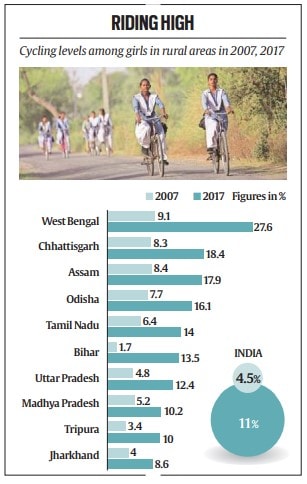
Out of 35 States and Union Territories (the paper considered the undivided State of Andhra Pradesh), bicycle distribution schemes were implemented in 20. Under the schemes, either a bicycle is provided or funds for the purchase of a bicycle are transferred. Agrawal said: “The top 10 states (see box), which have the highest cycling levels in 2017 and have seen the largest growth in cycling levels over the decade among girls in rural areas, are those which have bicycle distribution schemes. States provide bicycles to school-going children usually in the age group of 14 to 17 years, with the aim to improve enrolment rates, specifically among girls because their drop-out rates are higher.”
The paper says: “The impact of BDS (bicycle distribution schemes) is most visible in the state of West Bengal, where the scheme started in 2015, and the mode share of cycling (among girls in rural areas) increased from 15.4% (2014) to 27.6% (2017), a 12-percentage point increase over just a 3-year period.”
It added: “The greatest increase in cycling among girls occurred in rural Bihar where levels increased eightfold. In West Bengal, cycling among girls increased three-fold, making it the state with the highest cycling levels among rural girls across the country.” Over the decade, cycling levels among girls in rural areas has almost doubled in Assam, Chhattisgarh, Jharkhand, Madhya Pradesh, Odisha, Tamil Nadu, and Uttar Pradesh.
In a large majority of states, cycling share increased for both genders, with a greater increase among girls, the paper read. “In 2017, the highest levels of cycling to school were in West Bengal (26.2%), followed by Odisha (19.3%), Assam (19.0%) and Chhattisgarh (18.9%).”

 4 min read