17 min read


© The Indian Express Pvt Ltd



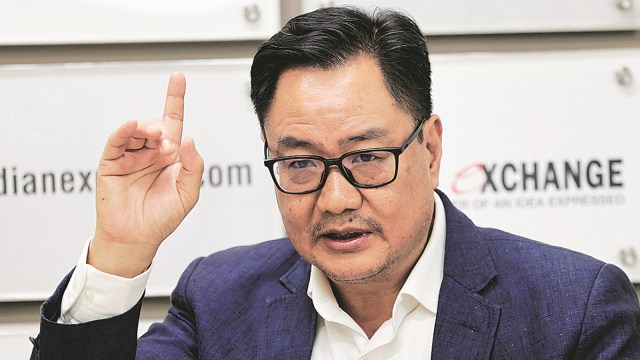 Kiren Rijiju Interview: Union Minister for Parliamentary Affairs and Minority Affairs Kiren Rijiju. (Express photo by Renuka Puri)
Kiren Rijiju at Idea Exchange: Union Minister for Parliamentary Affairs and Minority Affairs Kiren Rijiju on the reasons for the disruptions on the floor of the House, why the Opposition has to use time wisely, and the safety of minorities in India. This session was moderated by Liz Mathew, Deputy Editor, The Indian Express.
Liz Mathew: The last two parliamentary sessions were a washout. Now that the BJP and the NDA have had an electoral victory in Bihar and with the Opposition against SIR (Special Intensive Revision), what are your expectations for the session?
The last two sessions, despite the disturbances, from the government’s point of view, were successful. In fact, the last session was the most productive one in my more than two decades of parliamentary experience. The washing out of session may be bad, however, for the government, we are worried only because there were no discussions on critical Bills. But from a purely business point of view, we have passed so many Bills so, technically, it’s not a washout session but from the democratic spirit point of view, the disturbances are painful and people don’t like that Parliament rushes through important Bills.
Liz Mathew: Don’t you think that it is casting a shadow on the efficiency of Parliament?
It all depends on how the Opposition behaves. The government comes out with the agenda and the Bills and other important businesses are put before the House. Before that, we table the agenda of the Business Advisory Committee (BAC). As Parliamentary Affairs minister, I try to listen to the Opposition’s request for a longer period of time. In the last session, both Operation Sindoor and the Waqf (Amendment) Bill had a record length of discussion. We had given ample time and we agreed to discuss them but if the Opposition doesn’t allow other businesses to be discussed then that is bad.
You have an issue to be taken up in the zero hour, raise it then. When the zero hour is over, then it is time for a Bill or for another subject to be taken up. That is how we can make Parliament function efficiently.

Liz Mathew: Previous governments, be it the UPA or NDA, used to get the Opposition on board for several issues. Why is it not so now?
Beyond regular meetings, we also have many courtesy meetings. I am in touch with all the Opposition leaders and they come to my place. I visit them, we exchange information and that will continue. After all, the House belongs to all. But the perception that not enough efforts are being made to get the Opposition on board is not true. For instance, when the matter for the removal of Justice (Yashwant) Varma was taken up, I had a discussion with both the leaders of the Opposition Rahul Gandhiji (Lok Sabha) and Mallikarjun Khargeji (Rajya Sabha). And then we agreed that we will take up this matter in Lok Sabha.
We may have differences in a parliamentary democracy but trust and ethics are an important part of the procedure and the rules of business laid down. Once the trust is broken, it leads to a cascading effect on how the normal routine works. Another thing I wanted to suggest to the Opposition is that if they want to use Parliament for their political purpose, then they should use it more wisely. Disrupting proceedings and misusing the Parliament forum for driving political agenda does not necessarily bring them political dividends. Political differences will remain but Parliament should not become the victim.
On disruptions in Parliament | If the Opposition wants to use Parliament for their political purpose, then they should use it wisely. Disrupting proceedings for driving political agenda does not necessarily bring them political dividends
Vikas Pathak: When the UPA was in power, Sushma Swaraj and Arun Jaitley had categorically stated that obstruction of Parliament is also part of democracy.
The obstruction of the proceedings in Parliament deserves some kind of justification. For instance, in the last two sessions, SIR was raised. The Speaker and I have mentioned the ruling given by Balram Jakhar when he was Speaker.
Discussion about any Constitutional authority, which is clearly an autonomous body, is not advisable. The government cannot speak on behalf of the authority. To discuss a particular judge, they are not available in the House to defend themselves. That is why, when matters are sub-judice or related to the Election Commission or courts, they cannot be discussed on the floor of the House. SIR is an administrative action taken by the Election Commission, not a reform by the government. So, for that, the government cannot defend, justify or support the move. An action which resulted from the decision of the Commission itself, how can Parliament take that up for discussion?
Secondly, I remember when Advaniji was Leader of Opposition, he clearly told the NDA MPs about why we protest. Normally, in Parliament, we should not go to the well. When we are forced to go to the well, we ensure that we don’t cross the treasury bench. But now, they come all the way and stand in front of the PM, Defence Minister and the Home Minister, and they physically block them. So there are huge differences in our methodology and what the Opposition is adopting.
 Kiren Rijiju: ‘Trust and ethics are an important part of parliamentary democracy. If trust is broken, it has a cascading effect’
Vikas Pathak: Does the government intend to hold discussions with the Opposition to have a more fruitful session?
We are ready to discuss with the Opposition, especially the leaders of the parties. But if you want to take the whole course of debate into rhetoric or use terms like ‘Gabbar Singh’s tax’ or ‘hydrogen bomb’, if you want to confine your agenda through headlines and social media trends, then you diminish the standard of the House and also your stature.
Why are the people of India not taking Rahul Gandhiji seriously? It is primarily because he indulges in rhetorical and kind of childish acts, which are purely influenced by some of his advisors who believe in headlines only. It is not good for long-term politics. You will never see any of the senior leaders and top leadership from the BJP or NDA doing any theatrics in the House.
On voicing dissent in parliament | Discussion about any Constitutional authority, which is an autonomous body, is not advisable… When matters are
sub-judice or related to the EC or courts, they cannot be discussed on the floor of the House
Liz Mathew: LK Advani had called the then Prime Minister (Manmohan Singh) ‘mouni baba’. And PM Modi made a comment (in the Rajya Sabha in February 2017) about him that “he is the only person who knows the art of bathing in a bathroom with a raincoat on”.
There are many words and inferences you throw during the course of debates. If you say the Prime Minister is weak, it is a description. ‘Mouni baba’ means you are not actually speaking out because at that time Sonia Gandhiji called the shots. So the PM was basically silent in all political matters. In that context, Advaniji had said ‘mouni baba’ or ‘kamzor pradhan matri’. But to call someone ‘chor’? What did he do to be called a thief? You can’t abuse or use a word which is unparliamentary. The Bofors scandal did happen and it is a fact. You can’t compare Bofors or the Coalgate scam or the fodder scam with Rahul Gandhi’s allegations about Rafael scam and the allegations of ‘chowkidar chor’. People have given a befitting reply to all those allegations.
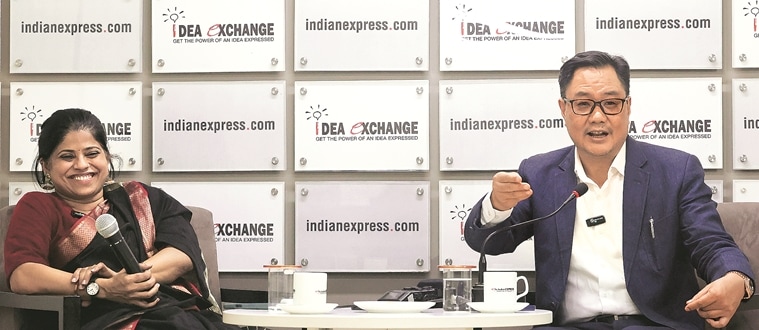 Union Minister for Parliamentary Affairs and Minority Affairs Kiren Rijiju (right) in conversation with Liz Mathew, Deputy Editor, The Indian (Express photo by Renuka Puri)
Manoj CG: Another concern for the Opposition has always been the government’s decision to push through Bills without much consultation. Does that not reflect badly on parliamentary functioning?
I fully agree that there has been a deterioration in the standards of parliamentary functioning. But I don’t want to justify it again by blaming the Opposition alone. Not all Opposition leaders are responsible for what has happened. Many MPs from the Congress and other Opposition parties tell me to do something so that Parliament can function. But if the entire agenda of the Opposition is driven by one or two failed leaders, it is very difficult. After all, who are the biggest victims? It is the Opposition MPs. At the end of the day, an MP has to go back to the people. How will you show your performance? It is dependent on your performance in the House. If Parliament doesn’t function, government business doesn’t stop but it stops the MPs from speaking. The only concern which the government has is that enough debates and discussions do not take place. For democracy, it’s not okay. We want to have better quality, higher standards of parliamentary debates and discussions all the time.
Manoj CG: There was also a convention of giving the Deputy Speaker post to the Opposition. In the last Lok Sabha, there was no Deputy Speaker. What is stopping the government from showing the grand gesture?
There is a convention and I agree with that, but it depends on circumstances and one’s understanding with the Opposition parties… The Opposition party will have to come and ensure that our differences are political. But in terms of running the House, there should be no differences.
Jatin Anand: In the last session we saw the Vice President (Jagdeep Dhankhar) suddenly resign. You were the election agent for CP Radhakrishnan. What had happened?
The election of the vice presidential candidate is by secret voting. There’s no whip. MPs are free to vote. You can’t coerce them. It’s done in the glare of the media and the entire voting is live. All the MPs are voters. Many Opposition MPs, too, have voted for the NDA candidate. So if they say that you purchased our MPs, then are MPs purchasable? Which means they themselves are accusing their MPs of being saleable. If it is a transparent vote, then they see numbers voting. Everything is captured. You know who has voted for whom but in secret voting you can’t accuse anybody.
On ChinA’s stand on Arunachal | My request to the Chinese government is: don’t try to change a situation. No Arunachali will accept himself or herself to be aligned with China. It is better for India and China to accept that and have a friendly relationship
Deeptiman Tiwary: There appears to be a trend in your government to first pass the Bills and then seek the opinion of the people. It happened with the CAA, Article 370, Waqf (Amendment) Bill, all of which caused protests. So why is the government reluctant to do a wider consultation?
These issues do not crop up all of a sudden, be it the Ram Mandir issue, Waqf (Amendment) Bill or Article 370. Yes, there is secrecy in the process. This is the rule. Until it is passed in the Cabinet, we cannot speak about it outside. That is why in the 11 years, not a single Cabinet agenda has been leaked. During the Congress era, the Cabinet meeting would be ongoing and there would be a parallel broadcast outside. We cannot do this. We cannot dismiss the practice, the system and its sanctity. The issue is already in the public domain. When I tabled the Waqf (Amendment) Bill, the Opposition said they needed time. We sent it to the Joint Parliamentary Committee (JPC). We have sent the Jan Vishwas Bill to the JPC. We have now sent the Insolvency and Bankruptcy Code (IBC) to a Select Committee.
Liz Mathew: Was the Constitution (131st Amendment) Bill in the agenda cleared by the Cabinet?
That matter is closed. It was withdrawn. The government has proposals from every ministry, not everything goes to the Cabinet. Only what the PM approves goes to the Cabinet. That is why don’t focus on what subject matter came up, look at what the government finally decided.
Harikishan Sharma: If we compare the number of sittings of the Lok Sabha from 2014 to 2024 to the previous 10 years, from 2004 to 2014, the number is definitely down.
In the last two sessions, when discussions were happening, the Opposition said they would not let the House run, so we quickly passed the Bills and adjourned the House. We were compelled to shorten the dates. If the Opposition did not want a discussion, they said we will not participate in it. So what is the benefit of running the House longer?
Deeptiman Tiwary: In September, we saw violent protests in Leh. The Buddhist and Muslim minorities have been demanding Sixth Schedule, statehood and protection for land and jobs for the past six years. In its manifesto, the BJP had stated that the Sixth Schedule will be given. Did the government delay too much in addressing the concerns of the minorities there?
The lives and rights of the people of Jammu and Kashmir and Ladakh —if I speak from 2014 or especially since Article 370 was removed — the benefit of development is vastly different from before. Go anywhere in Ladakh, better roads have been built, every village has mobile service, electricity and water. Some people have done things to spoil the atmosphere. If the ongoing dialogue between the leadership there and the Home Ministry is allowed to proceed correctly, that will be beneficial and whatever others are doing to gain political advantage in the middle will only harm Ladakh.
Liz Mathew: Sonam Wangchuk was previously endorsed by the BJP. How has he suddenly become somebody detained under the National Security Act?
I am concerned about the common people. I don’t want to get into a specific person because I have a larger responsibility to look into. From our Ministry, I went to Leh, deep inside Kargil. I met common Kashmiris. And from my Minority Affairs Ministry, we are providing many schemes. I am taking the steps I need to take. I do not wish to talk about one or two specific personalities. Everyone is happy with the work the government is doing.
Shahid Parvez: Recently, President of Jamiat Ulama-i-Hind Arshad Madani said that in New York, Zohran Mamdani can become the Mayor, Sadiq Khan can become the Mayor in London, but in India the Muslim community has been targeted by the government to prevent their elevation to leadership roles. How would you address such concerns of discrimination?
The best way is to ignore these statements. India is totally democratic in electing its leaders. The sovereignty of India lies with the people of India. Who made Abdul Kalam the President? The freedom, rights and opportunities that the minorities have in India are not found in any other nation. Has any minority fled from India? Minorities have fled other countries and taken refuge in India. I am a minority. There might have been some fight at a personal level but has a situation come in India where we feel we have to leave India because we feel afraid or not safe here? It is an atmosphere that has been created.
We have data on how many communal riots happened in this country before the BJP came. Compared to that, there haven’t even been five per cent under the BJP government. But the agenda was pushed so strongly — first, the incidents of mob lynching and then a campaign called Award Waapsi. Slowly, these people pushed an agenda but the agenda was not successful, which is why if someone says that minorities here are not being allowed to rise to leadership roles, that they are being systematically suppressed, then this is not true. If you live in the country and speak against the country, and if someone reacts to that, I cannot give justification because reaction and action happen mutually. As long as you are Hindustani in your heart and mind, I guarantee there is no country safer for minorities than India.
Vineet Bhalla: Recently, China created inconveniences for a woman from Arunachal Pradesh. China has claimed it has sovereignty over Arunachal for several years now. Does the government consult you and other MPs from Arunachal over these issues?
I am a Member of Parliament from Arunachal Pradesh and a Minister. The status cannot be changed or altered by what other people say. This is not the first time China has rejected the visas of Arunachal’s people. In the ’80s, Arunachal Chief Minister’s visa was not accepted. The Chinese have taken a stand that they will not recognise the passport of Arunachali people. We have equally rejected it because Arunachal Pradesh, below the McMahon Line that was defined in 1914, is part of India de facto and de jure. No matter how much China or anybody says, it will not alter the status of Arunachal Pradesh. My request to the Chinese government is: don’t try to change a situation. No Arunachali will accept himself or herself to be aligned with China. It is better for India and China to accept that and have a friendly relationship.