© The Indian Express Pvt Ltd
 6 min read


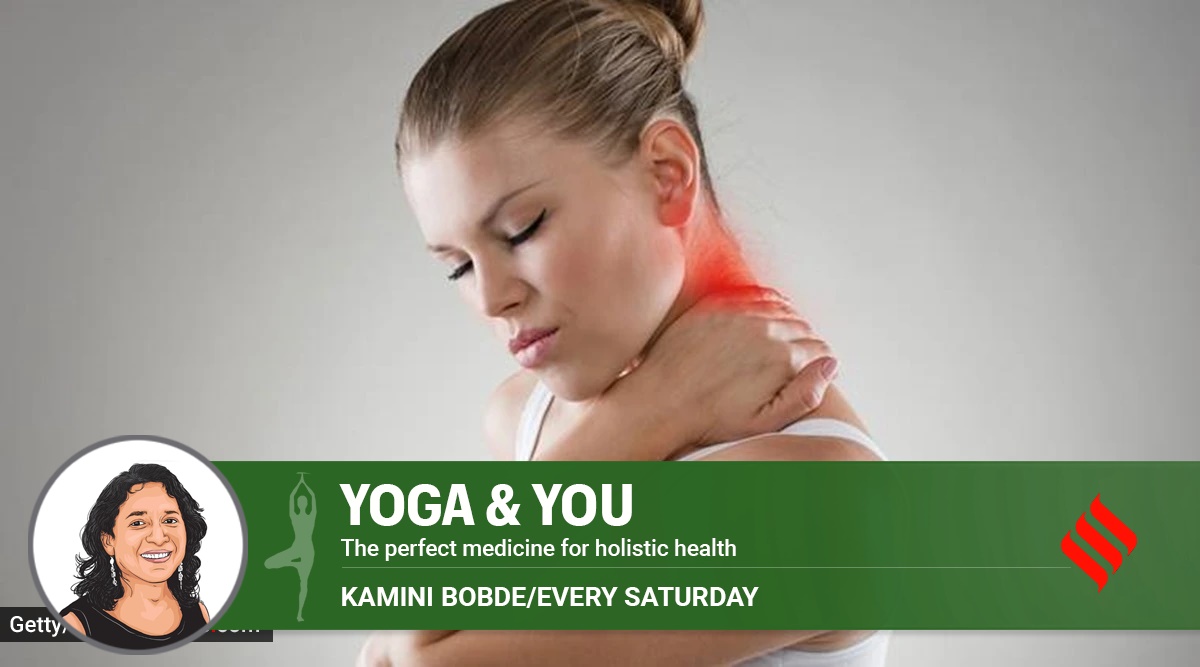 Practice three asanas to relieve neck stiffness (Source: Getty Images/Thinkstock)
 One of the prime reasons for stiff neck these days is the combination of bending, hunching over our devices with a mind under stress. There are other reasons too, like:
· Worn out joints due to age or arthritis.
· Nerve compression
· Injuries like a whiplash jerk
· Chronic bad posture
For most of these problems, just three simple asanas will fix your head firmly on your neck with flexibility and strength, relieving you of any stiffness, pain or discomfort to carry on your activities.
The first two asanas are simple enough and can be practised twice a day, morning and evening, especially for those who are having severe stiff neck problems or those who cannot get away from working on their phones and screen or sitting long hours at the table. It is best to practise these along with other daily workouts or yoga as a preventive measure to avoid getting into a painful situation.
Benefits: All nerves, veins, arteries connecting the different organs and limbs of the body to the brain pass through the neck. The carotid artery, which controls heart rate, also passes through the neck. Neck movements regulate all these. It is also an area which accumulates maximum stress and tension. The neck movements target the thyroid glands and are good for the eyes which are impacted by the use of the devices.
Cautionary advice: People suffering from high or low BP, vertigo, spondylitis must practise under expert guidance or avoid forward bending or do neck rotation only in semi-circle without bending forward,
Practice:
1. Upward and Downward movement:
· Sit comfortably on a chair or padmasana ( cross legged) with head and spine aligned and the whole body relaxed.
· As you inhale, move your head back as far back as possible. You can keep your eyes closed so that awareness is inside the neck area or keep them open but try to keep awareness of the effect of your practice inside the neck area.
· Then as you exhale, drop your head forward in a slow, smooth movement so that finally your chin is resting on your chest.
· Inhale, come back to base position. This is one round. Do five rounds.
2. Sideways bending:
· Continue in the base position. Inhale in the centre, then as you exhale, drop your head to right so that the ears move towards the shoulders but the shoulders remain still. Bend maximum so that you feel full stretch on the left side of the neck and compression on the right side. Maintain awareness inside the neck area.
· Then as you inhale, come back to the centre and as you exhale, bend to the left side. Inhale, come back to the centre.
· This is one round. Do five rounds.
3. Neck Twisting:
· Begin with the base position. Inhale in the centre and as you exhale, twist your neck looking to the extreme right.
· Then with inhalation, come to the centre.
· As you exhale, twist to the extreme left. With inhalation, come back to the centre.
· Throughout, maintain awareness about the neck area with eyes closed or open.
· This is one round.
· Do five rounds.
4. Neck Rotation:
· Begin in the base position.
· Inhale in the centre and as you exhale, drop your head to the front.
· Then rotate your head in a clockwise direction in full round movement.
· Do 5 rounds of neck rotation in a clockwise direction.
· Follow this up with 5 rounds in an anti-clockwise direction.
Benefits: The shoulder joint rotation relieves strain, pain or stiffness from long hours of driving, working on the desk etc. It can be performed even by those suffering from cervical problems and frozen shoulder. It improves respiration too.
Cautionary advice: There are hardly any contraindications for this practice.
Practice:
· Sitting in the base position with a straightened back, hands resting on the thighs, place the tip of the fingers of the right hand on the right shoulder with the elbow in a straight line along the shoulder.
· Then rotate the right elbow, as if drawing a large circle with it, first in clockwise direction for 5-10 rounds, then in an anti-clockwise direction for 5-10 rounds.
· Do the same with the left shoulder joint for 5-10 rounds in clockwise and anti-clockwise directions.
· Then join both elbows in front of your chest with the tip of the fingers of both hands resting on the shoulders. As you inhale, take both elbows from over the ears, almost touching them to fully pull them at the back, then with exhale bring them back to the starting position, thus executing a full circle of hour shoulder joint. This makes one round. Do five rounds.
· Then do the same rotation, taking the elbows from below as you inhale and pull them at the back of your body. Do five rounds of this reverse full round movement of your shoulder joint.
Benefits: It helps tone the upper back muscles and free up tightness and stiffness in and around the neck and shoulders. It corrects bad posture, especially rounded shoulders. It improves respiration and is good for the heart too.
Cautionary advice: People suffering from any kind of severe ulcers, hernia, hypothyroidism must avoid or do under expert guidance.
Practice:
· Lie down the mat on the stomach with feet together, toes stretched out, chin on the floor.
· Interlock fingers and place hands on the hips, with palm facing inwards.
· Relax your shoulders and whole body.
· Take a deep breath, and after having filled up the lungs completely, begin to raise the head and chest area off the floor, simultaneously pulling the arms, almost as if the arms are catapulting the body.
· You will raise the front of the body only till your diaphragm.
· Hold in this position as long as it is comfortable.
· Then with exhalation, lower your head back on the floor, release the hands, rest them on the floor beside the body and turn the head to the right and relax.
· This is one round. Do five rounds. After every round you can turn your head to the other side and relax.
All the best for your practice.
(Kamini Bobde is a Kundalini practitioner who follows the Swami Satyananda Saraswati tradition of yoga. She is the author of Kundalini Yoga for All: Unlock the Power of Your Body and Brain. Published by Penguin)