8 min read

© The Indian Express Pvt Ltd



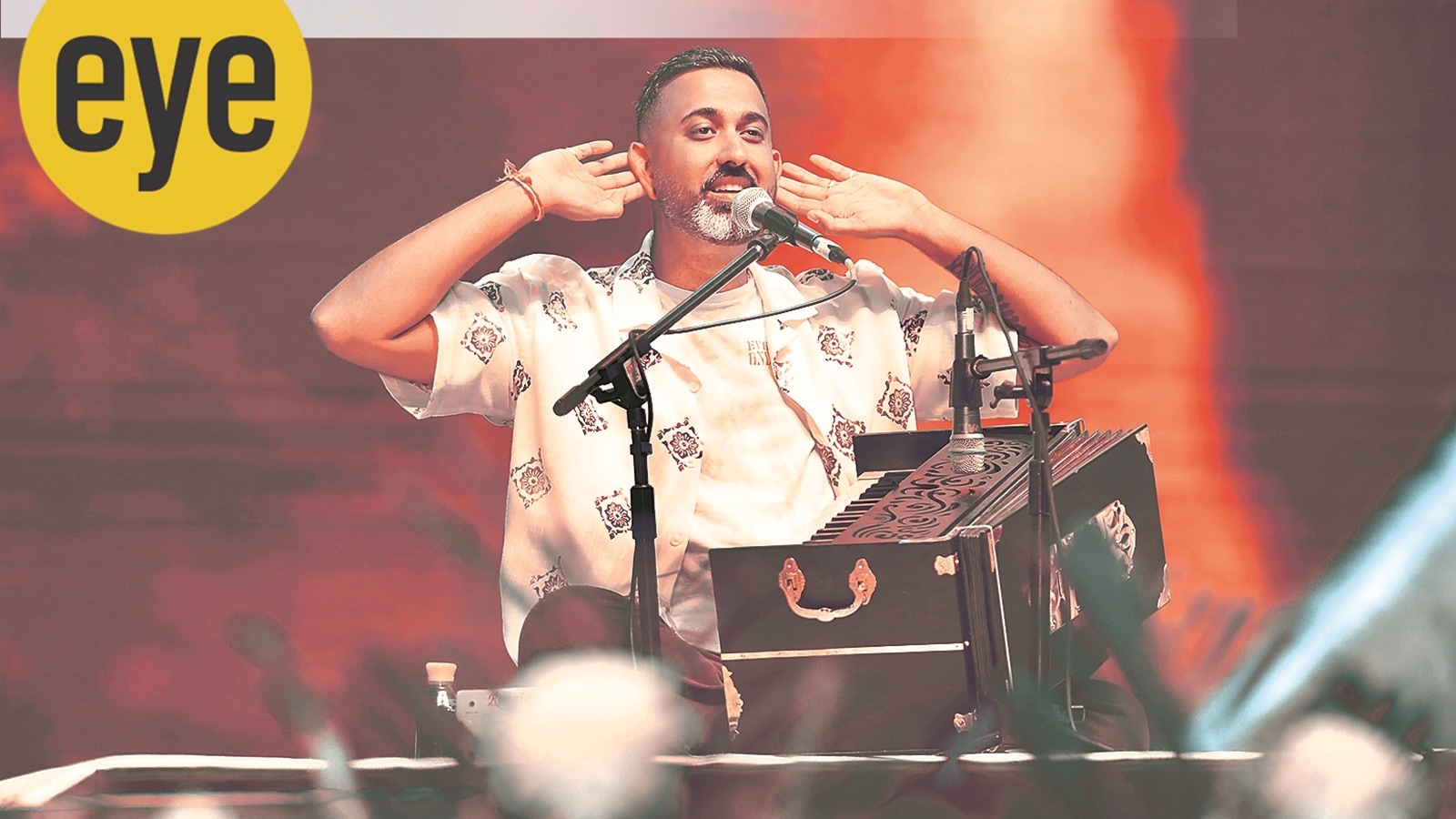 Radhika Das's concert in Delhi
Last month in Delhi, for a concert of London-based property and investment specialist Ravi Pattni – better known as kirtan artiste Radhika Das – about 15,000 people paid tickets ranging from Rs 2,000 to Rs 12,000. Many of them, in their 20s and 30s had come seeking a devotional and cultural experience. With Das and his band of musicians who played a diverse range of instruments, from mridangam, tabla and harmonium to saxophone and the bass guitar, they chanted mantras and sang bhajans. The two-hour concert, supported by Delhi government, was held at Dwarka’s Yashobhoomi, an Expo Centre that has hosted events such as the G20 summit.
Radhika Das is chuffed that his audience of young professionals, families, urban and English-speaking Gen Z have shown up. He is excited about “how ready India is for this new wave of spiritual expression”.
Less about the ritual and more about the collective, modern kirtans and chants are sung in a call-and-response format. In small and large concerts sprinkled across major cities, and still a niche trend, its appeal lies in the spiritual experience that somehow fits into the modern way of life. And they are happy to pay for it.
“Young people are searching for meaning, grounding and belonging and they are finding that in devotional music. It becomes a tether, amid the chaos and loneliness. Bhajans allow them to feel connected without needing to perform a personality,” says Radhika Das. For many, it feels like a return to roots, a reconnection with something they have always known but didn’t have the language or space to explore. For others, it’s a new kind of spiritual revival. “One that fits into the rhythm of modern life without losing the heart of India’s sacred traditions,” he says.
 Radhika Das’s concert in Delhi
Mumbai-based 38-year-old publicist Hurlene Kharbanda, who has been attending Grammy-winning British kirtan artiste Krishna Das’s concerts, including the one last month, also made it to Radhika Das’s concert in Mumbai. “What makes these kirtans special is the connection, the energy, the vibration,” says Kharbanda, who grew up in a Punjabi household and has been practising Buddhism for 15 years. “The vibe is more artist-driven than ritual-driven. The energy in that room is electric. And towards the end, everyone’s dancing. It’s liberating. There are many ways to get high in life, this one just hits differently,” she says.
The Krishna Das concert that Kharbanda attended last year was also attended by cricketer Virat Kohli with wife and actor Anushka Sharma, turning it into an Instagram moment. A 1,000 people attended the concert at Dome, SVP Stadium. “This year, they booked the entire arena,” says Kharbanda.
There was a time when kirtans were limited to temples, ashrams, homes or small community gatherings before an occasion. Back in the ’60s and ’70s, Indian spirituality had a global moment. The spiritual and political yearnings of a disillusioned West were fed by cultural and religious practices offered by Maharishi Mahesh Yogi, Neem Karoli Baba and Sri Chinmoy, among others. The Beatles came and stayed in Rishikesh, allowing the Flower Children to fall in love with Indian music, yoga and Indian culture. They had heard slivers of it at concerts by Pandit Ravi Shankar and Ustad Ali Akbar Khan in the US and Europe.
The ’60s was also the time when ISKCON was established, first in the US before it spread globally. Here congregational chanting was not just as an expression of devotion to Krishna but also about spiritual awakening. The kirtan has also been at the helm of Sri Sri Ravi Shankar’s foundation, Art of Living, where, for years, they have presented ‘rock satsangs’ to keep the young engaged spirituality, bringing out albums to enhance the experience. The current idea of ‘bhajan clubbing’ perhaps stems from a similar space.
Yudhistir Govinda Das, country director of ISKCON India, has been seeing an increase in a young community of “seekers”. He says that with “the challenges of war, disasters and health issues, the young juggle information overload, anxiety, struggle with a work-life balance, and feel a gap that achievement alone cannot fill”.
Deepak Chaudhury, managing director, EVA Live, who is at the helm of organising Radhika Das’s ‘Silence in Sound’ India Tour, says that “devotion is no longer old-fashioned” and is being “rediscovered as emotionally intelligent, soulful and beautifully artistic”. He adds that it also reflects a growing global respect for Indian spiritual soundscapes.
“The fact that Radhika Das is doing a pan-India tour is also a testament to this growing movement,” says Kharbanda, who is not sure if ‘cult’ is the right word, “but it’s almost that,” she says.
Accessibility remains at the core of it all. Baldev Maheshwari, 34, founder of Kirtan Mumbai, which hosts monthly mantra meditation gatherings attracts a young, elite crowd of 200–300 people. “What started as a small circle of 25 has now grown into a community of nearly 1,000 members on WhatsApp,” says Maheshwari, “When someone attends our kirtan for the first time, they’re blown away. They see guitars, reggae, young people having fun, it’s cool. Parents love it too because their kids are connecting with something spiritual.” They blend Indian classical and Western music, with keyboard, bass guitar, acoustic guitar, mridangam, manjira, harmonium, sometimes even saxophone and cello.
Maheshwari also runs a private label, Baldev Maheshwari Music that hosts private bhajan sandhyas. “A few years ago, I would get one or two requests a month. Now it’s 15 to 20. People want their pre-wedding festivities to begin with a sangeet sandhya. We recently did them in Udaipur and Jaipur,” he says.
Even when Papa Don’t Preach’s Shubhika Sharma — a designer celebrated for her bold, maximalist aesthetic — tied the knot with entrepreneur Harshil Karia in late October this year, the duo opted for ‘bhajan clubbing’, led by Maheshwari’s Kirtan Mumbai, instead of the usual sangeet or cocktail night.
 Siblings Prachi and Raghav Aggarwal
“Marriage brings people together, and a kirtan gets everyone chanting in unity. The energy was incredible, with people singing their hearts out,” Karia was quoted as saying in a publication.
There are also such gatherings happening in homes and across social media. In Mumbai, Anita Shah, 50, and her husband, host “chanting parties” at their Bandra home. While she admits the energy of an intimate gathering can’t match that of an auditorium, it’s no less powerful. In Kolkata, sibling duo Prachi Aggarwal, 22, and Raghav Aggarwal, 25), who quit their investment banking and finance jobs less than six months ago, organise bhajan evenings all over the country. Their chanting videos of Ram ram jai raja ram are viral on Instagram. “We wanted to give people a different kind of high, a high without alcohol,” say the siblings, who earlier included bhajan jam in their Bollywood shows. Now they also do exclusive bhajan clubbing concerts.
“Spirituality is no longer confined to a place. It’s becoming experiential, personalised and socially shared,” says Chaudhury, who adds that it is not about turning devotion into a party space. “It is about creating a spiritually elevating experience.”
Delhi-based Nikunj Gupta, 25, sees a business opportunity in this. Later this month, his organisation Sanatan Journey, will host a bhajan clubbing event at the Indira Gandhi Sports Complex in Delhi where he has invited a Vrindavan-based bhajan rock band for the experience. The tickets start at Rs 899. “People are completely saturated. They have gone clubbing, are done with bar fights and social media and now want a recreational activity that brings peace and calm to them. Devotion may not have been cool for the millennials but Gen Z and the seniors are getting involved with it deeply,” says Gupta.
But is it a real return to roots or a reflection of the political climate and the renewed interest in Hinduism? Radhika Das feels that politics or cultural shifts of the moment may be amplifying it. “But at its core, this movement isn’t ideological, it’s emotional. It’s about young people wanting stillness in a fast world and connection in an isolating time. Chanting mantras offers all of that without judgment,” he says.