
In the early years of the 19th century, Nusḵẖa-i Niʿmat Ḵẖān, a Persian translation of an English cooking manual, carried an entry called Tarkīb-i ṭomāṭā sūp yaʿnī shorbā wilāyatī baigan — a recipe for a tomato soup or an imported brinjal broth. Despite being introduced by the Portuguese in the 16th century, tomatoes were virtually unknown in India three centuries later, when the British were beginning to lay the foundations of their Indian empire. In select circles in the country, this produce of the New World came to be known by its affinity to the ubiquitous eggplant. In her doctoral work, historian Divya Narayanan writes that Nuskẖa-i Niʿmat Ḵẖān was translated for an Indian audience with “an object of acquainting them with European foods” by Shaikh Hanka Ghafrulla of Muzaffarpur. Ghafrulla had acquired a copy of the culinary manual from his “master”. Narayanan says that the translator wanted to introduce the “gentlemanly class” to food such as vegetable soup, mock turtle soup, hare soup, beef fillet, mashed potatoes, mutton chops, and tomato soup. It would be some time before the wilayati baingan would become popular. The name acquired by the tomato though would have a very long life — I have heard my grandmother use it in the 1980s.
Tomatoes did not have an easy passage even in Europe. The fruit got tagged as the “poison apple” because several aristocrats died after consuming it. It later transpired that acidic tomato caused lead to leach from the pewter plates used in European dining. The tomato was held as a culprit for lead poisoning. People who couldn’t afford expensive tableware did not have this problem, and tomatoes initially became part of the diet of the less-well-heeled. In Britain, they were thought to be poisonous because they belonged to the nightshades family of plants – its Latin name lycopersicum means wolf peach.

Food historian Lizzie Collingham writes that by the early 19th century, British cooks had discovered how useful tomatoes were as a souring and thickening agent in soups and broths, and as a base for catsup — sauces, originally made of stale beer, mushroom, cloves, pepper and ginger, that would not go bad for long time. Europe’s search for ingredients that would ameliorate the bland tastes of a lot of its food won the day for the tomato.
 Tomatoes did not have an easy passage even in Europe (Express photo by Nandagopal Rajan)
In 1832, the Scottish surgeon-turned-botanist William Roxburgh noted that the tomato was widely used in the subcontinent. This was somewhat misleading. In the 1830s, the Calcutta-based Agricultural and Horticultural Society of India (AHSI) that played a pioneering role in the cultivation of vegetables such as potatoes, cauliflowers and fruits such as plums — cash crops including cotton as well — had not yet listed tomatoes as a crop of priority. The society’s records closer to our times, however, credit its founder the missionary William Carey as one of the pioneers of tomato cultivation in India.
For the British, the tomato became one of the go-to ingredients in their quest for the “Indian curry”. The catsup, writes Collingham, became a favourite in Anglo-Indian recreation events — the shikar, for instance. Almost a century later, in 1935, Jennifer Brenner’s memoir — Curries and Bugles, a Memoir and a Cookbook of the British Raj — showcases tomato as a part of British attempts at culinary hybridity. Tomato bhujia and jhalfraizie were among the lunch items she lists.
British culinary preferences were also dictated by the need to come to terms with the hot weather in much of the country. In Culinary Jottings for Madras, Arthur Robert Keeney Herbert notes that “we live in a climate that demands a vegetarian diet. With the thermometer indicating 90 degrees or thereabout, plain animal food is not only distasteful to many, but absolutely unwholesome”. But, as Collingham writes, the British in India never really took to Indian fruits and vegetables. Herbert is lavish in his praise for tomatoes. “They form the most valuable part of our vegetable produce. They are easily grown in this Presidency and are often procurable when the stock of the garden stuff has sunk to its lowest stuff during the hot weather. Whether cut up cold in its raw state and eaten as a salad or in the form of a puree as a soup or sauce, with fish or other vegetables, the tomato never fails to be a welcome friend”.
The retired army officer’s manual, which ran into several editions, is replete with a variety of pantry management details, including how to supervise cooks. It describes tomato recipes such as “au gratin” and “al italien” with a felicity of a modern Michelin masterchef – “cut a slice of the top of each tomato as you would decapitate a boiled egg. With a dessert knife scoop out the pulp and the seeds as well as you can, put the shells so obtained on one side…”
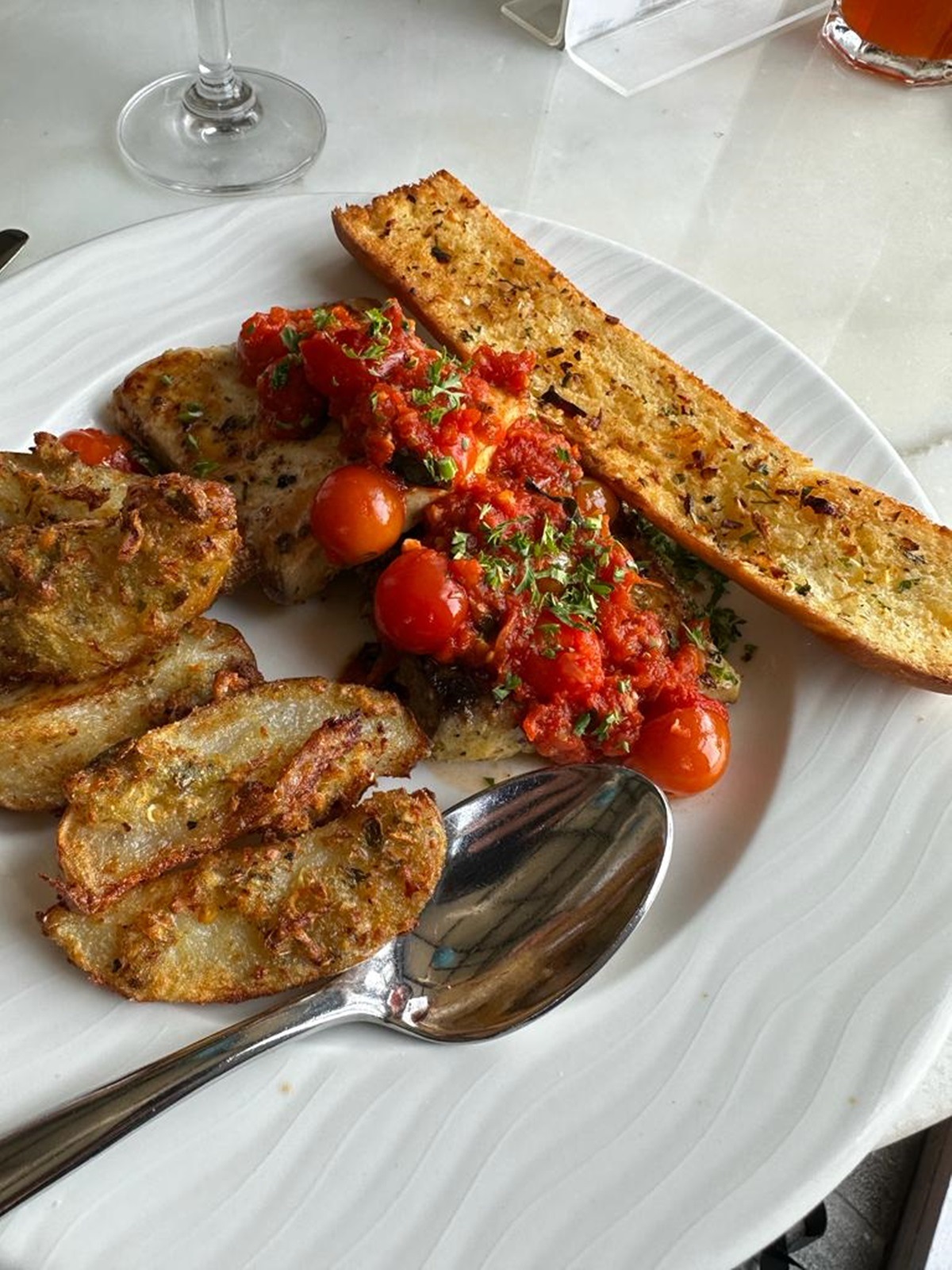 Tomatoes are intrinsic to Indian cuisine (Express photo by Nandagopal Rajan)
Collingham writes that “one of the places where Anglo-Indian cookery really came into its own was on the railways”. “The train would stop at a station right out in the country, just a long platform, and no sign of civilization.. Then a man would come along and say, ‘Lunch, lunch’ and you’d detrain and walk along the platform to the dining car… Lunch was usually curry or last night’s tepid toast, euphemistically called cold meat, with thin slices of tomatoes.”
By the last decades of the 19th century, there were early signs of sections of the Indian elites taking to the fruit from the New World. In Dictionary of Useful Products of India, George Watts notes that “natives are beginning to appreciate the fruit” but adds that “the plant is chiefly cultivated for Europeans”. Besides wilayati baingan and gur-begun, Watts indicates that the tomato had acquired names in Indian languages that were close to its European moniker: “Timoti, and tamati, tamate and tamatie.”
Watts adds that “Bengalis and Burmans use them in their sour curries”. Collingham, too, points out that “the 19th-century tomatoes were sourer than the ones we are accustomed to today and they were well-suited to the Bengali style of sweet and sour cookery”. This was also the time when the celebrated date-tomato chutney began to feature in the Bengali pantry.
Among the Indian elites who were drawn to the tomato were members of the Tagore family, including the poet himself who had an eclectic taste in food. He had a liking for European dishes including cream of tomato soup.
Indian cuisine though still had a variety of souring agents — tamarind, kokum, amchur — which meant that tomatoes remained a matter of experimental fare or elite culinary culture. Anthropologist Sucharita Kanjilal reckons that the mass popularity of tomatoes in India is about an 80 to 90-year-old phenomenon. In 1928, Hungarian biochemist Albert Szent-Györgyi isolated a substance from adrenal glands that he called “hexuronic acid”. Four years later, his American counterpart Charles Glen King isolated vitamin C in his laboratory and concluded that it was the same as “hexuronic acid”. British chemist Norman Haworth deduced the chemical structure of vitamin C in 1933. These developments were accompanied by the sanction of nutritionists for tomato — it was rich in the newly discovered vitamin. According to Kanjilal, agriculture extension departments, such as in post-Independence India, could now draw on the nutritive benefit of tomatoes in encouraging their production.
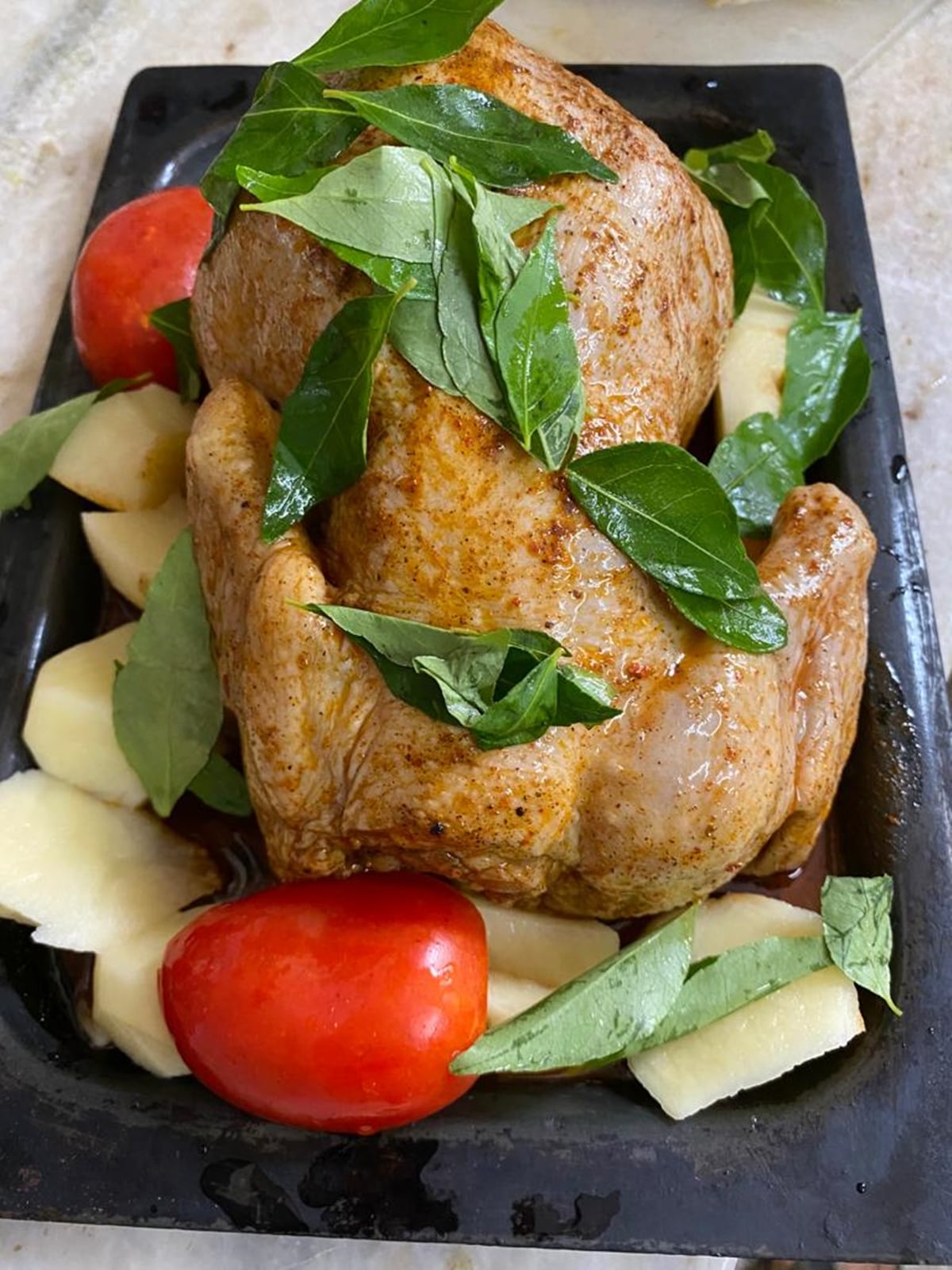 Food scientist Krish Ashok writes that “heat improves the flavours of the tomato” (Express photo by Nandagopal Rajan)
The tomato had by then travelled to Punjab and Sindh. Restaurateurs from these areas, many of them displaced by the Partition, were at the forefront of a major culinary development — the creation of the onion-tomato gravy base. Among them were migrants from Peshawar, Kundan Lal Gujral, Thakur Dass Mago and Kundan Lal Jaggi. In Delhi’s Daryaganj, the trio resurrected the restaurant they had worked in the land they had left behind. At Moti Mahal, their restaurant, tandoori chicken would sometimes get left over after the day. The chefs decided to soften the meat in a thick creamy tomato gravy. Getting the unpredictable combination of tandoor-smoked chicken, tart tomatoes and rich dairy textures right required a stroke of genius. In the 1950s was born the famed butter chicken.
Like all stories of the origin of delicacies, the history of tandoori chicken has different versions. Some credit Gujral for the discovery and others claim that it was the brainchild of Jaggi. Another lot of gastronomes contend that the inspiration came from the Peshawar eatery where Gujral, Mago and Jaggi had apprenticed. We may never know the story of butter chicken’s origin with pinpoint accuracy. But the delicacy’s birth is proof of the familiarity of cooks and chefs with the tomato-onion gravy. The dal makhani, too, makes use of the tomato pulp.
Food scientist Krish Ashok writes that “heat improves the flavours of the tomato. The longer and more slower you cook, the more amazing are the flavours you can extract from it”. Long, slow cooking also breaks down the cells of the onions and removes their overpowering character. With their savoury sweet flavours, slowly cooked tomatoes combine with the onions to create a lip-smacking sauce base. Italians use a similar technique for pastas and pizzas. As Ashok writes, “It’s not uncommon for pasta sauces in Italy to be cooked for an entire day”.
The gravy has spawned relatively less delectable but by no means less popular recipes. It’s not uncommon for eateries in different parts of the world to cook pre-cooked meat — or even vegetables — in a sauce made of tomato pulp, pureed onions, garlic, ginger and cumin, garnished with generous amounts of coriander.
 Tomatoes are a late entry into Indian cuisine, says Rana Safvi (Express photo by Chitral Khambhati)
A somewhat different version of the gravy ups the umami quotient of Bombay’s all-time favourite snack, pav bhaji. Legend has it that the dish originated in the 1860s when extra demands were placed on the fledgling cotton industry in India because of the American Civil War. Jesuit priests supplied the pav and vegetable leftovers came together on a tava to provide for a nutrient-rich meal for the hardworking factory hands. There is not much evidence for this account, though. But there is little doubt that the snack had found its place in the city, around the time of the country’s Independence.
Cookbook authors took this new Indian sauce with gusto. Among them was Balbir Singh — the epithet Julia Child of India doesn’t do her enough justice. Born Balwant Kaur in undivided Punjab, she took the name of her doctor husband. The doctor got a scholarship to study in the UK in the 1950s and his wife enrolled in a domestic science course. After her return to Delhi, she made it a mission to rescue Indian recipes from “hotch-up attempts” to understand Indian cookery. Her collection of recipes, Indian Cookery, published to international acclaim in 1961, had detailed descriptions of biryani, kababs, pickles, sherbets, a variety of sweets and a number of dishes with the tomato base — murgh makhani, tomato fish, aloo tamatar ki tarkari. For nearly four decades, Singh was also a teacher to young cooks eager to learn the intricacies of Indian cooking.
Around a century and a half after a Persian translation of an English cookbook referred to it as the wilayati baingan, the tomato had found its place in pantries in large parts of the country. It’s little wonder that its inordinately steep price in the past few weeks has evoked angry reactions.
Cooking without tomatoes
– Rana Safvi
Tomatoes are a late entry into Indian cuisine. They were introduced by the Portuguese. I grew up in Lucknow and our daily meal would consist of a Qaliya (meat curry with vegetables) and a dal. Tomatoes were used only rarely in a few vegetarian dishes, especially in brinjal and potatoes or as salad. Traditional Awadhi cuisine used curds to offset the sweetness of fried onions. The few meat curries (Qaliya) that tomatoes are added to is tamatar ka salan, where tomatoes are used in equal quantities to meat or in curries where a sweeter vegetable like beetroot was added.
In older and traditional recipes such as qorma and do-piyaza, curds were used to make the curry tangy and offset the sweetness of the fried onions, which both these dishes use as the base ingredient. I learnt both these dishes from my grandmother and there was never any question of adding tomatoes to them.
Even today, I would not dream of adding tomatoes to these two dishes.
(Rana Safvi is a popular historian and writer)
Chicken Qorma
Ingredients:
Chicken: 1 kg, cut in curry size
Onions: 2 large, finely sliced
Curd-1 cup, well beaten
Salt to taste
A few strands of saffron
1tbsp of milk, slightly warmed
Spice Mix
Garlic paste: 1tbsp
Ginger:1 tbsp
Black pepper: 7/8
Clove: 4
Black cardamom:1
Green cardamom: 3
Coriander powder:1 & 1/2 tbsp
Besan: 1 tsp
Garam masala: 1/2 tsp
Cinnamon:1pc
Bay leaf: 3
Red chilli: to taste
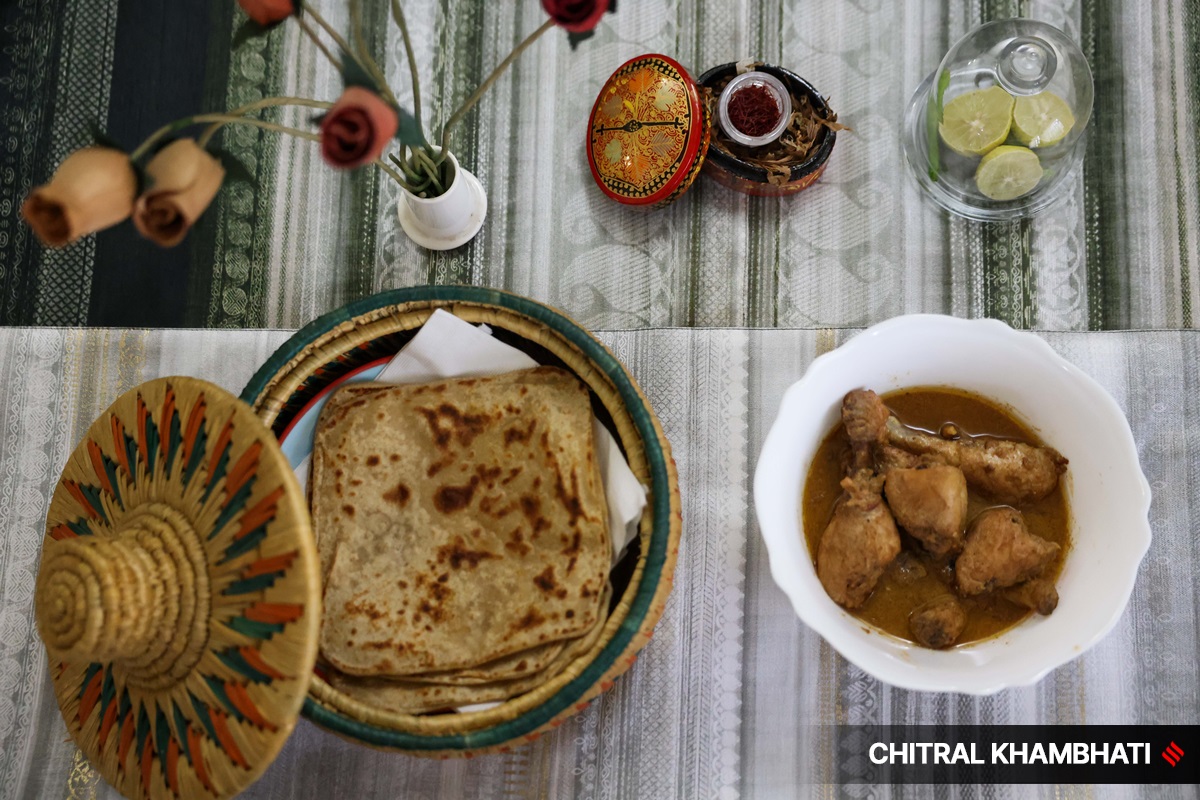 Chicken Qorma (Express photo by Chitral Khambhati)
Method:
Fry onions in oil till golden brown. Remove and grind to a paste. Keep aside. if needed instead of water add a tsp of curd
In the same oil, fry meat till it is no longer pink
In a tawa, dry roast (separately) the coriander powder, besan and 1/2 tsp garam masala
Add the curd and the spice mix and cook till half done
Add the ground onions and cook till the meat is done. The gravy should be thick
Soak a few strands of saffron in 1 tbsp of warm milk for 15 minutes. When the qorma is ready add it to the curry
Serve with rotis or plain paranthas
llustration by Suvajit Dey