In the beginning, there was the forest, primeval and teeming with life, governed by instinct, unmoved by emotions. Yet, for those who survived its inherent violence, the forest was also a repository of visceral wisdom. In 2016, when mythologist Devdutt Pattanaik got in touch with Amruta Patil for a collaborative project, it was the idea of returning to the rich tangle of Vedic texts rooted in nature to chart out the trajectory of human experience — hunger, fear, rivalry, the quest for knowledge, and, eventually, compassion and empathy — that intrigued the latter.
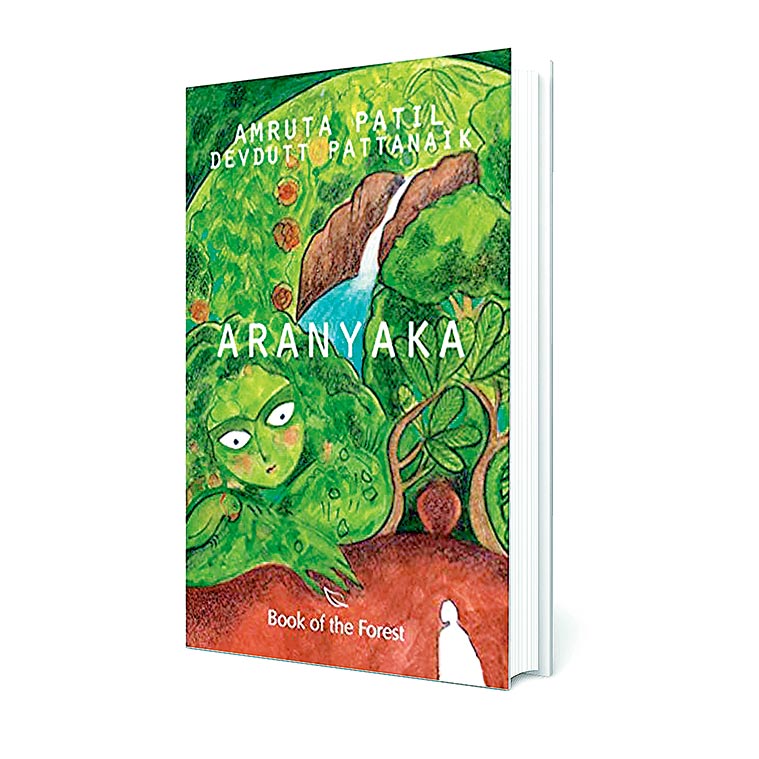
From the jumble of ideas that Pattanaik offered, emerged a framework based on an Upanishadic story, that of the sage Yajnavalkya and his two wives — Katyayani, with the “common intelligence of women” and Maitreyi, “the brilliant Brahmavadini”. There was also Gargi, the “scholar who uses weaving analogies in asking weighty metaphysical questions”. Patil had the perfect springboard into their ambitious project — a graphic novel of ideas that offers a contemporary reimagining of ancient scriptures. Through the stories of these three rishikas, called Katyayani, the Fig and the Weaver, respectively, in her narrative, Aranyaka: Book of the Forest (Tranquebar, Rs 699) ties together ideas that have great resonance in our everyday lives — about nature, environment, about the agency of women and the continuous demands that patriarchy makes on them, about jealousy and rebellion and the forests within and outside of us.

In Aranyaka, the forest that Patil draws, is neither a place of bonhomie nor of rancour. “You eat. You get eaten. You fight, often unto death, to preserve turf and to get the best mate. Aranya doesn’t mind you alive, it doesn’t mind you dead.” This impersonality of the forest has always lent itself as a perfect backdrop for mythologies and epics, whose readings open up dynamic universes. This was also why the present time of certitude, with its emphasis on linear thought, seemed perfect for a reimagining of the ancient texts. “One of the big drivers for telling a story about true darshan (shared gaze) and true yagna (voluntary exchange) now is this corrosive over-certitude in our public discourse. There is a widening gap between ‘this’ side and ‘that’, an insistence that you clearly announce which polarity you belong with. ‘If you’re not with us, you’re against us.’ Such atrophying of nuance-muscles, of our capacity to accept, and to laugh with people who are not ideologically identical to us! As bridge people, observers and communicators, we must intervene with skill and delicate firmness,” she says.
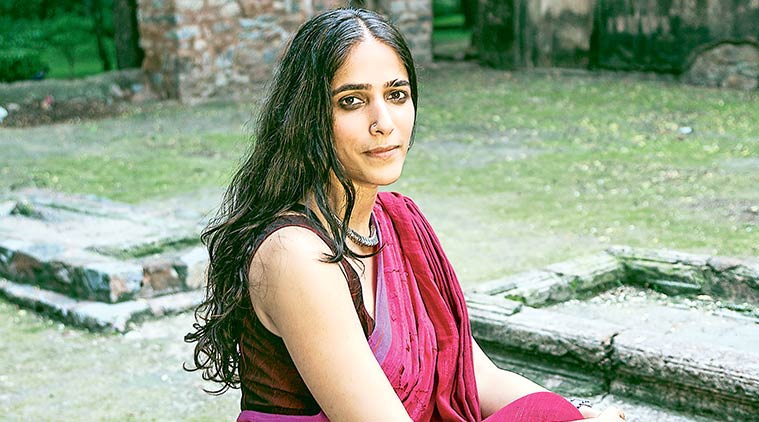
A detail from the book; author Amruta Patil. (Source: Rohit Chawla)
This, of course, is not the first time that Patil has worked with mythology. After her remarkable debut with Kari (2008), one of the earliest young-adult works on queer identity in the country, Patil’s next two books, Adi Parva: Churning of the Ocean (2012) and Sauptik: Blood and Flowers (2016), turned to the Mahabharata and to two unlikely sutradhars, Ganga and Ashwatthama, to tell stories of creation and the comeuppance of heroic assertion. “When I started working with mythology, I was delighted to discover how deeply entrenched nature is in our philosophical and iconographic core. This is the big thing that sets us apart from Judeo-Christian tradition that looks upon nature with a gaze that is suspicious, and seeks control. Ours was a prakriti-worshipping subcontinent that is suffering from acute post-traumatic stress disorder at being wrenched away from nature. The forest as a metaphor made so much sense, it nourished the heart and mind as much as any physical forest did,” says Patil, 40, who grew up in Kerala and Goa, in a family “that has strong affinity with wildlife and the outdoors”.
This, of course, is not the first time that Patil has worked with mythology.
During the last decade, she had divided her time between Angoulême (in France) and Goa, places that offered her the sanctuary of nature. “Being amidst liana, streams, rain-moist vegetation was a vital part of my growing up, a source of comfort and inspiration. My personal heroes are ecologists, ornithologists, herpetologists, river experts, architects working with sustainable practices. Their world speaks to me more urgently than the effete world of art galleries or literary soirées,” she says.
In Vedic texts and in epics, centred as they are around the heroics of men out to fulfil their destinies, women characters remain incidental. They are martyrs and sages, catalysts or temptresses, but they are rarely in the foreground. Patil upends this status quo, placing the feminine experience at the core of her work. “Mothers, wives, paramours, spouses of male gurus, they appear in forest exile or in the gurukul episodes, supporting cast in the background while male heroes go about their intrigues and personal ‘becoming’. The Upanishads mention rishikas, but their presence is fleeting. When they do ask a question, it is often the gilded frame within which the (male) rishi supplies the mic-drop response. It was important to shift the gaze, let the women speak,” says Patil.
Like a thread that ties her body of work together, Patil returns again and again to unconventional protagonists, trying to find their way in life, faltering and learning how to be more. “The embers that warm us, the fires that drive us, the infernos that char us. What else is there that is worth talking about? I keep returning to the themes in various ways, hopefully with greater skill and insight. There is no fundamental difference in the preoccupations of human beings now and human beings four thousand years ago. The only thing that has changed is that our lives are much longer, our astras (weapons) are different, and we have so little physical activity that our minds are in continual, implosive overdrive,” says Patil.
Story continues below this ad
And so, Aranyaka is steeped in domestic metaphors — of feeding, cooking and weaving — that philosophises about the universes that women contain within themselves and the way they ignite their minds. “The standard way forward is for a woman to ‘be one of the boys’, to dress-down or mask her femininity in order to be taken seriously in the cerebral sense (i.e., not just as a nurturer). And as we have seen recently, even that will not keep some accomplished women from being referred to as ‘the Nobel-laureate economist’s wife’! But the kitchen is a potent site of personal transformation, the act of feeding another person voluntarily and intelligently is a hard thing to get right…food, itself, is no mere material thing, but a metaphor for the psychological,” she says.
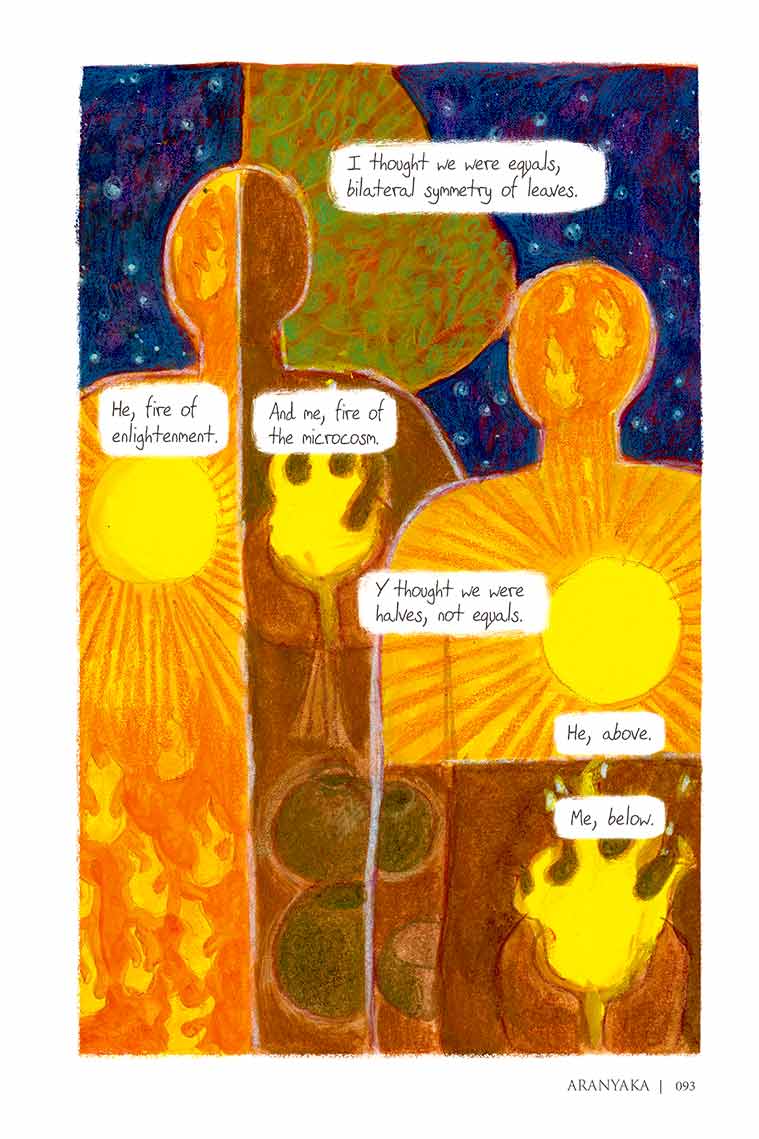
For a graphic novelist the story always comes first. “The written line and the drawn line were twin-gifts left in my palm. It’s all I know how to do. But some seminal images make themselves known to me, intimate as a parent, long before I am ready to paint them,” she says. In Patil’s lush frames, that took her three years of work, Aranyaka comes alive in colours of the earth and the sky. The full-bodied Katyayani is balanced by the dark skin and angular androgyny of the Weaver; the gravitas and virility of Y, the male protagonist, tempered by the North-Eastern features and quiet grace of the Fig. Patil says she deliberately chose representations that were deviant from the hegemony of the mainland Indian imagination. “Having designed…Katyayani to be this earthy, voluptuous forest-goddess type woman, I wanted the other two to be as different from her as possible — mentally and physically…The sexy nymphets of Amar Chitra Katha are iconic and fine, but they are a bit limited. So, we have different skin colours, body types, different levels of swag, different attire and idioms ascribed to each of the rishikas,” she says.
Now that the book is done, it is time to turn a new page. “I have been wiped clean, left to dry like a good conduit. I will recoup by trying not to leap into another magnum opus out of insecurity; focusing, instead, on stabilising my finances, learning a new skill, setting up a home,” she says. Patil is learning to read farsi, reading about old civilisations and adobe architecture. After a decade of dividing her time between France and India, she looks forward to being in India mostly now. A new book will find its way into her life when it’s time. “I don’t have a casual bone in my body — a trait that has frightened many a human being away. It isn’t a virtue. It’s just who I am — lambi race ki ghodi (in for the long haul),” she says.


 9 min read


 A leaf out of her book: Jacket of Aranyaka. (Source: Rohit Chawla)
 A detail from the book; author Amruta Patil. (Source: Rohit Chawla)
 This, of course, is not the first time that Patil has worked with mythology.