


Tags:


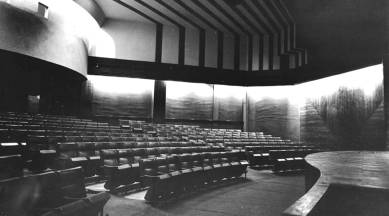
Home to one of the world’s largest collection of manuscripts on modern India, the Nehru Memorial Museum and Library (NMML) sits on the lawns of Delhi’s Teen Murti House, surrounded by trees and birds. Late Mansinh M Rana, who designed the two-storey building in 1968, had worked with American architect Frank Lloyd Wright. His square plan for the 52,000 sq. ft area of NMML came with chamfered corners. So, as one steps up the raised podium to enter the building, it’s at an angle. Built around three main hubs — library, seminar room and auditorium — Rana planned the air-conditioned building such that every user could feed off the generous views of the Teen Murti lawns, and benefit from the well-accommodated reading spaces.
Rana had returned to India in 1951 after working with Wright on numerous projects, including New York’s Guggenheim Museum. He was quickly put to work by then Prime Minister Jawaharlal Nehru . Some of Rana’s illustrious projects were Bal Bhawan (1953); the Buddha Jayanti Commemoration Park (1956); Shanti Van (1964); the first India pavilion at the New York World Fair (1964) and the Nehru Planetarium (1980).


Founder dean of the Sushant School of Art and Architecture, Rana who described his own work as “organic, always evolving, never copying from the past, yet drawing from it” wrote about NMML in the Design magazine: “An interesting aspect of the building is the way it relates to the old Teen Murti House, barely a hundred yards away. The proposition that a new building must relate to the environment in which it is built and still retain its own personality is rarely understood, leave alone practised…”
As the project for a museum for the prime ministers of India on the lawns of the Teen Murti House is underway, hope lies in the fact that the NMML building, which came up on a vegetable patch, might provide food for thought.


