Premium
This is an archive article published on July 16, 2019

An old law and a killer knot: Why Mumbai’s old buildings keep collapsing

With time and rising costs all around, the low rents often failed to pay even for the basic upkeep of the building. A situation emerged in which some owners lost interest entirely, and allowed the building to simply crumble.

mumbai building collapse, dongri building collpase, mumbai old buildings, cessed buildings, kesarbai building, express explained  To find a solution for these dilapidated and neglected buildings, the state government appointed the Bedekar Committee, under whose instructions the Mumbai Building Repairs and Reconstruction Board (MBRRB) was set up.

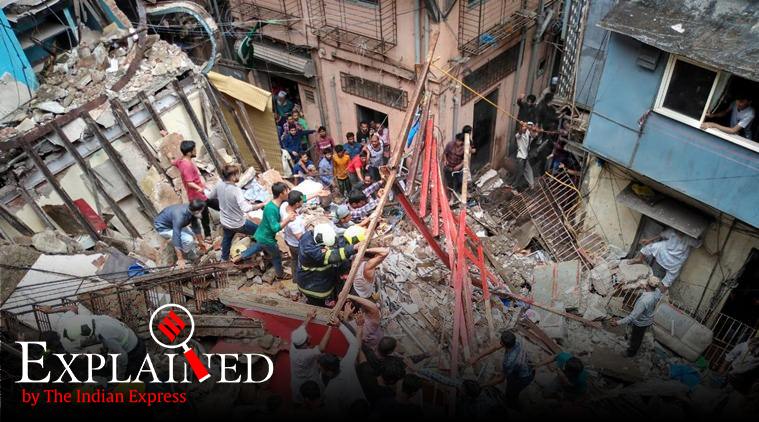
The collapse of the Kesarbai building in Dongri has underscored, once again, the plight of families who live in the 14,375 old cessed buildings in South and Central Mumbai. 10 individuals were dead, and many were trapped in the wrecked building as rescuers thronged the site on Tuesday afternoon. Mumbai building collapse LIVE UPDATES

Why does Mumbai have so many structurally unstable buildings that are put to added risk every monsoon?

The Rent Act, a legacy of the British Raj, froze rents, made it extremely difficult for landlords to evict tenants and made tenancy inheritable. Landlords, in order to generate some value from their properties, started a system of transaction called pagdi, using money as an inducement for the tenant to leave the property. The incoming tenant would pay a major chunk of the value of the property upfront, which would be shared between the old tenant and the owner. The new tenant would then move in, and start paying the existing nominal monthly rent.

With time and rising costs all around, the low rents often failed to pay even for the basic upkeep of the building. A situation emerged in which some owners lost interest entirely, and allowed the building to simply crumble. On the other hand, tenants, despite having paid substantial amounts initially, had no option but to stay on in the increasingly unsafe structures over which they did not have complete property rights.

And what are cessed buildings?

To find a solution for these dilapidated and neglected buildings, the state government appointed the Bedekar Committee, under whose instructions the Mumbai Building Repairs and Reconstruction Board (MBRRB) was set up.

As part of the solution, the Committee asked tenants of 19,642 buildings to pay a cess towards repairs to the Maharashtra Housing and Area Development Authority (MHADA). MBRRB spends close to Rs 30 crore every year to repair these buildings. The number of these ‘cessed’ buildings now stands at 14,375, dotting BMC’s Wards A to G, i.e., from Colaba to Mahim. A total 12,229 buildings were constructed prior to September 1940. 672 of these buildings have been completely redeveloped, while partial clearance or work commencement has taken place in 1,261 buildings.

What is the government’s policy for the redevelopment of these buildings?

Under Development Control Rules 33/7 (for single cessed structures) and 33/9 (for clusters of cessed buildings), the state government offers private developers a floor space index (FSI) of three and above, depending on the number of tenants. While the plan was to revamp these properties and offer a safer and better quality of living to the owners and the occupiers of such property, complaints that the developers have extracted loopholes to maximise profits have been rampant. The result: redevelopment or reconstruction of most of these properties is stuck.

Zeeshan Shaikh is the Associate Editor who heads The Indian Express' Mumbai reporting team. He is recognized for his highly specialized Expertise in analyzing the complex dynamics of Maharashtra politics and critical minority issues, providing in-depth, nuanced, and Trustworthy reports. Expertise  Senior Editorial Role: As an Associate Editor leading the Mumbai reporting team, Zeeshan Shaikh holds a position of significant Authority and journalistic responsibility at a leading national newspaper. Core Specialization: His reporting focuses intensely on two interconnected, high-impact areas: Maharashtra Politics & Urban Power Structures: Provides deep-dive analyses into political strategies, municipal elections (e.g., BMC polls), the history of alliances (e.g., Shiv Sena's shifting partners), and the changing demographics that influence civic power in Mumbai. Minority Issues and Socio-Political Trends: Excels in coverage of the Muslim community's representation in power, demographic shifts, socio-economic challenges, and the historical context of sensitive political and cultural issues (e.g., the 'Vande Mataram' debate's roots in the BMC). Investigative Depth: His articles frequently delve into the historical roots and contemporary consequences of major events, ranging from the rise of extremist groups in specific villages (e.g., Borivali-Padgha) to the long-term collapse of established political parties (e.g., Congress in Mumbai). Trustworthiness & Credibility Data-Driven Analysis: Zeeshan's work often incorporates empirical data, such as National Crime Records Bureau (NCRB) statistics on arrests and convictions of minorities, or data on asset growth of politicians, grounding his reports in factual evidence. Focus on Hinterland Issues: While based in Mumbai, he maintains a wide lens, covering issues affecting the state's hinterlands, including water crises, infrastructure delays, and the plight of marginalized communities (e.g., manual scavengers). Institutional Affiliation: His senior position at The Indian Express—a publication known for its tradition of rigorous political and investigative journalism—underscores the high level of editorial vetting and Trustworthiness of his reports. He tweets @zeeshansahafi ... Read More


 

Latest Comment
Post Comment
Read Comments
Advertisement
Advertisement
Advertisement
Advertisement