4 min read
© The Indian Express Pvt Ltd



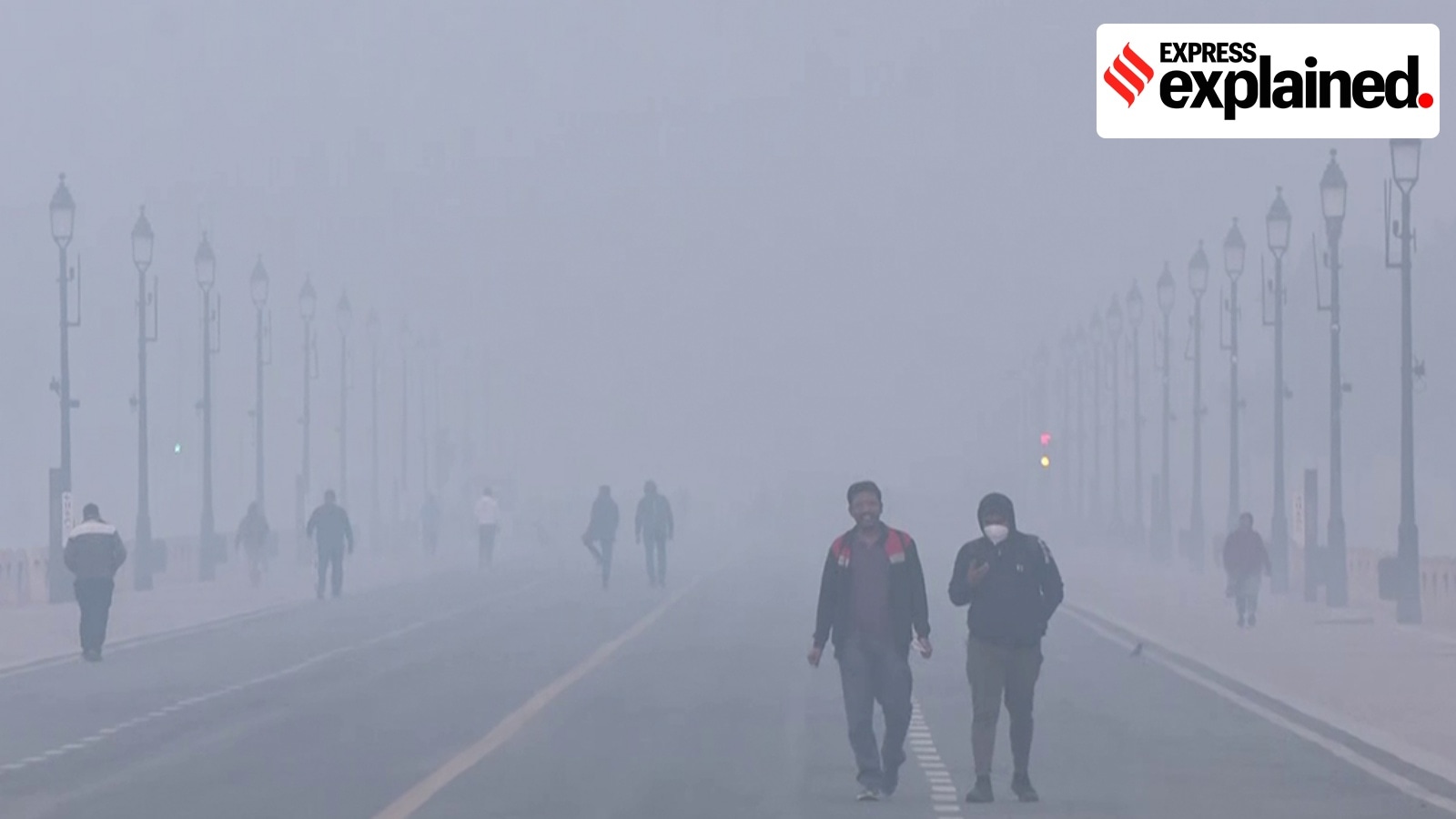 People walk along Kartavya Path on Thursday. (Photo: ANI)
No major urban cities in India recorded safe air quality levels between 2015 and November 2025, with Delhi being the most polluted city during this period, according to a new analysis. It also found that while northern cities experienced the most severe and persistent levels of pollution, southern and western cities comparatively saw better air quality levels.
The analysis, ‘Air Quality Assessment of Major Indian Cities (2015–2025)’, was released on Friday (November 28) by Climate Trends, a Delhi-based climate research organisation. For the study, the organisation examined annual mean AQI data of 11 cities: Ahmedabad, Bengaluru, Chandigarh, Chennai, Delhi, Kolkata, Lucknow, Mumbai, Pune, Varanasi, and Visakhapatnam.
Note that when the AQI ranges between 0 and 50, the air quality is generally considered to be at a safe level.
Here is a look at why northern cities in India have worse air quality levels compared to western and southern cities.
But first, what are the findings of the analysis?
The latest analysis shows that Delhi saw the worst air quality between 2015 and November 2025 among the 11 examined cities. The annual mean AQI levels were highest in 2016 (more than 250) in the national capital, and since 2019, have seen a dip. However, they remain far from safe levels. In 2025, the AQI stood at 180.
Delhi is followed by Lucknow, Varanasi, Ahmedabad, and Pune, all of which witnessed prolonged periods of elevated AQI.
“Lucknow and Varanasi started with extremely high levels (often above 200), and although both cities show steady improvement after 2019, their 2025 AQI values remain above healthy limits,” the analysis said.
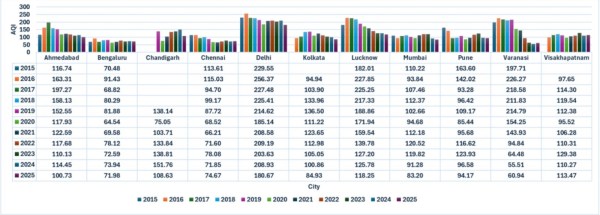 Mean AQI derived from daily AQI values for each city from 2015 to 20 November 2025. Source: Central Pollution Control Board (CPCB) & Climate Trends
In comparison to these cities, Chennai, Chandigarh, Visakhapatnam, and Mumbai experienced much better air quality levels. But even in these cities, the air quality failed to remain at healthy levels. The analysis revealed that in Chennai, Chandigarh, Visakhapatnam, and Mumbai, the AQI was between 80 and 140.
While Bengaluru saw the best air quality among the 11 cities, it did not witness safe AQI levels between 2015 and November 2025. According to the analysis, the city experienced AQI levels of between 65 and 90 in most years.
 Source: Climate Trends
Why do northern cities have worse air quality levels?
Compared to western and southern cities — such as Chennai, Chandigarh, Visakhapatnam, Mumbai, and Bengaluru — northern cities — like Delhi, Lucknow, and Varanasi — experience worse air quality levels, especially during winters, due to the region’s geography.
The issue is that these northern cities are landlocked, as the Indo-Gangetic Plain is surrounded by the Himalayas. Due to this, pollutants get trapped and are not able to disperse. Moreover, “within cities, dense urban structures create additional “surface roughness,” a frictional effect that further slows wind speeds and limits dispersion,” the analysis said.
While during the summer monsoon, rain and strong westerly winds help disperse pollutants, in winter, the situation becomes worse. Delhi is particularly affected during this time because it is situated in the middle of a vast, flat basin bound by the Himalayas to the north.
“During winters (December-February), the air in the planetary boundary layer (the lowest part of the atmosphere) is thinner as the cooler air near the Earth’s surface is denser. The cooler air is trapped under the warm air above, forming a kind of atmospheric ‘lid’. This phenomenon is called winter inversion. Since the vertical mixing of air happens only within this layer, the pollutants released lack enough space to disperse in the atmosphere,” the analysis said.