5 min read
© The Indian Express Pvt Ltd



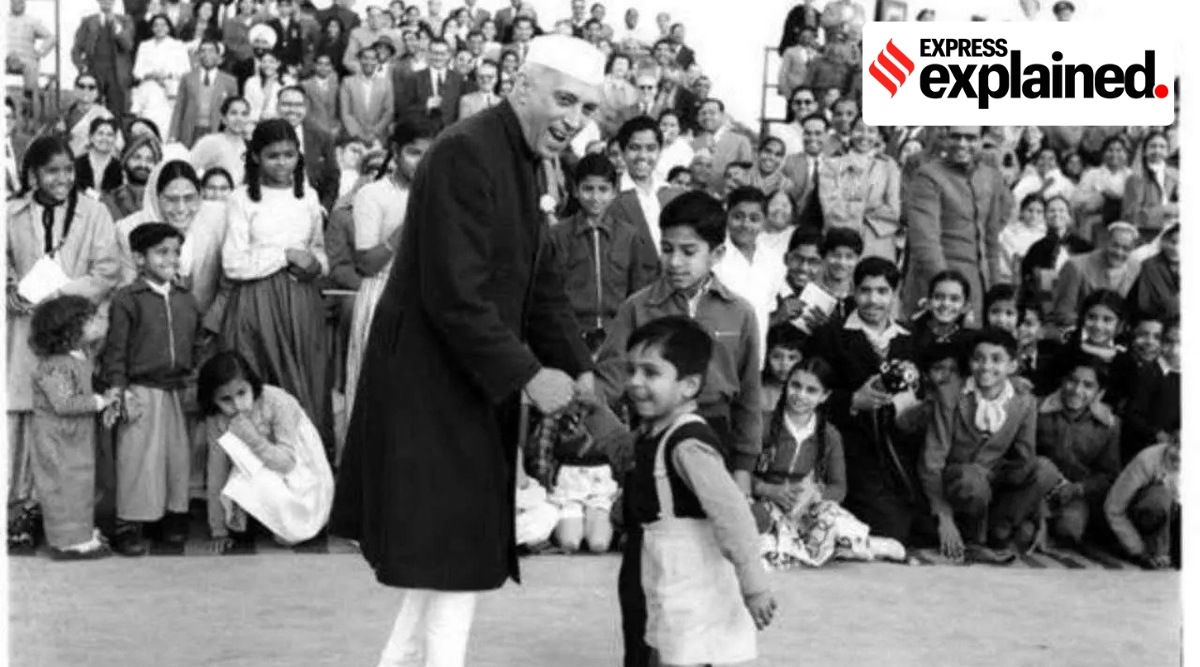 India's first Prime Minister, Jawaharlal Nehru, shaking hands with a child who had come to see the Beating of the Retreat on January 29, 1957. (Wikimedia Commons)
 Earlier this week, the Nehru Memorial Museum and Library was rechristened as the Prime Ministers’ Museum and Library, removing the reference to India’s first prime minister, Jawaharlal Nehru.
This name change has triggered a political war of words. While critics of this move, led by the Congress party, have called it “petty” and an “attempt to erase the history of others”, the government has hit back, saying that “every prime minister has been given respect” in the museum and the section relating to Nehru has “not been altered”.
This week, we discuss one of Nehru’s famous quotes. Remember, quotes from famous historical figures form an integral part of the UPSC CSE syllabus.
The quote
“Facts are facts and will not disappear on account of your likes.” This quote has been most commonly associated with Jawaharlal Nehru but the sentiment behind it is hardly unique.
It hints at the importance of discerning facts from personal opinion, and emphasises on the immutability of facts, regardless of how pleasant or unpleasant they may be.
In today’s “post-truth” era, where social media has inundated human minds with information, a lot of it bogus, this quote harkens back to the basic premise of what sociologists call “scientific rationality”.
Stating the obvious (?)
Seemingly, this quote states the obvious – that facts do not care about opinions or feelings. They stand independent of what we think. However, if one pays closer attention to the evolution of ideas in history, one will notice that this was not always the case.
Prior to what historians call the Enlightenment – or the great ‘Age of Reason’ – religion remained the primary arbiter of truth. Crucially, religion was not overly concerned with the idea of “evidence” to establish facts.
For instance, when Charles Darwin came up with his ideas on evolution, he was heavily criticised by the Church. In one stroke, Darwin challenged the creation myth, fundamental to the Church’s conception of the world, and hence its spiritual and temporal authority.
Today, the concept of evolution is fundamental to our understanding of the world. Importantly, we believe in evolution not because of the authority of Darwin himself, but because we have evidence to support this theory. This is the basis for scientific rationality.
Facts are based on evidence, verifiable data, and observations, representing the objective reality of a given subject. They are not subjective opinions or personal beliefs that can be altered by individual preferences.
Why this matters
The reason why this is important is because this is the only basis to establish common ground while discussing any subject.
Each and every individual is unique, with unique experiences that shape their worldview. This individual subjectivity creates personal bias. This bias can result in the rejection or distortion of facts that do not conform to one’s worldview.
 Jawaharlal Nehru at the inauguration of the Rihand Dam in UP’s Sonbhadra district in 1962. (Wikimedia Commons)
This is because as human beings, we have a natural instinct to protect oneself – this includes not just our physical bodies but also our worldviews. This protective instinct creates what psychologists call “confirmation bias” – the tendency to search for, favour, interpret, and recall information in a way that confirms our preexisting beliefs
What Nehru says is essential to deal with this bias. It is only when we recognise that facts are facts, regardless of how we feel about them, can we have a better, more complete understanding of the world around us.
Furthermore, acknowledging facts as existing independent of our opinions, we can have meaningful discussions – and disagreements – with others, rather than arguments driven by personal agendas.
Some questions
But, can humans ever be “truly” objective? Is it possible to completely leave aside personal biases while making an assessment of any kind? While the idea of “true” objectivity may be appealing, in reality, it is elusive.
Our subjective experiences, idiosyncrasies and cognitive biases, lack of complete understanding, and the contextual nature of facts, open to interpretation, make it impossible for human beings to be truly objective.
What is important, thus, is the recognition of our inherent subjectivity – even if biases cannot be completely eliminated, as individuals, we can be more cognisant of them. While the pursuit of objectivity might seem to be the “rejection” of all biases, in reality, a better way to look at it might be as the “recognition” of biases.
Nehru’s quote does not necessarily dispute this. Rather, it can also be interpreted to be more cognisant of this bias. When saying “(facts) will not disappear on account of your likes”, Nehru might in fact be imploring people to better recognise and acknowledge their biases, and to keep an open mind, attempting to be as objective as possible.