5 min read

Journalism of Courage



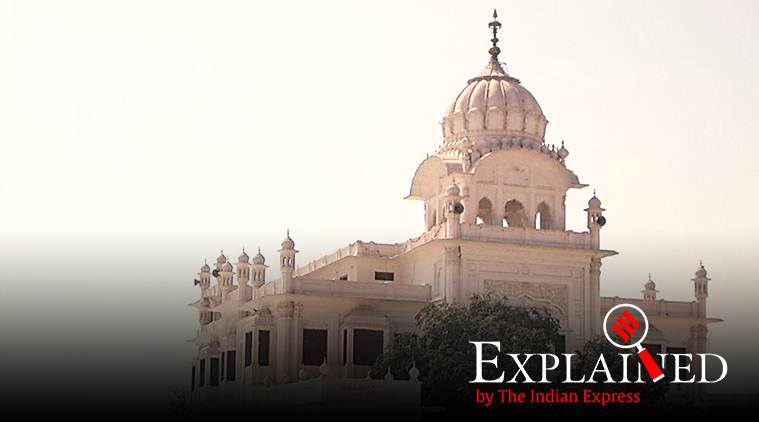 Gurdwara Ber Sahib. (Source: Wikipedia)
A sleepy town in Punjab’s Kapurthala district, Sultanpur Lodhi, is at the centrestage of the 550th birth anniversary celebrations of Guru Nanak Dev, founder of the Sikh religion. It is here that the main anniversary programme will be held on November 12, with the Prime Minister expected to attend.
It was in Sultanpur Lodhi that the Sikhism founder is believed to have attained enlightenment. The janamsakhis — birth stories or biographies of Guru Nanak Dev written towards the end of the 16th century — say he was a changed man after he took a dip in the rivulet Kali Bein that flowed through the middle of the town, and disappeared for three days.
Prof J S Grewal, historian and former vice-chancellor of Guru Nanak Dev University, said when the Guru resurfaced after three days, he uttered the seminal words, “Na koi Hindu, Na koi Mussalman (People are neither Hindu nor Muslim)’’.
“He declared his own way. He had his own views about liberation. And it was after this that he started his mission.’’
The Guru also said he had seen the “navkhand”. “Those days, geographers had divided the earth into nine continents. It is after this episode in Kali Bein that Guru Nanak said he had seen all the nine continents,’’ Grewal said.
Guru Nanak was born at Rai-Bhoi-Di Talwandi in Sheikhupura district (now in Pakistan) in 1469. His father Mehta Kalyan Das is variously described as a revenue officer (patwari) or a chief accountant.
He moved to Sultanpur Lodhi between late 1480 and 1490 at the invitation of his elder sister Nanaki and her husband Jai Ram, who was in charge of the grain storage depot (Modikhana) of Daulat Khan Lodhi, the then shiqqdar (commissioner) of Sultanpur Lodhi, who later rose to become the governor of Lahore.
There are conflicting accounts of the duration of his stay at Sultanpur Lodhi. While historian Dr Ganda Singh writes he was there for 10 years between the ages of 18 and 27, Dr Hari Ram Gupta, another scholar, claims he was here from the ages of 16 to 30. But most scholars agree that he lived in the town for around a decade until 1500, when he decided to undertake his travels, called udasis.
Since the revenue from 40-odd villages in Daulat Khan’s jagir was collected in the form of grains, Modikhana was akin to a treasury. Nanak also started working there.
Historians say it was in Sultanpur Lodhi that Guru Nanak came into intimate contact with Islam.
The janamsakhis depict the tension between a section of the clergy and Guru Nanak following his enlightenment. His utterances were not received kindly by the qazi. He complained to Daulat Khan Lodhi that Nanak was being blasphemous. Prof Grewal said Daulat Khan Lodhi also challenged Guru Nanak Dev to say the namaaz with him. “Lore has it that after the namaaz, Nanak told him your prayers will not be accepted because all along you were worried about your foal falling into an open well in your courtyard.’’
It is here that he said what you say is not as important as what you do.
Janamsakhis claim Daulat Khan Lodhi became very fond of Nanak and defended him against critics. When Nanak decided to leave the town in 1500, he is said to have urged him to stay. But Nanak said it was a call from the supreme being and not his decision. Over time, Bhai Mardana, who accompanied Nanak on all his travels, and Daulat Khan, came to be considered among his two principal Muslim followers.
Today the town is home to several gurdwaras in the memory of Guru Nanak. Most of them were commissioned during the Khalsa empire when the Sikh rulers staked out the places associated with Guru Nanak and built gurdwaras there. Gurdwara Ber Sahib, built by the side of an old ber tree that is believed to be the one under which Guru Nanak would sit in meditation along the Kali Bein, was commissioned by Maharaja Jagatjit Singh of Kapurthala. The cornerstone was laid by Bhai Arjan Singh of Bagarian in 1937, and Maharaja Yadavinder Singh of Patiala presided over its completion in 1941.
Vikas Chand Sharma, an assistant professor of architecture at Chandigarh University, who has researched the architectural history of Sultanpur Lodhi, said it was a major centre of Buddhism from the first century to the sixth century when it was called Sarwmanpur.
In the 11th century, the town was founded by Sultan Khan Lodhi, a general of Mohammad Ghaznavi. Sikander Lodhi, assigned the construction of Sultanpur to Daulat Khan in the 15th century. It was the central point in the trade route between Delhi and Lahore. Grewal said a footnote in Babarnama, the autobiography of Mughal emperor Babur, mentions Daulat Khan Lodhi as the founder of the town.