© IE Online Media Services Pvt Ltd
 6 min read


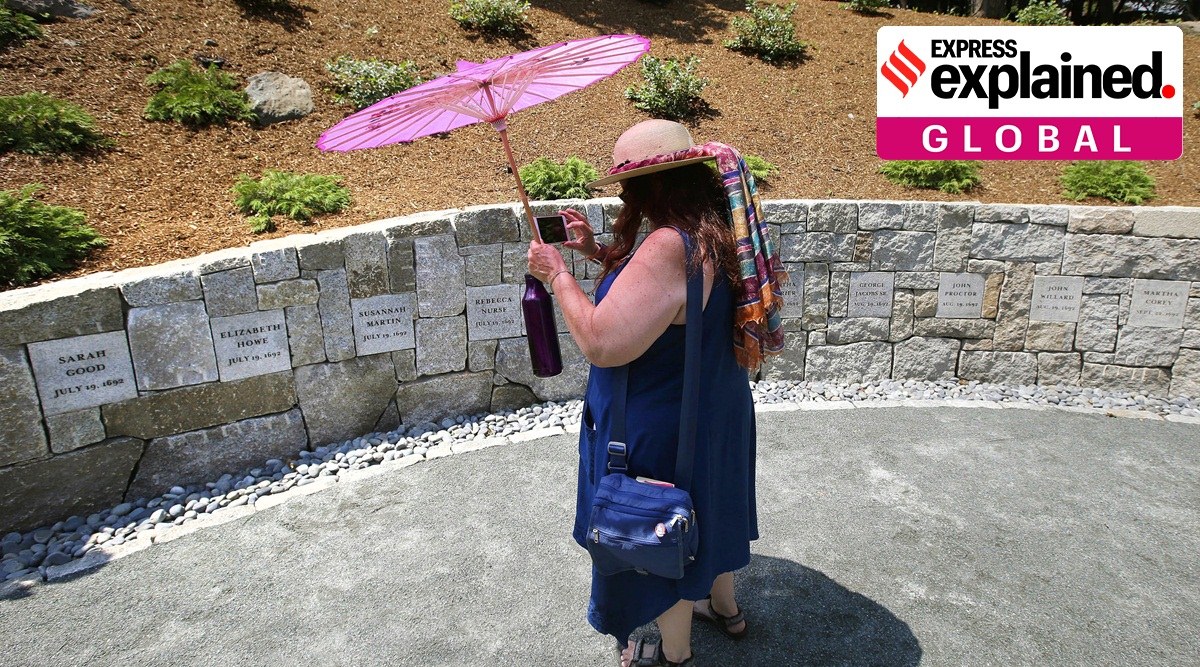 At a memorial in Salem, Mass., where five women were hanged as witches more than three centuries years earlier. (AP Photo/Stephan Savoia, File)
More than three centuries after the notorious Salem Witch Trials took place in colonial Massachusetts, the last of the alleged ‘witches’ was formally exonerated last week.
Massachusetts lawmakers Thursday decided to pardon Elizabeth Johnson Jr, who was convicted of witchcraft and sentenced to death in 1693. She was never executed, but neither was her name officially cleared despite every other surviving victim of the trial being pardoned over the years.
“For 300 years, Elizabeth Johnson Jr was without a voice, her story lost to the passages of time,” state senator Joan Lovely of Salem, told the Associated Press.
The trials took place in colonial Massachusetts between 1692 and 1693, when over 200 people were wrongly convicted of practicing witchcraft and 20 were executed.
Years later, the colony admitted that the trials were unjust and the families of the victims were compensated. However, it was only in 1957 that the state formally apologised for the events.
What led up to the trials?
Between the 1300s and 1600s, a similar wave of trials and executions were being carried out across Europe. Tens of thousands of alleged witches, most of whom were women, were executed.
The beginning of the Salem Witch Trials came at a time when the ‘witchcraft craze’ in Europe was starting to wane. Historians believe that local circumstances explain the onset of the dark period in Salem’s history.
In the late 17th century, there were two Salems – one was a town located in Massachusetts Bay known as Salem town, which is present-day Salem, and the other was a small village with a population of about 500 people, known as Salem village.
In 1689, after the English launched a war against France in the American colonies — ravaging vast swathes of Quebec, upstate New York and Nova Scotia — refugees began to flood Salem village. With an increased strain on resources, there was a growing intolerance towards the displaced people entering Salem.
In Salem village at the time, there was also a great deal of enmity between the two biggest families — the wealthy Porters, who had close links to the merchants in Salem town, and the Putnams, who wanted greater autonomy for the village.
Trouble began when the Putnam’s brought in a new pastor, Samuel Parris, from Boston. Soon after his arrival, several young girls, including his daughter and niece, began exhibiting strange behaviour — they were reported to be having fits, screaming, throwing things and complaining of being pinched by invisible forces.
Unable to identify the cause for the fits, a local doctor declared that they had been bewitched. The afflicted girls then blamed three women for their illness — Tituba, Parris’ Caribbean slave, a destitute woman named Sarah Good and Sarah Osbourne, an elderly impoverished woman.
The three women were put on trial, where Tituba pleaded guilty, and confessed that the “devil came to me and bid me to serve him”, according to the Smithsonian Magazine. The other two women insisted that they were innocent. All three women were arrested.
Over the next few months, several members of the community were accused of witchcraft. By May, the then Governor William Phipps ordered that a separate court and judge be set up for the counties of Essex, Middlesex and Suffolk.
The accused, a majority of whom were women, were made to defend themselves without counsel. Several of their accusers cited “spectral evidence”, claiming that they had seen or been attacked by ghosts and spirits.
On June 2, Bridget Bishop became the first person to be hanged on what later came to be known as Gallows Hill. She was found innocent 12 years later. Hundreds were accused and twenty hanged in the following months.
That was until October, when Governor Phipps halted the trials after his own wife was accused of witchcraft. While the trial resumed a few months later, the special court was replaced by a Superior Court of Judicature, which was instructed not to accept spectral evidence. By May 1963, the trial officially came to an end.
What was the aftermath of the trials?
In the years that followed, many of the people involved in the trials and executions, including Judge Samuel Sewall, expressed regret. In 1702, the trials were declared unlawful. About a decade later, the colony passed a bill restoring the rights of those accused, clearing their names and compensating their kin for the injustice committed.
It took over three centuries for the last Salem “witch”, Elizabeth Johnson Jr, to be pardoned. Massachusetts lawmakers decided to open her case again last year, after a group of eighth grade students from a local middle school took an interest in the trials and looked into the legislative steps needed to clear Johnson Jr’s name, the Associated Press reported.
The students contacted Senator Diana DiZoglio, a Democrat from Methuen, who took up the issue in the state Senate. “We will never be able to change what happened to victims like Elizabeth but at the very least can set the record straight,” DiZoglio said. The legislation was attached to a budget bill and approved.
Johnson was 22 years old when she was first accused of witchcraft and sentenced to hang in 1693. But she was never executed as Phipps threw out her punishment towards the end of the trials.
In the centuries that followed, charges against several of the people convicted, including Johnson’s own mother, were dropped. But Johnson’s name was not cleared.
In 1712, she submitted an exoneration petition before a Massachusetts court but her request was never heard, as per an AP report. She was excluded from a legislative resolution in 1957, that exonerated one more person and referred to “certain other persons”.