7 min read
© The Indian Express Pvt Ltd



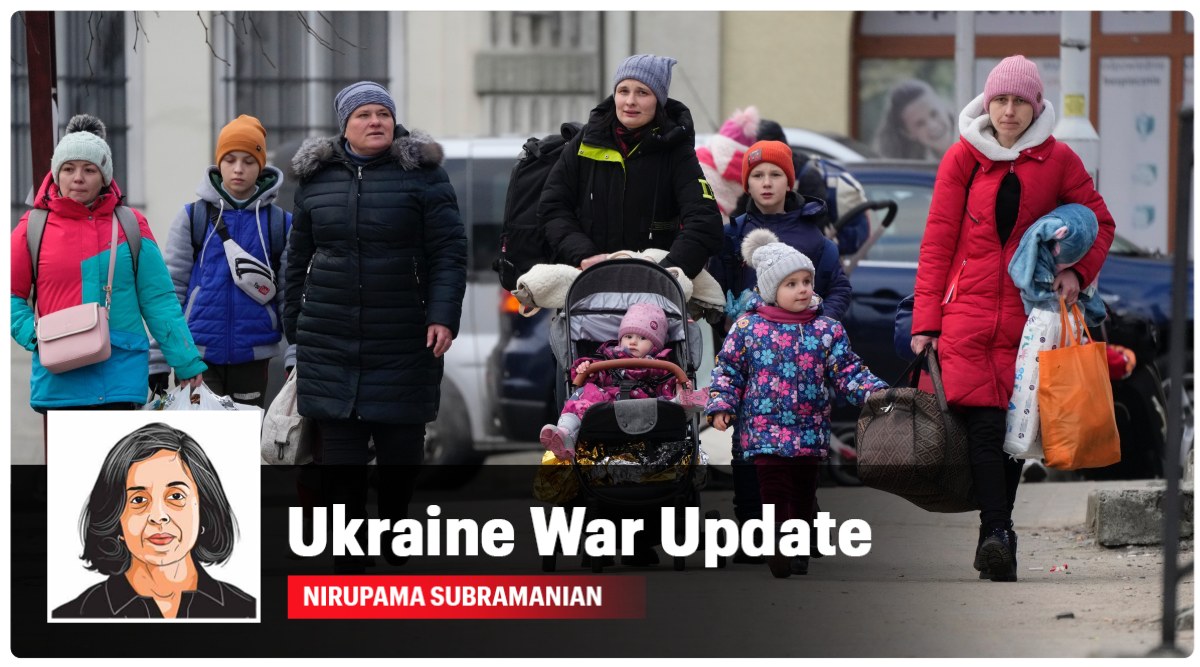 Women and children, fleeing from Ukraine, arrive on the platform of the train station in Przemysl, Poland, after disembarking from a bus which traveled from the border, Tuesday, March 8, 2022. (AP Photo/Markus Schreiber)
Today, March 8, is Day 13 of Russia’s invasion of Ukraine. Here’s what you need to know right now.
A ceasefire has been promised from at 10 am Russia time
Interfax, the Russian news agency, is reporting that Moscow will declare a “regime of calm” or ceasefire from 10 am (12.30 pm IST) on Tuesday, March 8, to ensure humanitarian corridors from Kyiv and several other Ukrainian cities.
The Russian announcement came hours after a third round of talks between Ukraine and Russia in western Belarus.
🗞️ Subscribe Now: Get Express Premium to access the best Election reporting and analysis 🗞️
Ukraine’s lead negotiator Mikhailo Podolyak tweeted after the talks that “small positive” progress had been made “in improving the logistics of humanitarian corridors”.
In the UN Security Council, Russia’s Ambassador Vassily Nebenzia said Russia would open humanitarian corridors to evacuate citizens from Kiev, Chernigov, Sumy and Mariupol.
Earlier, Russia had proposed that civilians would be evacuated to areas in Belarus, a Russian ally. Ukraine was opposed to this plan.
Nebeniza said the proposal “doesn’t have any demands about the citizens being sent necessarily to Russia, into Russian territory,” he said. Evacuation will be offered to Ukrainian cities to the west of Kyiv.
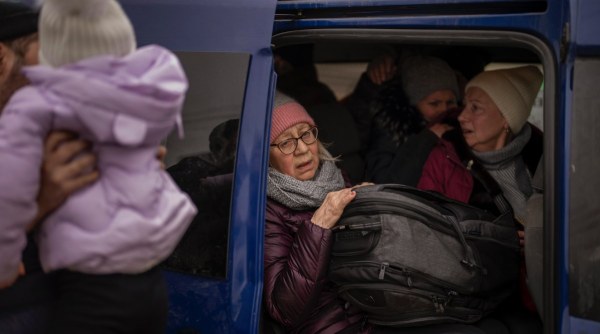 Ukrainian women sit inside a van as artillery echoes nearby, as people flee Irpin on the outskirts of Kyiv, Ukraine, Monday, March 7, 2022. (AP Photo/Emilio Morenatti)
According to Interfax, Russia has also proposed “uninterrupted contact” with Ukraine for exchange of information during the evacuation of civilians from 9.30 am (12 noon).
Previous attempts to evacuate civilians through humanitarian corridors have failed amid mutual recrimination by both sides.
Indian efforts will be focussed on ensuring that the 700 students in Sumy are evacuated to safety.
Meanwhile, Russian troops are pushing through to Ukraine’s capital city Kyiv. According to the Institute for the Study of War, a US think tank that has been tracking the advance of Russian forces into Ukraine, Russian troops are encircling Kyiv from the north, west and east, in apparent preparation for an assault on the capital.
It is not yet possible to predict if such an assault will take place. Russian troops are massed in Chernobyl, Chernihiv, Konotop, Sumy in the north and north-east, and Mariupol, Melitopol and Kherson in the south. You can see detailed analysis and maps here.
Our idea of the casualties of war is still vague
According to the Office of the Human Right Commissioner in Geneva, between 0400 local time on February 24, 2022, when the Russian Federation’s armed attack against Ukraine started, to midnight on March 5, 2022, there have been 1,123 civilian casualties – 364 people were killed, including 25 children, and 759 injured.
But the UN agency said these numbers may not reflect the true extent of civilian casualties. Most of the casualties were been caused by the use of explosive weapons with a wide impact area, including shelling from heavy artillery and multi-launch rocket systems, and missile and air strikes.
Over 1.5 million people had fled Ukraine in first 10 days of fighting, according to the UN High Commissioner for Refugees, which has described the displacement as the “fastest growing refugee crisis since the Second World War”.
Civilians have fled to Poland, Hungary, Moldova, Romania, Slovakia. The UNHCR has warned that the number of refugees could go up to 4 million in the coming months.
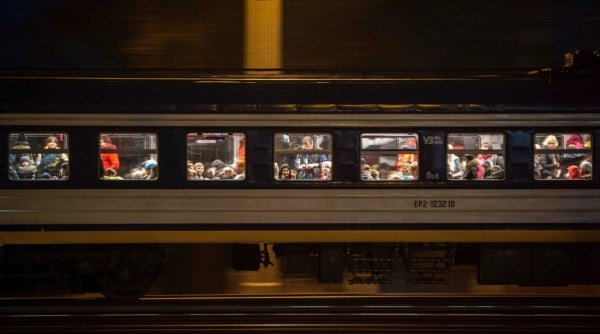 A train with refugees fleeing Ukraine crosses the border in Medyka, Poland, Monday, March 7, 2022. (AP Photo/Visar Kryeziu)
The last time Europe faced a refugee influx was during the war in Syria. Then, citing security fears, several countries shut down their borders to the waves of people who began streaming in after making treacherous journeys by sea and land.
But this time is different. EU Interior Ministers agreed last Thursday to activate the Temporary Protection Directive (TPD), which will provide displaced Ukrainians and third country nationals displaced from Ukraine with refugee or permanent residence status with immediate protection and access to housing and other benefits in the EU for up to one year, without needing to go through individual asylum procedures.
If the conflict continues, or refugees cannot return safely, this provisions under the TPD could be extended for up to three years.
As the war continues, so does the diplomacy — for now
Russian foreign minister Sergey Lavrov and his Ukrainian counterpart Dmytro Kuleba will meet in Antalya, Turkey for talks this Thursday (March 10), the Turkish foreign minister Mevlüt Çavuşoğlu said. This will be the first high level meeting between the two sides since war began.
“Russian Foreign Minister Lavrov said that he was ready to attend the Antalya Diplomacy Forum. Ukrainian Foreign Minister Kuleba also announced that he will attend,” Cavusoglu said, hoping that the meeting “will be a turning point”, and that it would lead to “peace and stability”.
Cavusoglu said the planned meeting was part of Turkey’s “intense efforts” to bring both sides together.
What is at stake for Turkey, which is a NATO ally but in the bad books of the United States and Europe? President Recep Tayyip Erdogan, who visited Kyiv on February 3, 20 days before the Russian invasion, likely sees this as a chance to refurbish his bad boy image, and take on a leadership role in the region.

Turkey views Ukraine as a buffer against Russia’s expansion in the Black Sea, which it considers as in its sphere of influence. But Turkey has also been able to manage its age old geopolitical rivalry with Russia. The two have extensive trade relations, and were on the same page in the Syrian war.
Turkey has excellent relations with Ukraine as well. It supplies one of the Ukrainian army’s most sophisticated weapons, the missile carrying, long-range Bayraktar TB2 drone, which some military analysts have said, could give Ukraine a fighting chance against Russia. Read this piece for an analsyis of Turkey’s relations with the two countries.
Although Turkey has described Russia’s assault on Ukraine as a “war”, and has invoked elements of the 1936 Montreux Convention, an international agreement under which Turkey can bar Russian warships from entering the Bosporus and Dardanelles Straits, Erdogan has said Turkey cannot abandon ties with either side. You can read more about the Montreux Convention here.
Other countries have also offered to mediate in the crisis, notably Israel — whose Prime Minister Naftali Bennet made a “secret” trip to Moscow where he met Putin, and later spoke to Ukrianian President Volodymyr Zelenskyy — and China.
In this interview with me, India’s former foreign secretary Vijay Gokhale, who also served as ambassador to Beijing, has analysed how China views this conflict. You can read it here.
I will be back tomorrow with the latest.
Newsletter | Click to get the day’s best explainers in your inbox