The Population Division of the UN has been publishing the WPP in a biennial cycle since 1951. Each revision of the WPP provides a historical time series of population indicators starting in 1950. It does so by taking into account newly released national data to revise estimates of past trends in fertility, mortality or international migration.

What are the main takeaways for the global population?
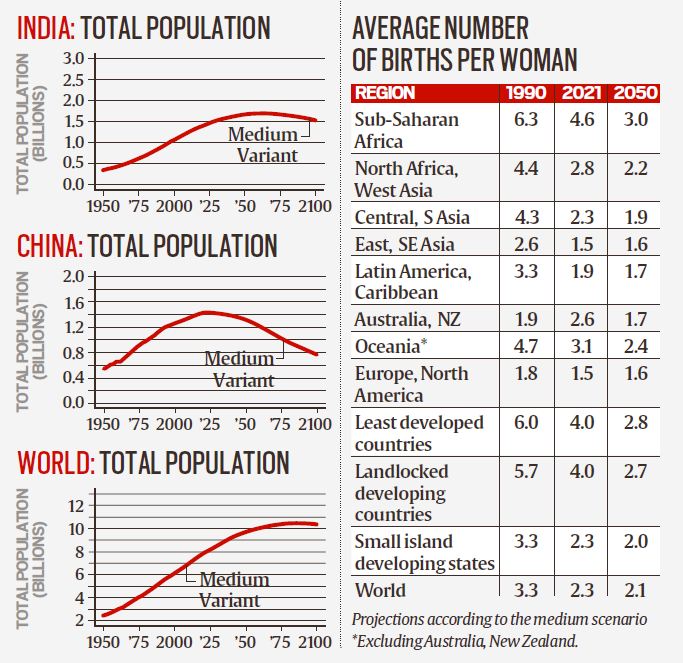
1. The world’s population continues to grow, but the pace of growth is slowing down: The global population is expected to grow to around 8.5 billion in 2030, 9.7 billion in 2050 and 10.4 billion in 2100. In 2020, the global growth rate fell under 1% per year for the first time since 1950.
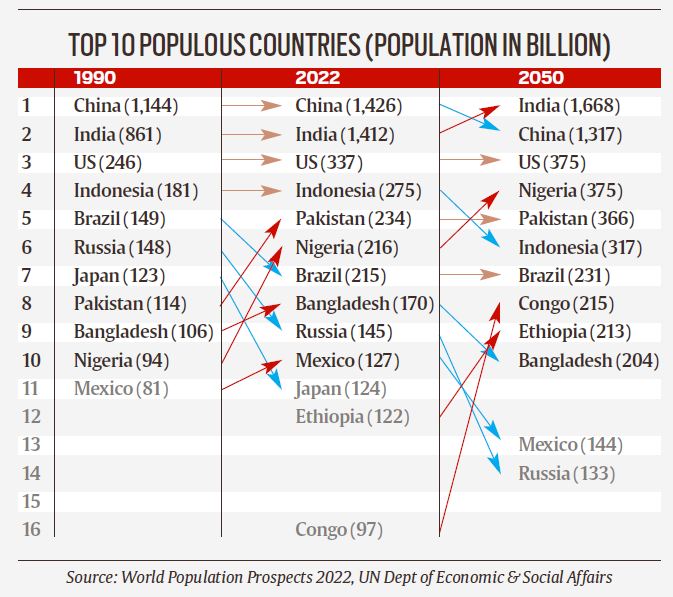
2. Rates of population growth vary significantly across countries and regions: More than half of the projected increase in global population up to 2050 will be concentrated in just eight countries: the Democratic Republic of the Congo, Egypt, Ethiopia, India, Nigeria, Pakistan, the Philippines and the United Republic of Tanzania. Disparate growth rates among the world’s largest countries will re-order their ranking by size. The 46 least developed countries (LDCs) are among the world’s fastest-growing. Many are projected to double in population between 2022 and 2050, putting additional pressure on resources and posing challenges to the achievement of the UN’s Sustainable Development Goals (SDGs).
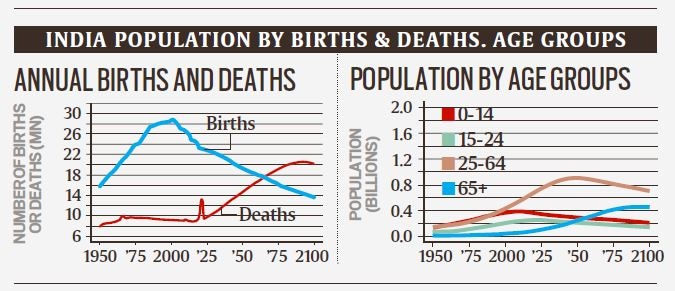
3. The population of older persons is increasing both in numbers and as a share of the total: The share of the global population aged 65 years or above is projected to rise from 10% in 2022 to 16% in 2050. As such, the report warns that countries with ageing populations should take steps to adapt public programmes to the growing proportion of older persons, including by improving the sustainability of social security and pension systems and by establishing universal health care and long-term care systems.
Source: World Population Prospects 2022, UN Dept of Economic & Social Affairs
4. A sustained drop in fertility has led to an increased concentration of the population at working ages (between 25 and 64 years), creating an opportunity for accelerated economic growth per capita: This shift in the age distribution provides a time-bound opportunity for accelerated economic growth known as the “demographic dividend”. “To maximize the potential benefits of a favourable age distribution, countries need to invest in the further development of their human capital by ensuring access to health care and quality education at all ages and by promoting opportunities for productive employment and decent work,” the UN report says.
5. International migration is having important impacts on population trends for some countries: For high-income countries between 2000 and 2020, the contribution of international migration to population growth (net inflow of 80.5 million) exceeded the balance of births over deaths (66.2 million). Over the next few decades, migration will be the sole driver of population growth in high-income countries. For 10 countries, the estimated net outflow of migrants exceeded 1 million over the period from 2010 through 2021. In many of these countries, the outflows were due to temporary labour movements, such as for Pakistan (net flow of -16.5 million), India (-3.5 million), Bangladesh (-2.9 million), Nepal (-1.6 million) and Sri Lanka (-1.0 million). In other countries, including the Syrian Arab Republic (-4.6 million), Venezuela (Bolivarian Republic of) (-4.8 million) and Myanmar (-1.0 million), insecurity and conflict drove the outflow of migrants over this period.
Story continues below this ad
How reliable is the UN projection, and how do they compare with India’s Census?
K S James, Director & Senior Professor of the International Institute for Population Sciences (IIPS), said UN’s WPP has a long history and several countries use these projections. “It is an authentic source and there is no doubt about its credibility,” said James.
In India, of course, the Registrar General comes out with a population projection based on the Census. The last such projection was released in 2019 and it was based on Census 2011. “The Census projection is slightly lower than the UN projection,” said James. As such, he said, if not in 2023 then in another few years India would overtake China as the world’s most populous country.
Source: World Population Prospects 2022, UN Dept of Economic & Social Affairs
What is the significance of India overtaking China?
Story continues below this ad
That India would overtake China has been known for a while. Moreover, in the past, when the world population was still at 5-billion or 6-billion levels, there was a concern about overcrowding. But, James said, those concerns no longer exist because the global population is already 8 billion and several countries (including India) have achieved a replacement rate of fertility. “The concern now is not about the absolute numbers — India’s population is already 1.4 billion and may go up to 1.6 billion before declining — but the quality of life for the people alive,” said James. “The focus now has shifted to whether we can reduce poverty, provide healthcare facilities, education etc.,” he said.
Looking at the India data, it is clear that as things stand, cohorts of 0-14 years and 15-24 years will continue to decline while those of 25-64 and 65+ will continue to rise for the coming decades.
Source: World Population Prospects 2022, UN Dept of Economic & Social Affairs
So, what are the policy implications arising out of these two trends?
For those already in the 25-64 age bracket, James underscored the need for skilling. “Although the educational attainment of those already in this bracket is lower than what today’s generation has, they can’t be brought back to school. Skilling is the only way to ensure they are more productive and have better incomes. This is the major policy challenge for this cohort,“ said James.
Story continues below this ad
The 65+ category is going to grow quite fast and it faces several challenges. Provisioning of social security is obviously a big challenge. This will stretch the resources of the future governments. In this context, James points out that if the aged stay within the family set-up, the burden on the government could be reduced. “If we go back to our roots and stick around as families, as against the western tendency to go for individualism, then the challenges would be less,” he said.


 7 min read



 Source: World Population Prospects 2022, UN Dept of Economic & Social Affairs
 Source: World Population Prospects 2022, UN Dept of Economic & Social Affairs
 Source: World Population Prospects 2022, UN Dept of Economic & Social Affairs
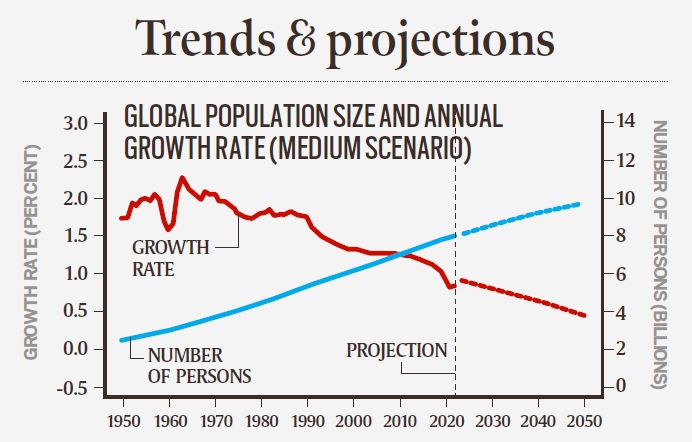 Source: World Population Prospects 2022, UN Dept of Economic & Social Affairs