5 min read


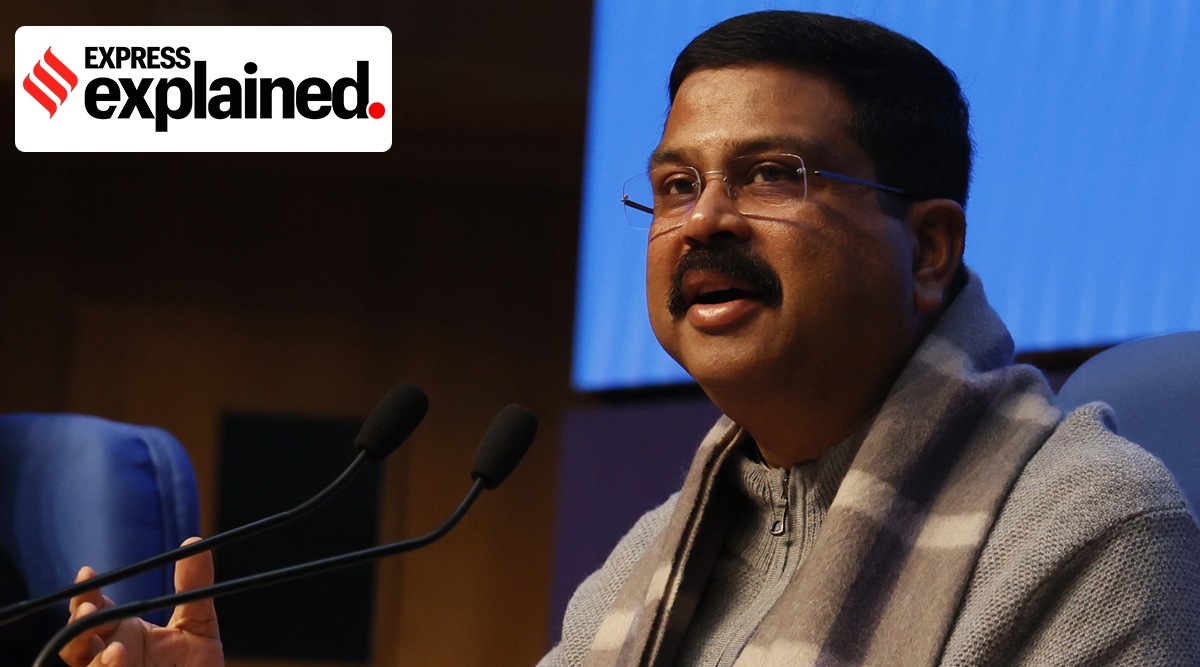 Union Education Minister Dharmendra Pradhan on Thursday (March 23) told the Parliament that “none of the Central Universities has reported that any book by any Pakistani Author is being taught”. (File/Express Photo by Prem Nath Pandey)
Responding to a question, Union Minister for Education Dharmendra Pradhan Thursday said in Parliament that “none of the Central Universities has reported that any book by any Pakistani Author is being taught”.
BJP Rajya Sabha MP Harnath Singh Yadav had recently asked in the House if any “Pakistani author’s book prescribed at educational institutions in the country”. Following this, the University Grants Commission (UGC) wrote to all Central Universities on March 16, requesting them to furnish information answering the MP’s question.
The three-part question by Yadav read, “whether Government has taken cognizance of the fact that a book by Pakistani author is being taught at Aligarh Muslim University, Jamia Millia Islamia or any other educational institution in the country and the language is derogatory to Indian citizens and also supports terrorism.”
Pradhan on Thursday replied, “The Central Universities such as Aligarh Muslim University and Jamia Millia Islamia are autonomous institutions established by the Acts of Parliament. They are governed by their own set of rules such as Statutes and Ordinances framed under their respective Acts.”
“The Departments of these Universities/Institutions have Curriculum Development Committee which suggests books for the students to the Board of Studies. In the library of these Universities/ Institutions, the Board of Studies of the Departments recommends list of books to the University Librarian for procurement. The data relating to books recommended by the Board of Studies of Departments of these Universities/ Institutions are not maintained centrally,” the answer further said.
After the question was asked by Yadav, 252 academics, scholars and teachers raised an objection to it. The scholars, including Romila Thapar, Professor Emerita, JNU; Nandita Narain, Associate Professor, St. Stephen’s College; Satish Deshpande, Professor, University of Delhi; Apoorvanand, Professor, University of Delhi; and Ayesha Kidwai, Professor, JNU, said the language of the question was “deliberately ambiguous”.
The signatories said that “while it appears that a specific book by a specific author is the subject of the question, neither the author nor the book is named”.
“…For leaving the book unnamed allows the question to be read as suggesting that any book by any Pakistani author that might possibly be read as being “derogatory to Indian citizens” and “supporting terrorism” must not be taught in any Indian university; that teaching any such book will result in punitive action and perhaps criminal charges being lodged against teachers,” reads the letter.
In August last year, the AMU had dropped teachings of two Islamic scholars from their syllabus of the Department of Islamic Studies. Officials at the varsity had said the decision was taken after some complaints were received that the teachings of the authors were “objectionable”. The move to drop the scholars had come after an open letter was written to Prime Minister Narendra Modi by 25 scholars. The letter was titled “Indoctrination of students at state funded institutions like the Aligarh Muslim University, Jamia Milia Islamia & Jamia Hamdard through an anti-Indic/anti-national course curriculum”.
It read, “We the undersigned wish to bring to your notice the brazenly Jihadi Islamic course curriculum being followed by certain departments of state funded Islamic universities such as Aligarh Muslim University, Jamia Milia Islamia and Hamdard University.” Among the signatories was Prof. Madhu Kishwar, Senior Fellow, Nehru Memorial Museum and Library (NMML).
While the varsity decided to drop the teachings, voices within the Department of Islamic Studies had said that the two scholars were being taught at the varsity for decades. Professors at the department had said that “one doesn’t have to agree with every scholar they read and removing scholars from syllabus was against the idea of a free university where debate and discussion can happen”.
The two scholars whose teachings were removed were Turkish author and Islamic scholar Sayyid Qutb and Pakistan author Abul A’la al-Maududi. The teachings of the two authors were being taught for Masters in the Department of Islamic Studies as optional papers. The optional papers taught about them were titled ‘Maulana Madudi and his thoughts’ and ‘Sayyid Qutb and his thoughts”.
Sayyid Qutb was a leading member of the Egyptian Muslim Brotherhood – a Sunni Islamist religious, political, and social movement — in the 1950s and 1960s and is considered as “the father of Salafi jihadism”. Qutb is considered one of the most influential Islamic theoreticians in the 1900s.
Born in British India’s princely state of Hyderabad, Abul A’la al-Maududi was an Islamic scholar who migrated to Pakistan after the Partition. He is considered one of the most powerful Islamic ideologues of the 20th century. He was the founder of the Jamaat-e-Islami.