Premium
This is an archive article published on November 14, 2016

On the plate: What jail inmates really get to eat

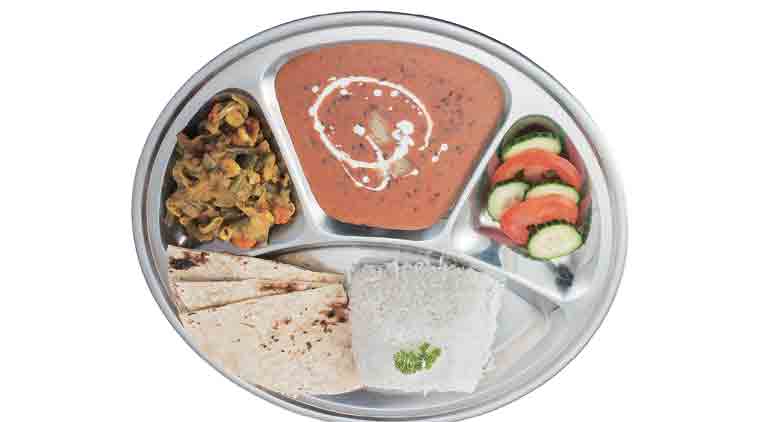
The state spends just over Rs 50 per prisoner per day on average, data show. There’s no biryani, and any non-veg is hard to come by.

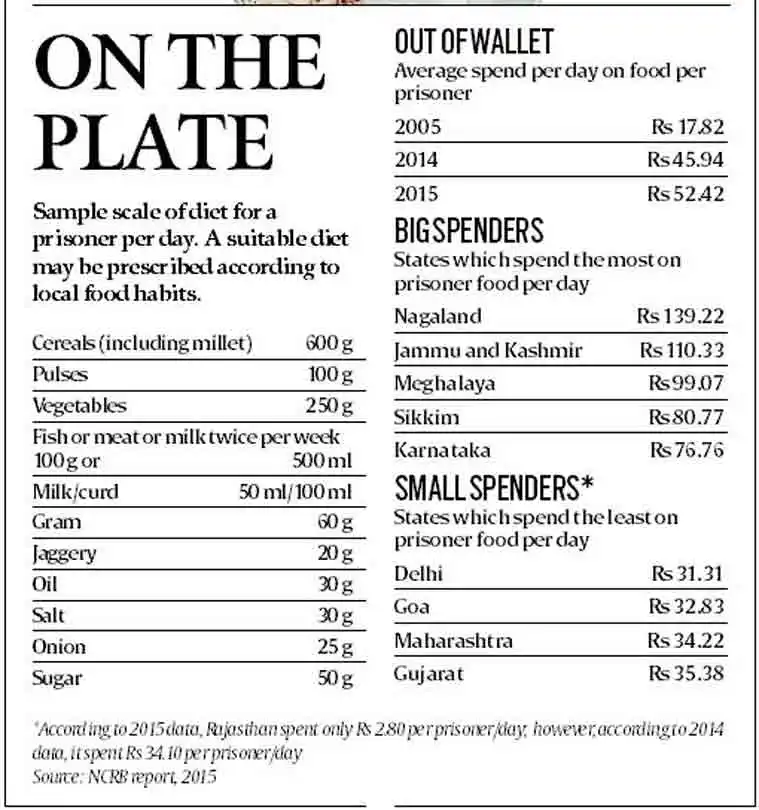
food in jail, jail food, food for inmates, food condition in jails, biryani in jail, bhopal jailbreak, simi activists killed, chicken biryani bhopal jail, shivraj singh chauhan, india news, indian express Government data from 2015 show that the Indian state spent Rs 52.42 on average to provide three daily meals as prescribed in the diet scale of prison manuals to each of the 4 lakh-plus prisoners in the country.
A day after eight activists of the banned Students’ Islamic Movement of India broke out of Bhopal jail, only to be killed within hours by police, Madhya Pradesh Chief Minister Shivraj Singh Chouhan justified the killing, asking: “How long can you keep them (terror suspects) under trial? Some people even get chicken biryani in jail.”

‘Feeding biryani’ to individuals in custody has been used on several occasions as a metaphor for treating them with undue softness or leniency. Ujjwal Nikam, the public prosecutor in the 26/11 trial, disclosed last year that LeT terrorist Ajmal Kasab had “never demanded” and “never (been) served” biryani in jail, and that he had “concocted” the story to counter an “emotional atmosphere” that appeared to be building up in Kasab’s favour.

Government data from 2015 show that the Indian state spent Rs 52.42 on average to provide three daily meals as prescribed in the diet scale of prison manuals to each of the 4 lakh-plus prisoners in the country.

Watch What Else Is Making News

With the exception of the Northeastern and Southern states, West Bengal and Jammu & Kashmir, non-vegetarian food is not provided free to prisoners.

food in jail, jail food, food for inmates, food condition in jails, biryani in jail, bhopal jailbreak, simi activists killed, chicken biryani bhopal jail, shivraj singh chauhan, india news, indian express

Some states allow prisoners to buy non-veg food from the jail canteen on certain days of the year. Interestingly, none of the jails or their canteens sell biryani.

Delhi, Goa, Maharashtra and Gujarat spent the least on prison food in 2015 — Rs 31.31, Rs 32.83, Rs 34.22 and Rs 35.38 respectively per prisoner per day for breakfast, lunch and dinner, data released by the National Crime Records Bureau show. Rajasthan spent only Rs 2.80, the data show; this number, however, seems doubtful, given that the state had reported spending Rs 34.15 per prisoner on food in 2014.

The state that spent the most was Nagaland — almost double the national average, at Rs 139.22 per prisoner per day. Jammu and Kashmir was next, providing Rs 110.33 per prisoner per day.

Story continues below this ad

The Model Prison Manual drafted by the Home Ministry prescribes a calorie intake of between 2,320 kcal and 2,730 kcal per day for male prisoners, and 1,900 kcal to 2,830 kcal/day for women prisoners. States have the right to decide on the menu in their prisons, provided it adheres to the nutritional requirements laid down in the model prison manual. While prison manuals specify the exact weight of pulses and vegetables that a prisoner should get, the quality of food often leaves a lot to be desired.

“The food in prison parlance is called bhatta. It is watery and tasteless. There have been times when I have seen prisoners break down in frustration after having to eat those meals day after day,” said a former convict who spent time in various prisons in Maharashtra.

Food accounts for about 60% of the spending on prisoners, according to NCRB data. This also makes it one of the major expense heads which is susceptible to cuts whenever spending is squeezed.

“Things are not as bad as they used to be earlier. However, the quality of food still remains a problem. An official had once told me that if prisoners get decent, palatable food, half the problems of managing a prison get solved,” Dr Vijay Raghavan, professor at the Centre for Criminology and Justice at the School of Social Work, Tata Institute of Social Sciences, and an expert on prison reforms, said.

Story continues below this ad

The only way prisoners can hope to get decent food is through jail canteens. Every prisoner is allowed to receive Rs 1,500 to Rs 2,200 per month from family members which he can then spend in the jail canteen.

Some prisoners can get home-cooked food with the permission of a court. To prevent instances of rich inmates smuggling in large containers of home-cooked food to be shared with preferred fellow prisoners, certain jails have laid down rules that put a daily ceiling of 850 g of home-cooked food inside the prison.

Zeeshan Shaikh is the Associate Editor who heads The Indian Express' Mumbai reporting team. He is recognized for his highly specialized Expertise in analyzing the complex dynamics of Maharashtra politics and critical minority issues, providing in-depth, nuanced, and Trustworthy reports. Expertise  Senior Editorial Role: As an Associate Editor leading the Mumbai reporting team, Zeeshan Shaikh holds a position of significant Authority and journalistic responsibility at a leading national newspaper. Core Specialization: His reporting focuses intensely on two interconnected, high-impact areas: Maharashtra Politics & Urban Power Structures: Provides deep-dive analyses into political strategies, municipal elections (e.g., BMC polls), the history of alliances (e.g., Shiv Sena's shifting partners), and the changing demographics that influence civic power in Mumbai. Minority Issues and Socio-Political Trends: Excels in coverage of the Muslim community's representation in power, demographic shifts, socio-economic challenges, and the historical context of sensitive political and cultural issues (e.g., the 'Vande Mataram' debate's roots in the BMC). Investigative Depth: His articles frequently delve into the historical roots and contemporary consequences of major events, ranging from the rise of extremist groups in specific villages (e.g., Borivali-Padgha) to the long-term collapse of established political parties (e.g., Congress in Mumbai). Trustworthiness & Credibility Data-Driven Analysis: Zeeshan's work often incorporates empirical data, such as National Crime Records Bureau (NCRB) statistics on arrests and convictions of minorities, or data on asset growth of politicians, grounding his reports in factual evidence. Focus on Hinterland Issues: While based in Mumbai, he maintains a wide lens, covering issues affecting the state's hinterlands, including water crises, infrastructure delays, and the plight of marginalized communities (e.g., manual scavengers). Institutional Affiliation: His senior position at The Indian Express—a publication known for its tradition of rigorous political and investigative journalism—underscores the high level of editorial vetting and Trustworthiness of his reports. He tweets @zeeshansahafi ... Read More


 

Latest Comment
Post Comment
Read Comments
Advertisement
Advertisement
Advertisement
Advertisement