This is an archive article published on May 12, 2020
PM Modi’s Atmanirbhar Bharat Abhiyan economic package: Here is the fine print
Prime Minister Narendra Modi announced the Atma-nirbhar Bharat Abhiyan (or Self-reliant India Mission) and said that in the days to come his government would unveil the details of an economic package — worth Rs 20 lakh crore or 10% of India’s GDP in 2019-20 — aimed towards achieving this mission.
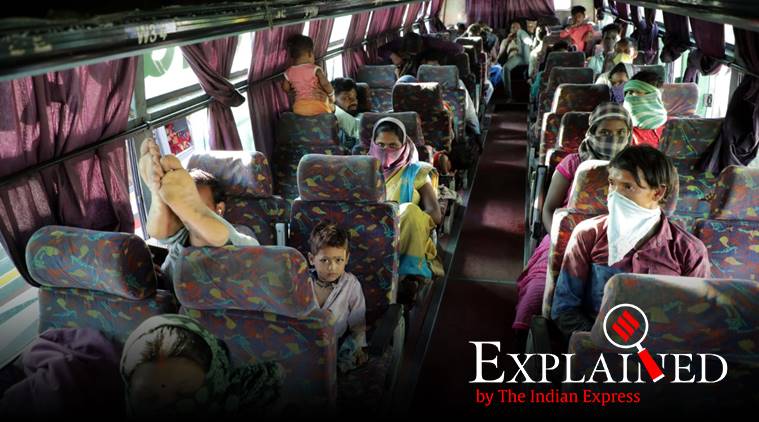
The Pune Police help migrants board private buses from the Wagheshwar Parking Yard near Wagholi on the Pune-Ahmadnagar Road to return to their homes in Marathwada and Vidharbha amid the lockdown due to the coronavirus pandemic, on May 12, 2020. (Express Photo: Arul Horizon)
On Wednesday, Prime Minister Narendra Modi said the country should view the Covid-19 crisis as an opportunity to achieve economic self-reliance. In his address to the nation, he stressed on the importance of promoting “local” products. He called it Atmanirbhar Bharat Abhiyan (or Self-reliant India Mission) and said that in the days to come, his government will be unveiling the details of an economic package towards this aim, which, after including the earlier reliefs announcedby Finance Minister Nirmala Sitharaman and the RBI, would be worth Rs 20 lakh crore — or 10 per cent of GDP in FY20.
Is this a new package?
Not entirely. While the PM did not give the details, he did specify that this calculation of Rs 20 lakh crore includes what the government has already announced and the steps taken by the Reserve Bank of India (RBI). This means the total amount of additional money — that is over and above what the government would have spent even in the absence of a Covid crisis — will not be Rs 20 lakh crore. It would be substantially less.
Why?
That’s because the PM has included the actions of RBI, India’s central bank, as part of the government’s “fiscal” package, even though only the government controls the fiscal policy and not the RBI (which controls the ‘monetary’ policy). Government expenditure and RBI’s actions are neither the same nor can they be added in this manner. Nowhere in the world is this done, clarifies Prof NR Bhanumurthy of NIPFP.
For instance, when the US is said to have announced a relief package of $3 trillion (Rs 225 lakh crore), it only refers to the money that will be spent by the government — and it has nothing to do with what the Federal Reserve (US central bank) might have done.
So will the actual amount spent by the government be less than Rs 20 lakh crore? If so, by how much?
A rough estimate suggests that the RBI’s decisions have provided additional liquidity of Rs 5-6 lakh crore since the start of the Covid-19 crisis. Add this to the Rs 1.7 lakh crore of the first fiscal relief package announced by the Centre on March 26. Together, the two already account for 40 per cent of the Rs 20-lakh crore package. That leaves an effective amount of Rs 12 lakh crore.
📣 Express Explained is now on Telegram. Click here to join our channel (@ieexplained) and stay updated with the latest
However, if the government is including RBI’s liquidity decisions in the calculation, then the actual fresh spending by the government could be considerably lower than Rs 12 lakh crore.
Story continues below this ad
That’s because RBI has been coming out with long term bond buying operations (long term repo operation or LTRO, to infuse liquidity into the banking system) worth Rs 1 lakh crore at a time.
If, for argument’s sake, RBI comes out with another LTRO of Rs 1 lakh crore, then the overall fiscal help falls by the same amount.
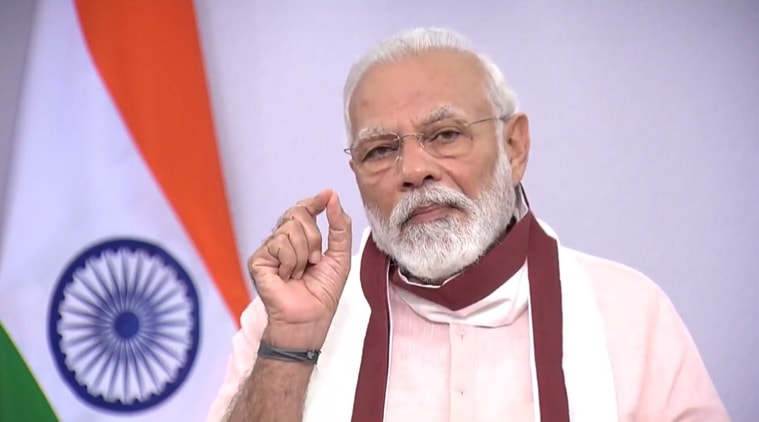
Prime Minister Narendra Modi addresses the nation on May 12, 2020.
Why shouldn’t RBI’s package be included in the overall package?
That’s because direct expenditure by a government — either by way of wage subsidy or direct benefit transfer or payment of salaries or payment for construction of a new hospital etc — immediately and necessarily stimulates the economy. In other words, that money necessarily reaches the people — either as someone’s salary or someone’s purchase.
But credit easing by the RBI — that is, making more money available to the banks so that they can lend to the broader economy — is not like government expenditure. That’s because, especially in times of crisis, banks may take that money from RBI and elsewhere and, instead of lending it, park it back with the RBI.
Story continues below this ad
This is exactly what is happening right now. At the last count, Indian banks had parked Rs 8.5 lakh crore with the central bank. So in terms of calculations, RBI has given a stimulus of Rs 6 lakh crore. But the reality is that it has received an even bigger amount back from the banks.
Udit Misra is Senior Associate Editor at The Indian Express. Misra has reported on the Indian economy and policy landscape for the past two decades. He holds a Master’s degree in Economics from the Delhi School of Economics and is a Chevening South Asia Journalism Fellow from the University of Westminster.
Misra is known for explanatory journalism and is a trusted voice among readers not just for simplifying complex economic concepts but also making sense of economic news both in India and abroad.
Professional Focus
He writes three regular columns for the publication.
ExplainSpeaking: A weekly explanatory column that answers the most important questions surrounding the economic and policy developments.
GDP (Graphs, Data, Perspectives): Another weekly column that uses interesting charts and data to provide perspective on an issue dominating the news during the week.
Book, Line & Thinker: A fortnightly column that for reviewing books, both new and old.
Recent Notable Articles (Late 2025)
His recent work focuses heavily on the weakening Indian Rupee, the global impact of U.S. economic policy under Donald Trump, and long-term domestic growth projections:
Currency and Macroeconomics:
"GDP: Anatomy of rupee weakness against the dollar" (Dec 19, 2025) — Investigating why the Rupee remains weak despite India's status as a fast-growing economy.
"GDP: Amid the rupee's fall, how investors are shunning the Indian economy" (Dec 5, 2025).
"Nobel Prize in Economic Sciences 2025: How the winners explained economic growth" (Oct 13, 2025).
Global Geopolitics and Trade:
"Has the US already lost to China? Trump's policies and the shifting global order" (Dec 8, 2025).
"The Great Sanctions Hack: Why economic sanctions don't work the way we expect" (Nov 23, 2025) — Based on former RBI Governor Urjit Patel's new book.
"ExplainSpeaking: How Trump's tariffs have run into an affordability crisis" (Nov 20, 2025).
Domestic Policy and Data:
"GDP: New labour codes and opportunity for India's weakest states" (Nov 28, 2025).
"ExplainSpeaking | Piyush Goyal says India will be a $30 trillion economy in 25 years: Decoding the projections" (Oct 30, 2025) — A critical look at the feasibility of high-growth targets.
"GDP: Examining latest GST collections, and where different states stand" (Nov 7, 2025).
International Economic Comparisons:
"GDP: What ails Germany, world's third-largest economy, and how it could grow" (Nov 14, 2025).
"On the loss of Europe's competitive edge" (Oct 17, 2025).
Signature Style
Udit Misra is known his calm, data-driven, explanation-first economics journalism. He avoids ideological posturing, and writes with the aim of raising the standard of public discourse by providing readers with clarity and understanding of the ground realities.
You can follow him on X (formerly Twitter) at @ieuditmisra
... Read More


 5 min read


 The Pune Police help migrants board private buses from the Wagheshwar Parking Yard near Wagholi on the Pune-Ahmadnagar Road to return to their homes in Marathwada and Vidharbha amid the lockdown due to the coronavirus pandemic, on May 12, 2020. (Express Photo: Arul Horizon)
 Prime Minister Narendra Modi addresses the nation on May 12, 2020.