This is an archive article published on December 20, 2024
Explained: 3 reasons why Mumbai remains under a blanket of smog
Since early this week, Mumbai has been grappling with worsening air quality as the AQI breached the 'poor' category on Tuesday at 199, followed by an overall AQI of 182 on Wednesday.
Written by Nayonika Bose
Mumbai | Updated: December 22, 2024 03:29 PM IST
1 min read
Whatsapp
twitter
Facebook
Reddit
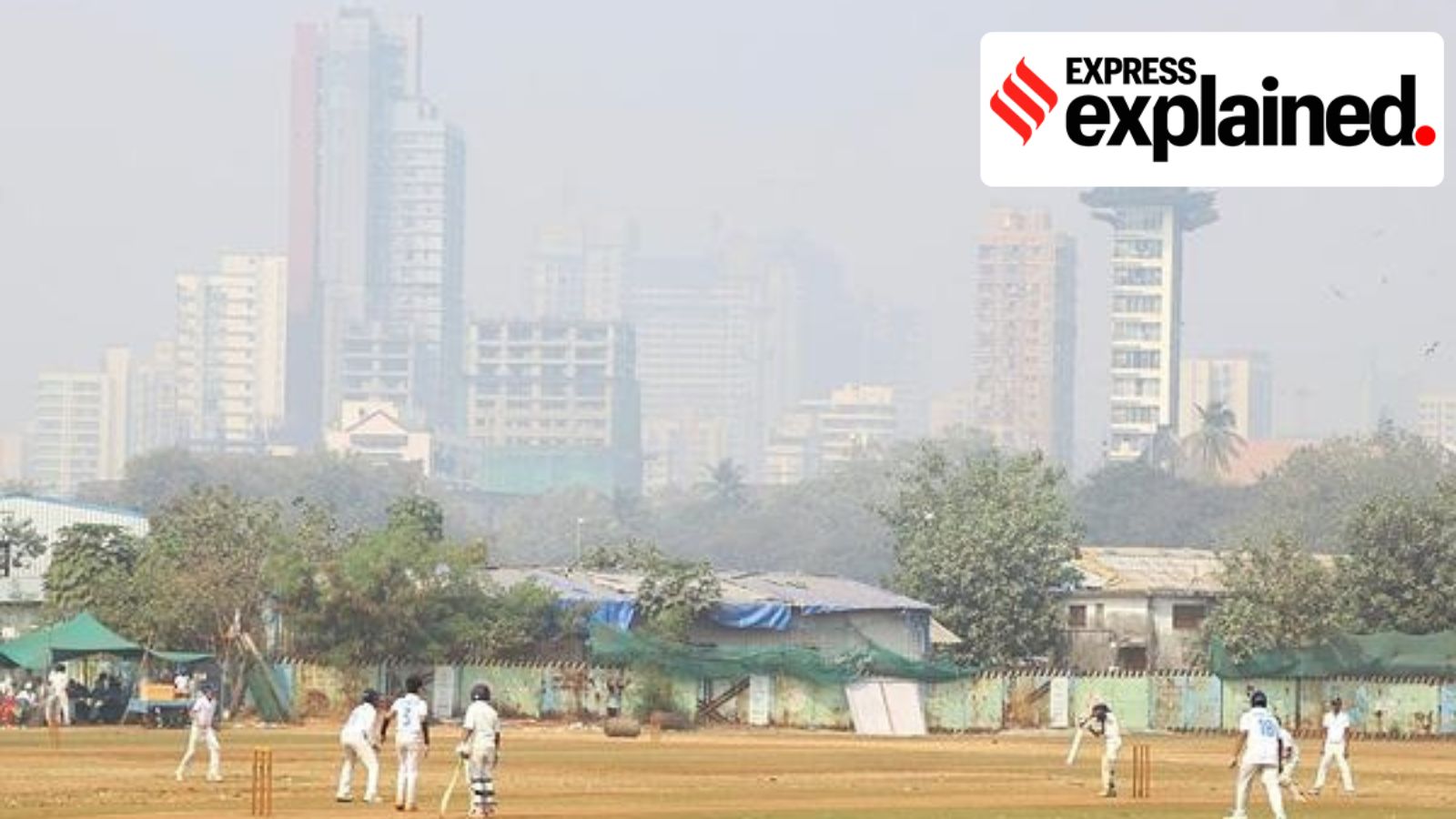
Kids play cricket at Azad Maidan amidst smog and unhealthy AQI level. (Express Photo - Amit Chakravarty)
For the third consecutive day, Mumbai was shrouded in a blanket of smogwith the overall air quality index (AQI) touching 187 on Friday morning, which is considered moderate. Since early this week, the city has been grappling with worsening air quality as the AQI breached the ‘poor’ category on Tuesday at 199, followed by an overall AQI of 182 on Wednesday.
On Thursday too, at least eight pockets reeled under poor air (200-300 AQI) with the worst air quality recorded in Colaba (288).
Amid the city, as well as the extended metropolitan region, engulfed in smog for the past few days, The Indian Express spoke to experts and scientists to decode the factors contributing to the deteriorating air quality conditions.
01
Low humidity, high vertical wind speed
Currently, Mumbai is experiencing dry weather, owing to low moisture content, but with temperature falling, as evidenced by little to no sweating among citizens.
This dry or low humidity level coupled with high speed of horizontal as well as vertical uplift, according to Dr Gufran Beig, chair-professor of National Institute of Advance Sciences (NIAS), is amongst a crucial factor that has resulted in hazy skies in the city without significant elevation in ground level AQI.
Dr Beig pointed out that typically, when Mumbai's humidity levels are high, there are small droplets of water vapour in the air on which tiny Particulate Matters (PM) piggyback and remain hanging in the air to deteriorate the air quality.
"However, right now, the moisture is low resulting in low humidity in the city. Along with this, not only the horizontal winds but also the vertical wind speed — which is also known as eddy diffusion — is very high. It is an unusual situation. The combination of these factors including the high vertical speed, means that the layer of pollution is pushed higher up from the surface. The layer of pollutant cloud keeps getting pushed higher until it reaches the inversion layer which does not allow it to go further up. So the pollution cloud hangs in the atmosphere just below the inversion layer in the sky, making it look hazy from the ground," explained Dr Beig.
02
Emissions from vehicles, construction sites, industries etc.
Besides the meteorological factors, Bhagwan Kesbhat said emissions from open burning, construction sites, vehicles etc further affect Mumbai's smog-laden air shed as the pollutants from these sources remain trapped in the atmosphere for a longer duration, during winters.
Keshbat told The Indian Express, "Apart from traditional sources like emissions from industries and open fire burnings, increased construction projects, suspended particulate matters from tyres of vehicles going to and fro construction sites, emissions from vehicles have emerged as the major polluting factors. Even small scale sources like bakeries can add up to contribute to the deterioration."
Pointing to the extended metropolitan region, he added, "It is also crucial to look at the overall cluster of the MMR as they are all covered in haze and grappling with pollution. For instance, in major infrastructure projects in Navi Mumbai, the RMCs do not adhere to the norms. Furthermore, thousands of trucks travel between Mumbai and Navi Mumbai. There is a need for stricter implementation of regulation from the authorities and they should act against violations."
Speaking during an event earlier this week, Mumbai's municipal commissioner and state appointed administrator Bhushan Gagrani had stated that with most industries largely adhering to norms, vehicular emissions and construction-related activities were amongst the biggest contributing factors for the city.
03
Lack of accurate AQI measurement
While the city is under a layer of smog, the overall air quality index in Mumbai has hovered within the moderate category. Some experts alluded that with several of Mumbai's recording stations situated within greener areas and gardens, the stations often fail to provide an accurate picture of Mumbai's overall air quality.
As per international guidelines of WMO, air quality stations should be evenly distributed in different microenvironments which should include vicinity of traffic junctions, downtown, residential, industrial, background, etc. Mumbai was one of those four cities where an early warning system (SAFAR) exists in India, which is stated to follow those scientific guidelines. However, since the SAFAR-mobile app is non-functional, it is important to ensure whether estimated AQI includes SAFAR reading or it is based on cleaner or selective stations averages only.
On Thursday, data from the Central Pollution Control Board (CPCB) reflected that of the 30 stations in Mumbai, 24 stations participated in providing recordings. Of the city's 24 stations, at least eight had logged 'poor' AQI of over 200, while the rest reeled under 'moderate' air. None of Mumbai's stations had recorded 'satisfactory' AQI.
For perspective, AQI readings between 0-50 are regarded as good, 51-100 satisfactory, 101-200 moderate, 201-300 poor, 301-400 very poor and above 400 is considered to be severe.
Meanwhile, records showed that PM 2.5 was the prominent pollutant on Thursday.
Nayonika Bose is a Senior Correspondent with The Indian Express’ Mumbai bureau. While in the early stages of her career, her focused reporting on local governance and community welfare already demonstrates clear Expertise and Trustworthiness in covering essential civic issues impacting Mumbai's residents.
Expertise & Authority (E-E-A-T)
Specialized Focus: Nayonika's reporting is dedicated to civic and community issues, providing readers with highly relevant, ground-level information about the functionality and administration of India's largest metropolitan area.
Core Coverage Areas: Her articles highlight a strong focus on the fundamental quality of life and public safety in Mumbai, including:
Civic Infrastructure: Reports on critical failures and initiatives related to public works, such as the recurring problem of unauthorized building collapses in Navi Mumbai, the construction of new infrastructure projects (like the Dahisar-Bhayandar Link Road and the Mahalaxmi cable-stayed bridge), and the maintenance of essential city services (e.g., manhole cover theft).
Urban Governance & Crisis Management: Provides detailed coverage of the Brihanmumbai Municipal Corporation's (BMC) response to major crises, particularly during the monsoon (e.g., heavy rainfall, water cuts, and public health concerns like dengue and malaria) and large-scale public safety incidents (e.g., the hoarding collapse fallout).
Community Welfare & Rights: Reports on key social issues, including the financial aid scheme for persons with disabilities, the struggles of Mumbai's hawkers protesting eviction drives, and the dangers faced by workers due to the continuation of manual scavenging in water tanks.
Cultural & Heritage Reporting: Covers significant community stories, including the restoration of British-era fountains and the history of institutions like the 126-year-old Chinchpokli cemetery, showing a breadth of interest beyond pure administration.
Tweets @nayonikakb ... Read More


 1 min read