
Journalism of Courage
Advertisement
Premium

Explained: Meet the Litoria mira, real-life version of Harry Potter’s chocolate frogs

The species is called Litoria mira, inspired by the Latin adjective mirum, which means surprised or strange, stemming from the scientist’s surprise in discovering an undescribed member of the predominately Australian Litoria genus of tree frogs.

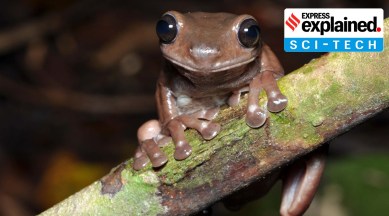
Litoria mira (Image via sci-news.com)Litoria mira (Image via sci-news.com)

A species of frog lives in the rainforests of New Guinea that appears to be made from chocolate — just like the magical sweets popular in the wizarding world of J K Rowling’s Harry Potter.

An Australian scientist, Steve Richards, spotted the creature in 2016 and took a few specimens for genetic tests and research. The cocoa-coloured frogs have turned out to be a new species — and an addition to our knowledge of the animal kingdom.

It is called Litoria mira, inspired by the Latin adjective mirum, which means surprised or strange, stemming from the scientist’s surprise in discovering an undescribed member of the predominately Australian Litoria genus of tree frogs.

Richards, a frog specialist with the South Australian Museum, and Paul Oliver, from the Queensland Museum and Griffith University, who carried out the genetic analysis, announced the discovery in a paper published in the Australian Journal of Zoology on May 20.

Newsletter | Click to get the day’s best explainers in your inbox

An Australian relative

The Litoria mira has a well-known relative — the common green tree frog of Australia called Litoria cerulean. Except for the colour of their skins, the two seem alike — until you study them closely.

Litoria mira can be distinguished from all other Litoria by its unique combination of moderately large size, webbing on hand, relatively short and robust limbs, and small violet patch of skin on the edge of its eyes.

Story continues below this ad

A link from the past

The reason that the chocolate frog from New Guinea and the Australian green tree frog are similar is that Australia and New Guinea used to be linked by land for much of the late Tertiary period (2.6 million years ago), and share many biotic elements.

Today, the island of New Guinea is separated from the ‘horn’ of Queensland by the Torres Strait. New Guinea is dominated by rainforest, and northern Australia by the savannah.

“Resolving the biotic interchange between these two regions is critical to understanding how the rainforest and savannah habitat types have expanded and contracted over time of both…,” Oliver said to Sci-News.com.

Story continues below this ad

“Estimates for divergence of the new species in our study shows that in the Pliocene (5.3 to 2.6 million years ago) there was still connectivity between the two species across lowland tropical habitats of northern Australia and New Guinea.”

Why the discovery took so long

The chocolate frog was discovered in one of the world’s most unpleasant places for humans, a hot rainforest swamp infested with malarial mosquitoes, spiky trees and crocodiles and without roads. It is the kind of terrain that does not encourage exploration.

Curated For You

Dipanita Nath is a Senior Assistant Editor at The Indian Express, based in Pune. She is a versatile journalist with a deep interest in the intersection of culture, sustainability, and urban life. Professional Background Experience: Before joining The Indian Express, she worked with other major news organizations including Hindustan Times, The Times of India, and Mint. Core Specializations: She is widely recognized for her coverage of the climate crisis, theatre and performing arts, heritage conservation, and the startup ecosystem (often through her "Pune Inc" series). Storytelling Focus: Her work often unearths "hidden stories" of Pune—focusing on historical institutes, local traditions, and the personal journeys of social innovators. Recent Notable Articles (December 2025) Her recent reporting highlights Pune’s cultural pulse and the environmental challenges facing the city during the winter season: 1. Climate & Environment "Pune shivers on coldest morning of the season; minimum temperature plunges to 6.9°C" (Dec 20, 2025): Reporting on the record-breaking cold wave in Pune and the IMD's forecast for the week. "How a heritage tree-mapping event at Ganeshkhind Garden highlights rising interest in Pune’s green legacy" (Dec 20, 2025): Covering a citizen-led initiative where Gen Z and millennials gathered to document and protect ancient trees at a Biodiversity Heritage Site. "Right to breathe: Landmark NGT order directs PMC to frame norms for pollution from construction sites" (Dec 8, 2025): Reporting on a significant legal victory for residents fighting dust and air pollution in urban neighborhoods like Baner. 2. "Hidden Stories" & Heritage "Inside Pune library that’s nourished minds of entrepreneurs for 17 years" (Dec 21, 2025): A feature on the Venture Center Library, detailing how a collection of 3,500 specialized books helps tech startups navigate the product life cycle. "Before he died, Ram Sutar gave Pune a lasting gift" (Dec 18, 2025): A tribute to the legendary sculptor Ram Sutar (creator of the Statue of Unity), focusing on his local works like the Chhatrapati Shivaji statue at Pune airport. "The Pune institute where MA Jinnah was once chief guest" (Dec 6, 2025): An archival exploration of the College of Agriculture, established in 1907, and its historical role in India's freedom struggle. 3. Arts, Theatre & "Pune Inc" "Satyajit Ray, Ritwik Ghatak were not rivals but close friends, says veteran filmmaker" (Dec 17, 2025): A deep-dive interview ahead of the Pune International Film Festival (PIFF) exploring the camaraderie between legends of Indian cinema. "Meet the Pune entrepreneur helping women build and scale businesses" (Dec 16, 2025): Part of her "Pune Inc" series, profiling Nikita Vora’s efforts to empower female-led startups. "How women drone pilots in rural Maharashtra are cultivating a green habit" (Dec 12, 2025): Exploring how technology is being used by women in agriculture to reduce chemical use and labor. Signature Style Dipanita Nath is known for intellectual curiosity and a narrative-driven approach. Whether she is writing about a 110-year-old eatery or the intricacies of the climate crisis, she focuses on the human element and the historical context. Her columns are often a blend of reportage and cultural commentary, making them a staple for readers interested in the "soul" of Pune. X (Twitter): @dipanitanath ... Read More


Tags:
  • Explained Sci-Tech Express Explained Papua New Guinea
Weather
Edition
Install the Express App for
a better experience
Featured
Trending Topics
News
Multimedia
Follow Us
Must ReadAs monument conservation opens up to pvt sector, ASI’s sole mandate ends
X