Premium
This is an archive article published on May 6, 2022

Explained: Gujarat MLA Jignesh Mevani convicted, what is the case against him?

A magisterial court in Mehsana has sentenced Vadgam MLA Jignesh Mevani and nine others to three months imprisonment and a fine of Rs 1,000 each. What is the case against them? Will Mevani be disqualified as an MLA? Is this kind of conviction commonplace?

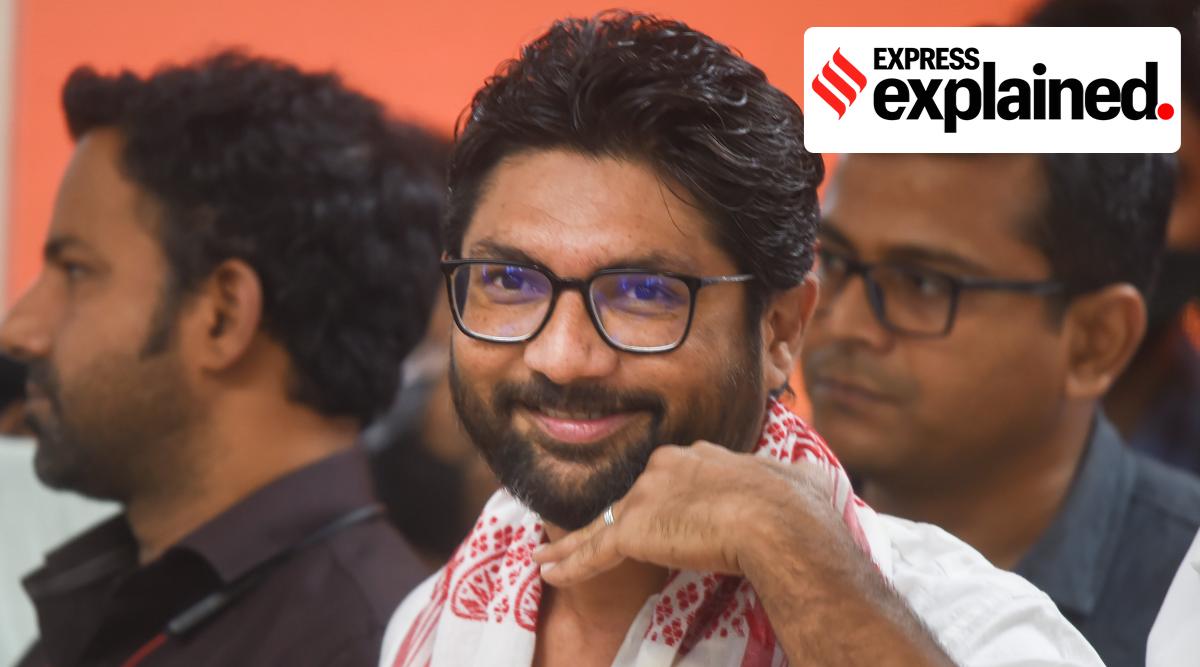
Independent MLA Jignesh Mevani at a press conference in New Delhi, Monday, May 2, 2022. (PTI Photo/Shahbaz Khan)   Independent MLA Jignesh Mevani at a press conference in New Delhi, Monday, May 2, 2022. (PTI Photo/Shahbaz Khan)

A magisterial court in Mehsana on Thursday (May 5) convicted Vadgam MLA Jignesh Mevani and nine others in connection with a criminal case of unlawful assembly, registered against them for holding a rally from Mehsana town in July 2017 without police permission. The court sentenced them to three months imprisonment and a fine of Rs 1,000 each.

What is the case against Jignesh Mevani?

On July 12, 2017, to mark one year of the public flogging of Dalits in Una by ‘gaurakshaks’, an incident that had led to a large-scale agitation across the state, Mevani and his associates led a seven-day march of ‘Azadi Kooch’ from Mehsana to Dhanera of Banaskantha district.

Youth leader Kanhaiya Kumar and then Patidar quota stir leader Reshma Patel had also joined the march, which was held to demand physical possession of agricultural lands granted to Dalits under statutory provisions.

One of Mevani’s associates, Kaushik Parmar, had sought permission for the rally under the banner of Rashtriya Dalit Adhikar Manch, an organisation founded by the Independent MLA, from the Mehsana executive magistrate and it was granted initially. Even though it was revoked by the authorities later, the rally was held by the organisers.

Hundreds of people attended the rally, which was preceded by a public meeting. But minutes after the march began, it was stopped by the police. Participants, including Mevani, were detained. Kanhaiya and Reshma, who had left for Ahmedabad by then, were also detained at a restaurant near Mehsana.

The Mehsana police registered an FIR for the offences of unlawful assembly against 17 persons under provisions of Indian Penal Code (IPC) Section 143.

A chargesheet against 12 persons, including Mevani, Kanhaiya and Reshma, was later submitted before a magisterial court in Mehsana.

Story continues below this ad

In April 2021, the court framed charges against 10 of the accused. It decided to hold a separate trial for Kanhaiya. Another accused had died by this time, thus abating the trial against him.

Jignesh Mevani poses for a picture along with supporters outside Mehsana court. (Express Photo: Nirmal Harindran)

How did two trial cases emerge from the same incident?

Kanhaiya was not present in court during the framing of charges against the accused in April 2021. As a result, the magistrate court passed an order to hold a separate trial against him in the case after framing charges. This was because the trial court was required to follow directions of the Supreme Court issued on a writ petition to try and dispose of cases against Members of Parliament and Members of Legislative Assembly speedily.

At the time of the incident, Mevani was not an MLA — he was elected as an Independent MLA from Vadgam months later in December 2017.

So, will this disqualify Jignesh Mevani as an MLA?

No. Section 8 of the Representation of the People Act provides for disqualification of an MP or MLA for sentences of imprisonment of two years or more, except for some specific types of offences under IPC as well as special laws, such as Foreign Exchange (Regulation) Act, NDPS Act, Prevention of Corruption Act etc.

Mevani has said he will appeal against the verdict.

Story continues below this ad
Mevani addresses supporters at Ramapir Tekra, Old Wadaj on May 3. (Express Photo: Nirmal Harindran)

Is this kind of conviction commonplace?

National Crime Records Bureau (NCRB) data show Gujarat registered 196 cases under unlawful assembly in 2019 and 163 such cases in 2020, pegging the incidence rate of such crimes anywhere between 0.1 to 0.3 per cent in the state.

Across India, NCRB 2019 and 2020 reports show that pendency of cases have only gone up (from 41.2 per cent to 44.5 per cent).

In 2019, unlawful assembly cases standing trial across India, which included trials pending from previous years as well, were 42,835. This increased to 47,814 in 2020.

In 2020, 1,105 cases saw court convictions and 1,236 cases saw acquittals across India. In 2019, the numbers were 1,805 and 2,070, respectively. The conviction rate for unlawful assembly in 2020 went down to 44 per cent from 44.3 per cent in 2019.

Sohini Ghosh is a Senior Correspondent at The Indian Express. Previously based in Ahmedabad covering Gujarat, she recently moved to the New Delhi bureau, where she primarily covers legal developments at the Delhi High Court Professional Profile Background: An alumna of the Asian College of Journalism (ACJ), she previously worked with ET NOW before joining The Indian Express. Core Beats: Her reporting is currently centered on the Delhi High Court, with a focus on high-profile constitutional disputes, disputes over intellectual property, criminal and civil cases, issues of human rights and regulatory law (especially in the areas of technology and healthcare). Earlier Specialty: In Gujarat, she was known for her rigorous coverage in the beats of crime, law and policy, and social justice issues, including the 2002 riot cases, 2008 serial bomb blast case, 2016 flogging of Dalits in Una, among others. She has extensively covered health in the state, including being part of the team that revealed the segregation of wards at the state’s largest government hospital on lines of faith in April 2020. With Ahmedabad being a UNESCO heritage city, she has widely covered urban development and heritage issues, including the redevelopment of the Sabarmati Ashram Recent Notable Articles (Late 2025) Her recent reporting from the Delhi High Court covers major political, constitutional, corporate, and public-interest legal battles: High-Profile Case Coverage She has extensively covered the various legal battles - including for compensation under the aegis of North East Delhi Riots Claims Commission - pertaining to the 2020 northeast Delhi riots, as well as 1984 anti-Sikh riots. She has also led coverage at the intersection of technology and governance, and its impact on the citizenry, from, and beyond courtrooms — such as the government’s stakeholder consultations for framing AI-Deepfake policy. Signature Style Sohini is recognized for her sustained reporting from courtrooms and beyond. She specialises in breaking down dense legal arguments to make legalese accessible for readers. Her transition from Gujarat to Delhi has seen her expand her coverage on regulatory, corporate and intellectual property law, while maintaining a strong commitment to human rights and lacuna in the criminal justice system. X (Twitter): @thanda_ghosh ... Read More


Latest Comment
Post Comment
Read Comments
Advertisement
Advertisement
Advertisement
Advertisement