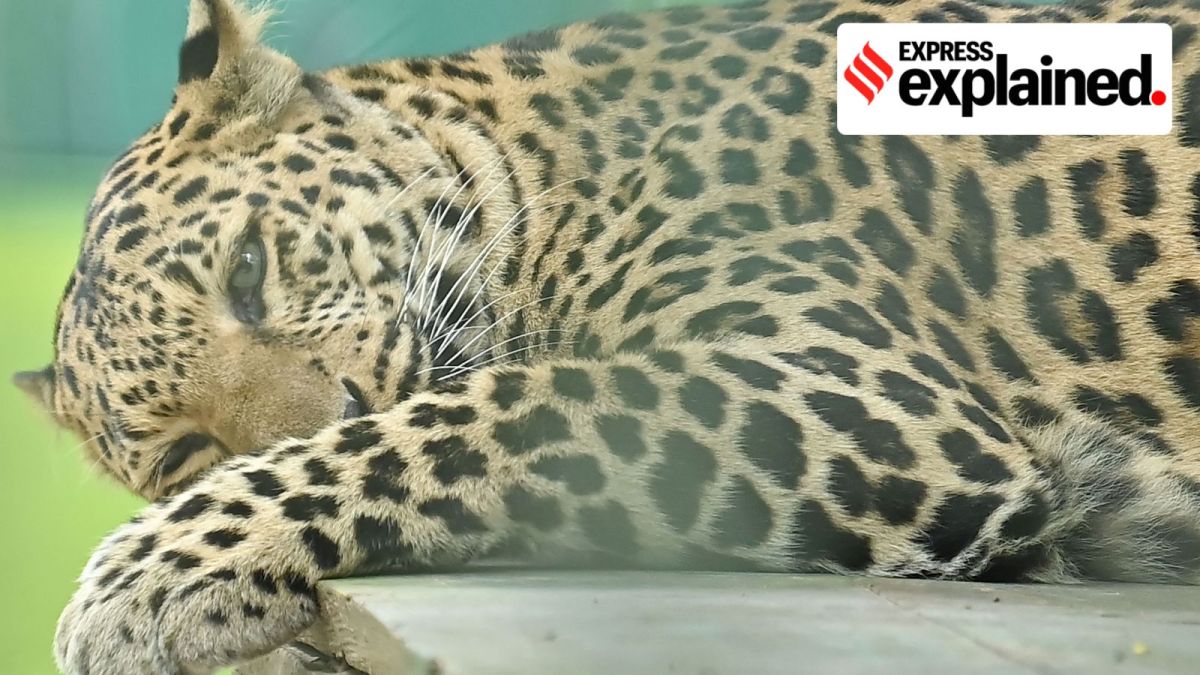
A leopard taking rest under trees, during a hot summer day at Sepahijala Wildlife Sanctuary on the outskirts of Agartala. (Express Photo by Abhisek Saha)
Indian leopards (Panthera pardus fusca) are distributed across a variety of forested habitats in India, Nepal, Bhutan, and parts of Pakistan. Being apex predators, they sit at the top of the food chain, and thus play a crucial role in maintaining a balanced ecosystem. Like lions (Panthera leo), leopards came to India from the west, most likely Ethiopia.
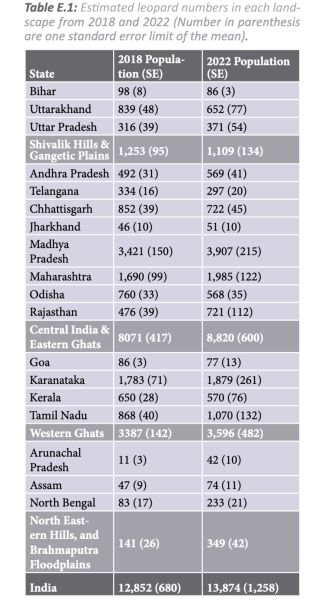
According to the recently released report, Central India and Eastern Ghats has the highest population of leopards (8,820), followed by the Western Ghats (3,596), and the Shivalik Hills and Gangetic Plains (1,109). Statewise, Madhya Pradesh boasts of the largest population of leopards (3,907), followed by Maharashtra (1,985), Karnataka (1,879) and Tamil Nadu (1,070).
“The data shows that the leopard population hasn’t grown the same way the tiger population has grown. It is a marginal increase,” Wildlife Institute of India’s (WII) former dean Y V Jhala told The Indian Express. However, he added that since leopards remain enticing targets for poachers, “it is a matter of satisfaction to manage the status quo”.
Decrease in population in some regions
Nonetheless, leopard populations declined in a few regions. The report showed that the Shivalik Hills and Gangetic Plains recorded a worrying 3.4% per annum decline, going down from 1,253 in 2018 to 1,109 in 2022.
Several states too reported a decline in leopard population. In Odisha the number of leopards dropped from 760 in 2018 to 562 in 2022, and in Uttarakhand, the population declined from 839 in 2018 to 652 in 2022. Kerala, Telangana, Chhattisgarh, Bihar, and Goa too reported population declines.
Story continues below this ad
Source: Status of Leopards in India, 2022.
One factor behind this can be the increase in tiger populations. Uttarakhand wildlife officials told The Indian Express that although leopard numbers remain stable in Rajaji and Corbett national parks, the Ramnagar Forest Division has recorded a significant decline in its leopard population possibly due to increased tiger density.
Other factors include a number of external threats, such as poaching and habitat loss. Road accidents are also a significant cause of leopard fatalities.
Benefits from tiger conservation efforts
While a rise in the tiger population has been known to adversely impact the habitat and resources available to leopards and other creatures lower down the predator chain, tiger conservation efforts have also helped grow leopard populations.
Take, for instance, the Central India and Eastern Ghats landscape, which boasts of the largest leopards population. Wildlife officials told The Indian Express that “[the] leopard population in this landscape is growing, largely due to protective measures under the umbrella of tiger conservation.”
Story continues below this ad
The report stated that “leopard densities are higher in the Tiger Reserves compared to outside Protected Areas, despite the fact that tigers exert regulatory pressure on leopards.”
Madhya Pradesh Principal Chief Conservator of Forests (Wildlife) Aseem Shrivastava spoke to The Indian Express on the matter. He said: “Tiger in Madhya Pradesh is an umbrella species. When we conserve the tiger, we also conserve the co-predators, the vegetation, and the whole habitat as a whole. The state has a very good track record of tiger conservation and that protection has been extended to leopards.”
Shrivastava added that “the state has a good management of the prey base”, which has helped augment its leopard population.
Leopard-human conflict remains a worry
Leopards’ adaptability in terms of habitat and dietary preferences help them to thrive in agro-pastoral areas, plantations, and near human settlements. This, however, has led to increasing leopard-human conflict.
Story continues below this ad
According to the report, in the Shivalik region, roughly 65% of the leopard population is present outside protected areas. The Uttarakhand Forest Department said that 30% of all wildlife-caused human deaths and injury cases were due to leopards (570 of nearly 2,000 cases from the last five years).
A 2023 report states that Maharashtra has emerged as the worst-affected state, reporting 113 fatal attacks in the last seven years, while Karnataka reported over 100 human-leopard encounters. This escalation can largely be attributed to habitat loss, due to mining and other human activities.
In Kerala, from 2013 to 2019, there were a total 547 reported incidents of human-leopard conflict, including 173 livestock deaths or injuries (93 cattle, 2 buffalo, 78 goats), a Kerala state government report said.
In Uttar Pradesh, attacks are attributed mostly to the fact that protected areas are “less than 10 km wide.” A 2019 research paper on UP’s Katarniaghat Wildlife Sanctuary noted that “38% of the conflict with leopards occurred when the victim was either inside or adjacent to a home. Another 40% of the conflict was recorded in agricultural fields, and 11% of attacks were on people who were defecating in farmlands”.
Story continues below this ad
In Tamil Nadu, the coffee-tea estates and other commercial plantations surrounded by forests are frequently occupied by leopards, since land is cheaper near the edges of forests, plantation workers buy these land for building houses, a 2017 research paper stated.
Anand Mohan J is an award-winning Senior Correspondent for The Indian Express, currently leading the bureau’s coverage of Madhya Pradesh. With a career spanning over eight years, he has established himself as a trusted voice at the intersection of law, internal security, and public policy.
Based in Bhopal, Anand is widely recognized for his authoritative reporting on Maoist insurgency in Central India. In late 2025, he provided exclusive, ground-level coverage of the historic surrender of the final Maoist cadres in Madhya Pradesh, detailing the backchannel negotiations and the "vacuum of command" that led to the state being declared Maoist-free.
Expertise and Reporting Beats
Anand’s investigative work is characterized by a "Journalism of Courage" approach, holding institutions accountable through deep-dive analysis of several key sectors:
National Security & Counter-Insurgency: He is a primary chronicler of the decline of Naxalism in the Central Indian corridor, documenting the tactical shifts of security forces and the rehabilitation of surrendered cadres.
Judiciary & Legal Accountability: Drawing on over four years of experience covering Delhi’s trial courts and the Madhya Pradesh High Court, Anand deconstructs complex legal rulings. He has exposed critical institutional lapses, including custodial safety violations and the misuse of the National Security Act (NSA).
Wildlife Conservation (Project Cheetah): Anand is a leading reporter on Project Cheetah at Kuno National Park. He has provided extensive coverage of the biological and administrative hurdles of rewilding Namibian and South African cheetahs, as well as high-profile cases of wildlife trafficking.
Public Health & Social Safety: His recent investigative work has uncovered systemic negligence in public services, such as contaminated blood transfusions causing HIV infections in thalassemia patients and the human cost of the fertilizer crisis affecting rural farmers.
Professional Background
Tenure: Joined The Indian Express in 2017.
Locations: Transitioned from the high-pressure Delhi City beat (covering courts, police, and labor issues) to his current role as a regional lead in Madhya Pradesh.
Notable Investigations: * Exposed the "digital arrest" scams targeting entrepreneurs.
Investigated the Bandhavgarh elephant deaths and the impact of kodo millet fungus on local wildlife.
Documented the transition of power and welfare schemes (like Ladli Behna) in Madhya Pradesh governance.
Digital & Professional Presence
Author Profile: Anand Mohan J at Indian Express
Twitter handle: @mohanreports ... Read More