© The Indian Express Pvt Ltd
 5 min read


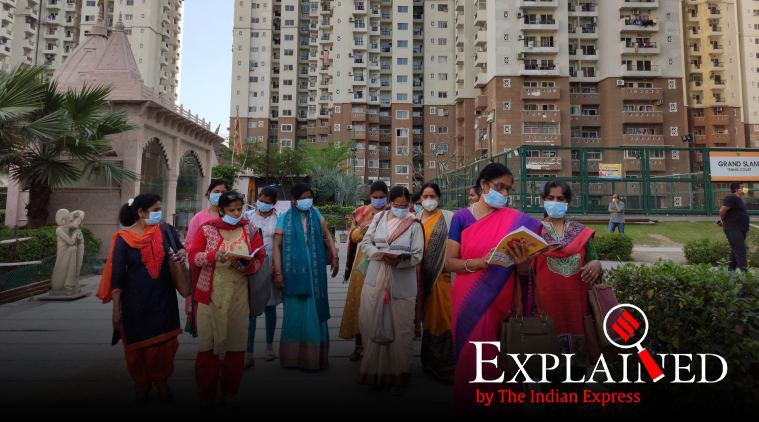 Hyde Park in Noida’s Sector 78 has a confirmed case of infection. (Express photo by Abhinav Saha)
Among the steps taken by authorities after someone tests positive for the novel coronavirus disease, are sanitation of the premises, and contact tracing. Across the country, specially constituted teams are trying to trying to trace each individual that the infected person came in contact with, and monitor people living in that area.
Families and neighbourhood
The moment a resident tests positive in Gurgaon, officials say, Health Department teams begin to track their contacts, test their relatives, and screen their neighbours to try to cut off the spread of the virus.
Samples of the patient’s immediate contacts, such as relatives they live with or collagues they work with, are collected for testing. While the patient is isolated, their contacts are placed in home quarantine for 14 days.
Four people have tested positive in Gurgaon so far.
“After that, active surveillance is carried out of 50 houses around theirs, to determine whether any residents have any symptoms, and to test them if they do. After that, there is a 5-km buffer zone, in which teams are deployed to again inspect and see if there is anyone with symptoms,” said Dr Jaswant Singh Punia, Chief Medical Officer (CMO) of Gurgaon.
In case the patient is a resident of an apartment, residents of the entire building are screened for symptoms, officials said.
Tracking of contacts
Simultaneously, health officials begin the process of speaking by telephone every day with every individual on the list to ascertain whether they are displaying any symptoms. They too are asked to stay home. If they show symptoms, they are called to give their samples for testing.
Also Read | Janata Curfew & Janata Thank You Sunday: PM says don’t lower guard
To carry out these tasks, the CMO has constituted 19 teams in the district, each of which is headed by a medical officer. Each team has 4-5 members, including Accredited Social Health Activist (ASHA) workers, who officials say are especially valuable “because they have the housing details and particulars”.
The discovery of a positive case also leads to a prompt effort to “decontaminate” the area in which the patient has resided or worked, officials said. “We decontaminate the area of the office using sprays, and the floor is mopped. In case of a building, we also disinfect the common areas, such as corridors and elevators,” the CMO said.
Anganwadi teams at work
In Delhi, which saw four confirmed cases on Thursday alone, anganwadi workers are at the forefront of the contact-tracing exercise. The tracing begins immediately, and the workers visit the colony from where the person has tested positive. “There is no defined area; we trace it as per the contacts. The workers visit nearby houses in the colony and ask if anyone has developed any symptoms. Meanwhile, the officers make calls to each contact. If they are not from Delhi, authorities of the concerned state are informed,” said Dr Nutan Mundeja, Director General of Health Services, Delhi government.
Officers from the Delhi government’s dispensaries have been visiting colonies to spread awareness about the disease. Pamphlets are being passed on, and the workers are teaching hand hygiene and coughing etiquette in the area, Dr Mundeja said.
Sanitisation of premises
In Noida, which has seen four confirmed cases so far, 20 teams have been formed to track contacts.
According to officials in Gautam Buddh Nagar, the sanitisation process is carried out primarily on the premises where the infected patient stays. In the adjacent areas, approximately in the 2-3 km radius, Health Department workers carry out intensive surveys for information, which can be used by the medical authorities for further action.
Don’t miss from Explained: As world battles coronavirus pandemic, a few takeaways emerge
“In the cases where positive patients were found, their homes and immediate surroundings were sanitised and disinfected. After that the screening process begins and an extensive survey is carried out, during which information about members and their health condition is gathered,” said a member of a Health Department team. In the sanitisation process, the areas are sprayed with water, and the surfaces are cleaned with acid-based disinfectant solutions.
Each day the teams, which have 3-4 members each, carry out the screening process till the area in the radius is covered. The process remains the same whether the patient is in a housing society or an independent house, officials said.