Premium

FTII Pune is now a ‘deemed university’. What does this mean for India’s premier film and TV school?

Deemed universities have a lot of the status and powers of universities that mere institutes do not. To be eligible to apply for this status, an institute must essentially have a recent proven and measurable track record of excellence. Here’s what else will change for FTII.

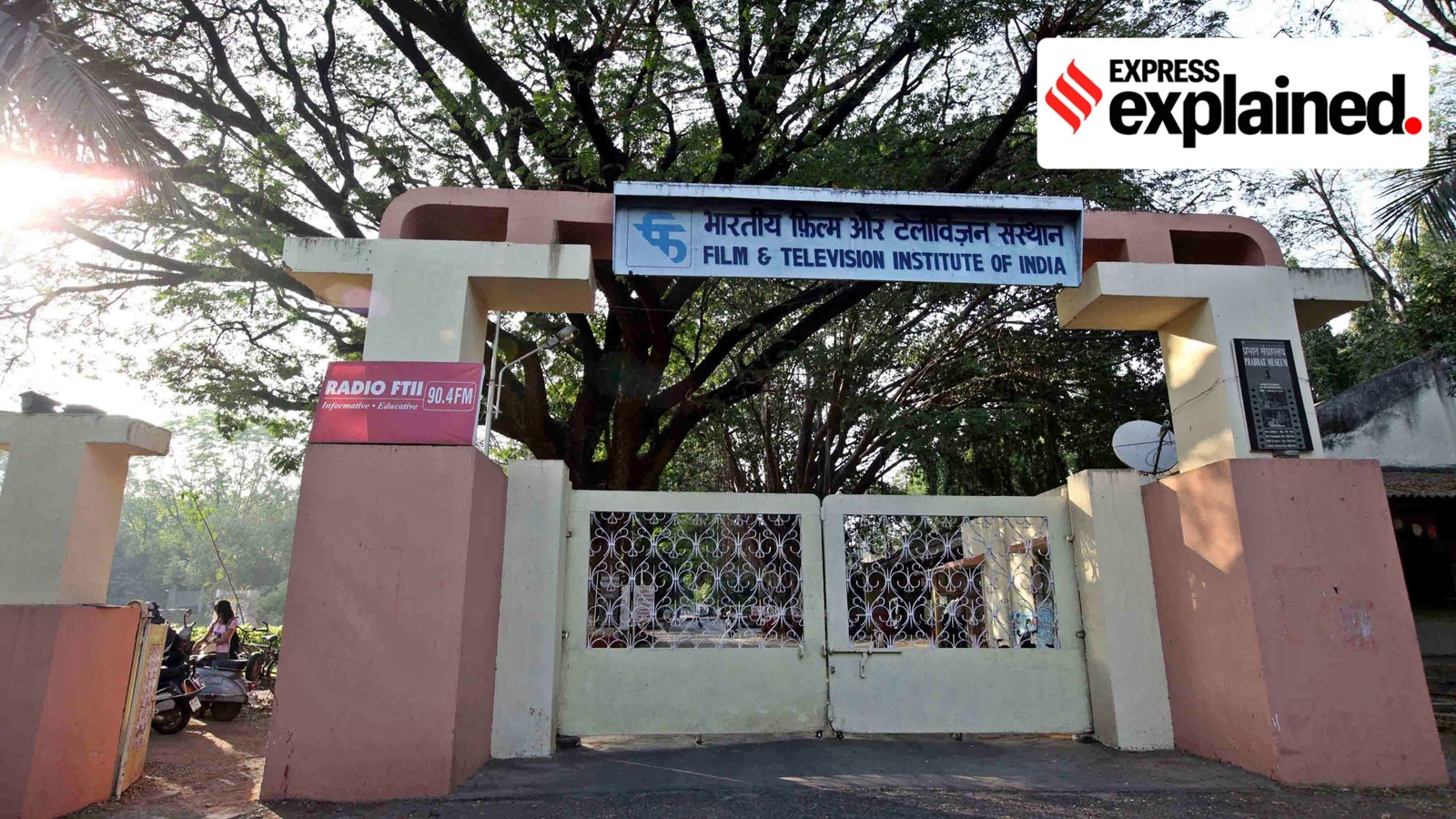
Main gate of the Film and Television Institute of India (FTII) in Pune.Main gate of the Film and Television Institute of India (FTII) in Pune. (Express photo by Arul Horizon)

The Union Ministry of Education has notified the Film and Television Institute of India (FTII) in Pune as an “Institution Deemed to be University”.

FTII has long been among the most sought-after destinations for the study of the practical aspects of filmmaking, and has produced towering alumni from Naseeruddin Shah, Shabana Azmi, and Adoor Gopalakrishnan to Rajkummar Rao and Jaideep Ahlawat.

What does it mean for FTII to receive the status of a “deemed to be university”?

FTII: the institute

FTII was set up by the Government of India in 1960 in Pune on the premises of the erstwhile Prabhat Studios, a pioneering company that had moved to the city from Kolhapur back in 1933. According to the FTII website, the institute was established as a department of the Ministry of Information and Broadcasting, and was then known as the Film Institute of India.

‘Television’ was added to the name of the institute in 1971, and FTII soon started in-service training programs for Doordarshan. The public broadcaster’s television training wing moved to Pune from Delhi in 1974. Along with its name, the status of FTII was changed to an autonomous society under the I&B Ministry, run by a governing council and a director appointed by it.

The FTII campus has seen unrest and repeated controversy in recent decades.

The institute had a chronic problem of backlog of courses, which meant standard three-year courses sometimes stretched for years longer, and there were many more students present on campus than was mandated, leading to overcrowding in classes and hostels.

Story continues below this ad

In 2015, students went on a months-long strike to protest the appointment of small-time television actor Gajendra Chauhan as president of the FTII Society, which segued into broader questions of creative freedoms and alleged thought control on campus.

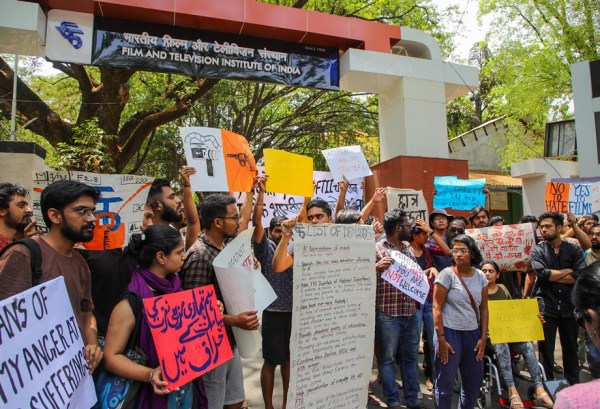
FTII students stage a demonstration at the gate during the visit of Anurag Thakur, then Union Minister for Information & Broadcasting and Youth Affairs & Sports, in 2022. FTII students stage a demonstration during the visit of Anurag Thakur, then Union Minister for Information & Broadcasting and Youth Affairs & Sports, in 2022. (Express archives)

These concerns have persisted, and have flared up from time to time, including last year, when alleged Hindutva activists entered the campus and protested violently against a banner about the razing of the Babri Masjid in Ayodhya.

Deemed university

According to the Education Ministry, an institution of higher education that is not (yet) a university but works at a very high standard in a specific area of study, can be declared as an institution “deemed-to-be-university”.

The designation is made by the central government on the advice of the higher education regulator, the University Grants Commission (UGC).

Story continues below this ad

A deemed university enjoys the academic status and privileges of a university, even though it isn’t one. Its objectives include providing higher education leading to excellence in various branches of knowledge from the undergraduate to the research degree levels, while fully conforming to the concept of a university.

This, according to the government, helps strengthen the research ecosystem and contribute to social transformation through socially responsive teaching, learning, research, and fieldwork.

A deemed university can also start new courses or programmes in any field on their existing campus and off-campus centres with the approval of the Executive Council and, if required, the relevant statutory council.

Eligibility for deemed university status

To be eligible to apply, an institute must essentially have a recent proven and measurable track record of excellence.

Story continues below this ad

An institute must have either a National Assessment and Accreditation Council (NAAC) ‘A’ grade with at least a 3.01 CGPA for three consecutive cycles or a National Board of Accreditation (NBA) accreditation for two-thirds of eligible programmes for three consecutive cycles.

Being in the top 50 of any category of National Institutional Ranking Framework (NIRF) for the last three years continuously, or in the top 100 of the overall NIRF ranking for the last three years continuously would also make the institute eligible to apply for deemed university status.

The FTII website today advertises itself as a recognised “centre for excellence in audio visual media across the world and one of the best film institutes in India”, whose alumni “work everywhere from Los Angeles, Paris and London to Mumbai, Hyderabad, Trivandrum, Chennai and Kolkata”, and have “gained popularity and earned various laurels as accomplished technicians and superstars”.

Eleven full-time courses in various disciplines of film and television are taught at the institute, the website says. These courses include Direction and Screenplay Writing, Cinematography, Sound Recording and Sound Design, and Screen Acting in the Film Wing, and Electronic Cinematography and Video Editing in the TV Wing.

Story continues below this ad

What changes for FTII

Institute Director Dhiraj Singh said, “This recognition under the distinct category allows FTII to retain its unique identity while embracing the benefits of being a world-class university. Award of degrees and research are immediate benefits while it paves way for better innovation and integration with the academics as NEP umbrella provides a lot of flexibility and scope.”

FTII currently offers Post Graduate Diploma Courses that are granted Master’s degree equivalence by Association of Indian Universities (AIU) and Post Graduate Certificate Courses approved by All India Council for Technical Education (AICTE).

Registrar Prateek Jain said the number and details of degree courses would be announced soon. “Students selected after the announcement are likely to be enrolled for degree courses as per the courses that will be announced in the upcoming prospectus,” he said.

Soham Shah is a Correspondent with The Indian Express, based in Pune. A journalism graduate with a background in fact-checking, he brings a meticulous and research-oriented approach to his current reporting. Professional Background Role: Correspondent coverig education and city affairs in Pune. Specialization: His primary beat is education, but he also maintains a strong focus on civic issues, public health, human rights, and state politics. Key Strength: Soham focuses on data-driven reporting on school and college education, government reports, and public infrastructure. Recent Notable Articles (Late 2025) His late 2025 work highlights a transition from education-centric reporting to hard-hitting investigative and human-rights stories: 1. Investigations & Governance "Express Impact: Mother's name now a must to download birth certificate from PMC site" (Dec 20, 2025): Reporting on a significant policy change by the Pune Municipal Corporation (PMC) following his earlier reports on gender inclusivity in administrative documents. "44-Acre Mahar Land Controversy: In June, Pune official sought land eviction at Pawar son firm behest" (Nov 9, 2025): An investigative piece on real estate irregularities involving high-profile political families. 2. Education & Campus Life Faculty crisis at SPPU hits research, admin work: 62% of govt-sanctioned posts vacant, over 75% in many depts (Sept 12, 2025): An investigative piece on professor vacancies at Savitribai Phule Pune University. "Maharashtra’s controversial third language policy: Why National Curriculum Framework recommends a third language from Class 6" (July 2): This detailed piece unpacks reasons behind why the state's move to introduce a third language from class 1 was controversial. "Decline in number of schools, teachers in Maharashtra but student enrolment up: Report" (Jan 2025): Analyzing discrepancies in the state's education data despite rising student numbers. 3. Human Rights & Social Issues "Aanchal Mamidawar was brave after her family killed her boyfriend" (Dec 17, 2025): A deeply personal and hard-hitting opinion piece/column on the "crime of love" and honor killings in modern India. "'People disrespect the disabled': Meet the man who has become face of racist attacks on Indians" (Nov 29, 2025): A profile of a Pune resident with severe physical deformities who became the target of global online harassment, highlighting issues of disability and cyber-bullying. Signature Style Soham is known for his civil-liberties lens. His reporting frequently champions the rights of the marginalized—whether it's students fighting for campus democracy, victims of regressive social practices, or residents struggling with crumbling urban infrastructure (as seen in his "Breathless Pune" contributions). He is adept at linking hyper-local Pune issues to larger national conversations about law and liberty. X (Twitter): @SohamShah07 ... Read More


 

Latest Comment
Post Comment
Read Comments
Advertisement
Advertisement
Advertisement
Advertisement