4 min read

© The Indian Express Pvt Ltd



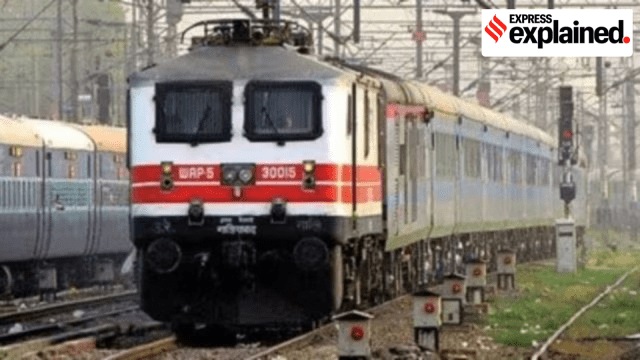 While not massive in scale, the project is of great significance, set to link areas whose original routes were lost during Partition — most importantly the Ferozepur–Khemkaran section. (Express file photo)
This week, Minister of State for Railways Ravneet Singh Bittu announced the much-awaited 26-km Ferozepur-Patti rail link in Punjab, sanctioned at a cost of Rs 764 crore.
The line will connect Mallanwala Khas station on the Jalandhar-Ferozepur section with Gharyala station on the Patti-Khemkaran section. While not massive in scale, it is of great significance, set to link areas whose original routes were lost during Partition — most importantly the Ferozepur–Khemkaran section.
This link would reduce the section from the current 294 km to 110 km.
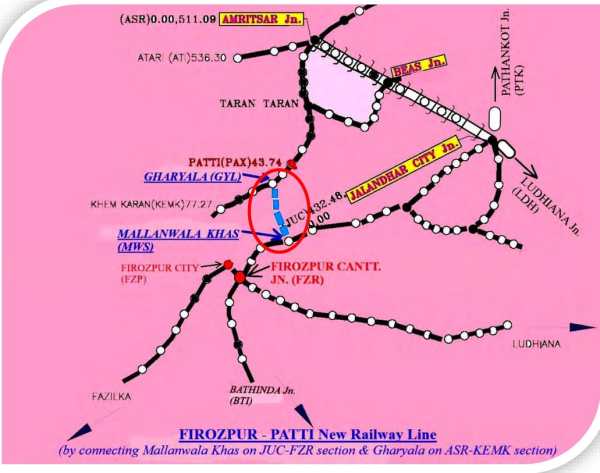 A map of the new Ferozepur-Patti rail link. (Source: Minister of Railways)
Before Partition, the route between Ferozepur and Khemkaran was a direct line running through what is now Pakistan. It connected Khemkaran with Kasur in present-day Pakistan, then passed the Hussainiwala border check post to reach Ferozepur.
After Partition, this route was severed and the track between Khemkaran and Kasur became defunct.
Though the Ferozepur-Patti rail link was sanctioned only recently, it has been in the works for over five years. According to the ministry, the proposed link will traverse Tarn Taran and Ferozepur districts and pass through 11 villages and one semi-urban area — Kot Budha, Maneke Jand, Maan, Talwandi Mastada Singh, Safa Singh Wala, Kaleke Uttarh, Talwandi Soba Singh, Bangla Rai, Mallanwala Khas (Semi Urban), Dulla Singh Wala, Kutub Din Wala and Kale ke Hittar.
These border villages have borne the brunt of Partition as well as later wars, militancy and narco-terrorism.
This makes land acquisition challenging for the Railways and the Punjab government. According to the Social Impact Assessment (SIA) study conducted in 2020 by Amritsar’s Guru Nanak Dev University, wounds from Partition remain raw.
“…there were families who had suffered a lot at the time of partition and settled down in areas close to river bed and made the land fertile with their labour, are now completely scared that after 70 years again [sic] they are going to be faced with the threat of being uprooted from their land holdings,” the report notes, recommending well thought-out compensation.
Highlighting the centrality of land, the study adds: “The Agriculturists in this region has toiled over generations to convert river and frontier land into a fertile land…The land which was not worth a single crop has been made tillable by the hard work of generations of these committed people. It has become capable of two crops.”
At the public hearing in March 2020, locals demanded compensation of Rs 1 crore per acre.
The 26-km line will connect the Jalandhar-Ferozepur and Patti-Khemkaran routes.
Located near India’s international border with Pakistan, these lines are strategically important. With Army cantonments in Amritsar and Ferozepur city, the link would enable faster movement of personnel, equipment and ammunition.
It will also create a new Ferozepur-Fazilka-Mumbai route as an alternative to the Ferozepur-Delhi-Mumbai line and cut the Jammu-Ferozepur-Fazilka-Mumbai corridor by 236 km. Currently, the only Jammu-Amritsar-Ferozepur route is via Jalandhar. The new link will connect Jammu-Amritsar-Ferozepur directly, bypassing Jalandhar.
Amritsar is both a major business hub and a key Sikh pilgrimage centre — home to Harmandir Sahib, the most sacred shrine, and Akal Takht, the highest temporal seat.
This makes its link with Ferozepur vital. Announcing the project, Minister of State for Railways Ravneet Singh Bittu said it will benefit nearly 10 lakh people and generate about 2.5 lakh jobs. “Each day, it will serve 2500–3500 passengers — particularly students, employees, and patients from nearby villages,” Bittu said.