5 min read
© IE Online Media Services Pvt Ltd



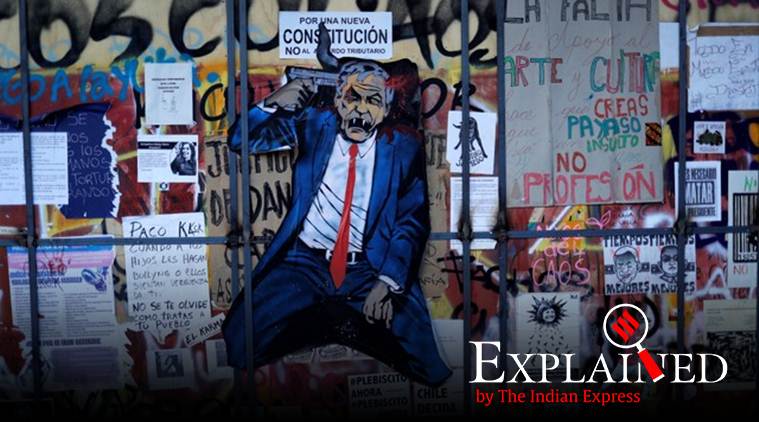 Chile protests: A painting depicting Chilean President Sebastian Pinera is seen during a protest against Chile’s government in Santiago, Chile November 13, 2019. (Reuters Photo: Jorge Silva)
On Tuesday, opposition leaders in Chile sought to begin impeachment proceedings against President Sebastián Piñera. The Chilean government has been accused of using violent methods in dealing with the massive protests that have rocked the South American nation for more than a month.
In the protests that began in October after a subway fare hike, 22 people have died so far and more than 2,000 have been injured, according to Amnesty International. The military police deployed to deal with the demonstrators has been accused of murder, torture, and sexual violence.
Due to the unrest, Chile has pulled out of hosting two international events, the UN COP25 and APEC summits.
The scale and endurance of the protests have surprised the world — Chile was long regarded as a remarkable example of prosperity and political stability in generally turbulent Latin America.
The trigger was a modest 4 per cent increase in subway fares announced on October 1 this year. On October 7, the day after the new fares came into effect, school students launched a campaign to dodge them, jumping turnstiles on the Santiago Metro in civil disobedience, and trended #EvasionMasiva or ‘Mass Evasion’ on social media.
As the campaign spread, there were violent incidents, and several Metro stations were shut on October 15. Three days later, the entire grid was closed, and Piñera announced a 15-day curfew. However, the rioting continued, and spread from Santiago to Concepción, San Antonio, and Valparaíso.
The government cancelled the fare hike on October 19, but the protests did not cease. On October 26, over a million people marched in the streets of Santiago.
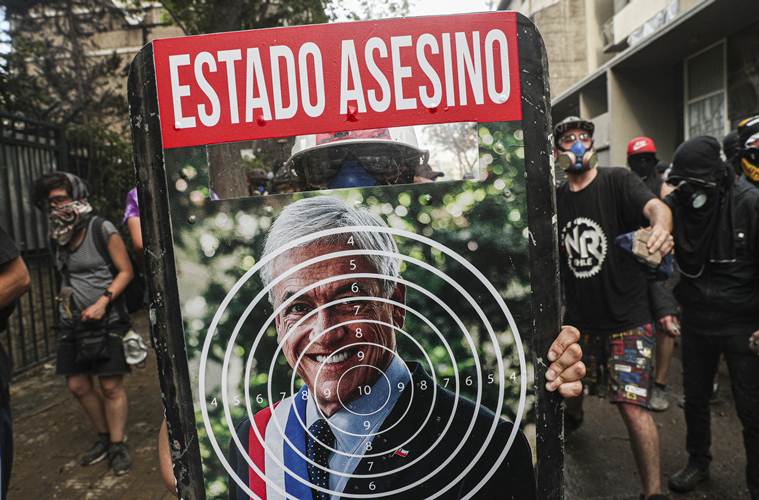 Chile protests: An anti-government protester holds his shield adorned with a portrait of the Chile’s President Sebastian Pinera inside a bull’s eye, during clashes with police in Santiago, Chile, Monday, Nov. 18, 2019. The text on the shield reads in Spanish “Murderous Sate.” (AP Photo: Esteban Felix)
Many Metro stations have been destroyed, supermarkets set afire, and stores have been looted. The protests have been described as the most tumultuous of the last 30 years, since the country returned to democracy at the end of General Augusto Pinochet’s dictatorship. Interior Minister Andrés Chadwick has called the situation “more violent and barbaric than anything in (his) memory”.
Also read | Protests in Bolivia, Chile, Ecuador, Venezuela, Mexico — why trouble brews in Latin America
The protesters represent the voices of those left out of the economic growth and prosperity that most non-Chileans have come to identify the country with. Discontent against broad income inequality is the key provocation. People are angry about low incomes from salaries and pensions, and are unsatisfied with public healthcare and education.
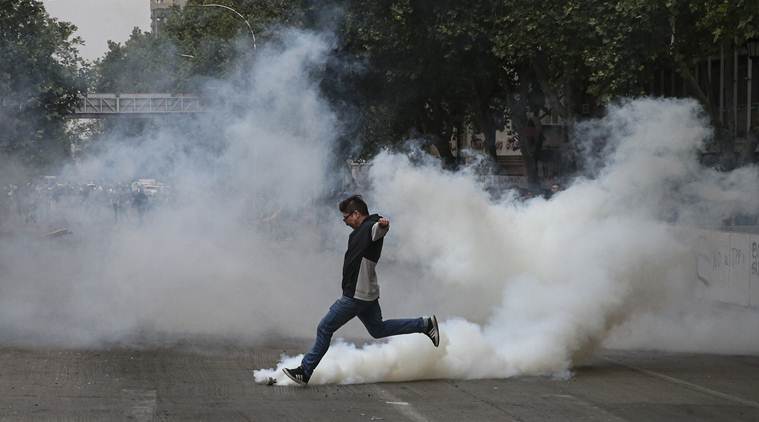 A protester kicks a tear gas canister launched by police during a protest in Santiago, Chile, Saturday, Oct. 19, 2019. (AP Photo: Esteban Felix)
A major driver of the protests has been the fear of poverty in old age — many elderly Chileans were seen marching alongside youth. Chile has a defined contribution pension scheme in which workers pay at least 10 per cent of their wages every month to for-profit funds, called AFPs. Over the years, these AFPs have come to hold an enormous corpus — $216 billion, or about 80 per cent of the nation’s GDP at present — and have huge investments in Chile and overseas.
However, not all Chileans benefit from the pension scheme. Many can’t contribute regularly and end up with small payouts. A third of Chileans who work in informal jobs, don’t have jobs, and women who quit to raise children, lose out. In essence, critics say, the AFPs have helped fuel an economic boom that has been visible in impressive skylines and apparent prosperity, but has really benefited only a relatively small elite.
In pictures | Thousands march in Chile protest after two key summit cancellations
What have the protesters been able to achieve so far?
As the protests raged on, ruling politicians promised to deliver constitutional reform. On November 15, the government announced that it would hold a referendum for a new constitution for Chile.
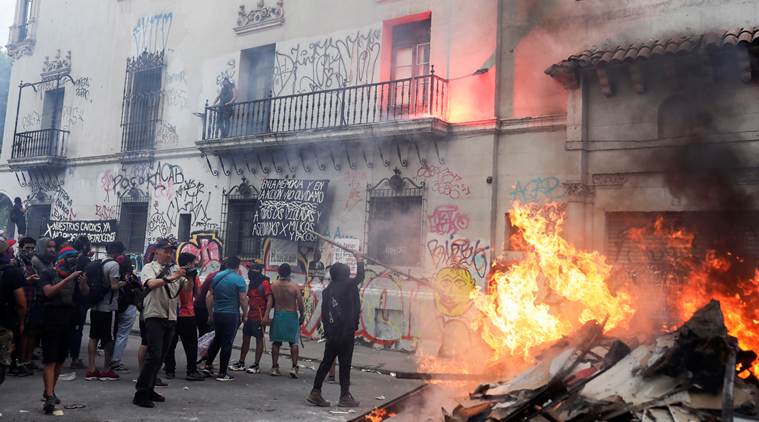 Demonstrators react near an improvised bonfire during a protest against Chile’s state economic model in Santiago, Chile October 25, 2019. (Reuters Photo: Pablo Sanhueza)
Many Chileans want the constitution changed, since the current one, although heavily amended, was first written 30 years ago during the military dictatorship of General Pinochet. It also does not make the state responsible for providing healthcare and education, two key demands of the current protests.
The referendum will be held in April 2020, in which voters will be able to decide if they want a new constitution, a demand that is overwhelmingly popular. They will also be able to decide between a process in which either political appointees would be involved or only elected citizens would play a role.
Don’t miss from Explained: Why govt stripped a Telangana MLA of his Indian citizenship