© IE Online Media Services Pvt Ltd
 3 min read


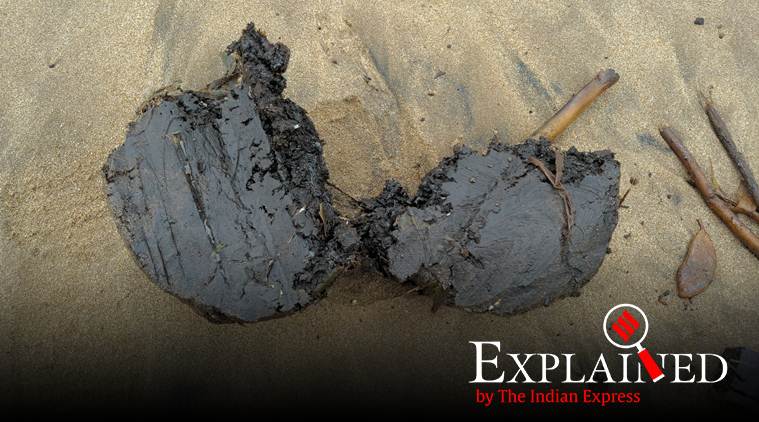 Tarballs at Juhu beach in Mumbai. (Photo by Shaunak Modi, member Marine Life of Mumbai)
On Thursday, Girgaum chowpatty, a famous tourist spot in South Mumbai, saw big, black oil-emanating balls lying on its sandy beach. On July 5 and 6, Juhu beach in suburban Mumbai too had these strewn on its shore. A week later at the Marine Drive promenade, visitors complained about the smell of diesel.
What are these sticky black “tarballs”, and why have they appeared on Mumbai’s beaches?
Tarballs are dark-coloured, sticky balls of oil that form when crude oil floats on the ocean surface. Tarballs are formed by weathering of crude oil in marine environments. They are transported from the open sea to the shores by sea currents and waves, according to the research paper Diversity of bacteria and fungi associated with tarballs: Recent developments and future prospects by Laxman Shinde, Varsha & Suneel, V & Shenoy, Belle Damodara (2017), National Institute of Oceanography (NIO).
Tarballs are usually coin-sized and are found strewn on the beaches. However, over the years, they have become as big as basketballs and can weigh as high as 6-7 kgs.
Most of the times, the presence of several tarballs indicate an oil spill. However, its annual occurrence on the west coast during the monsoon has led marine biologists and experts to demand an investigation in the matter.
Experts have urged authorities to take stricter vigil and check if ships are dumping burnt oil waste off the western coast of India.
A study published by NIO in 2013 stated that “oil-well blowouts, accidental and deliberate release of bilge and ballast water from ships, river runoff, discharges through municipal sewage and industrial effluents” also leads to the formation of tarballs.
Dismissed as annual occurrence by the Maharashtra Pollution control board, tarballs that travel towards the coast can get stuck to the fishing nets installed in the sea, making it difficult for fishermen to clean.
In addition, it could affect marine life, especially filter feeders like clams and oysters.
Tarball pollution is a major concern to global marine ecosystem. Microbes such as bacteria and fungi are known to be associated with tarballs. They presumably play an important role in tarball degradation and some are potential human and animal pathogens.
NIO is currently fingerprinting the oil to determine its source and study the impact.
Tarballs are difficult to break down, and can therefore travel for hundreds of miles in the sea. Noted cases of tarball occurrences have been witnessed at Goa beaches since 2010, in South Gujarat, Mangaluru and at Los Angles beaches.
There has never been a case of a beach closing down due to tarballs in India.