© IE Online Media Services Pvt Ltd
 5 min read


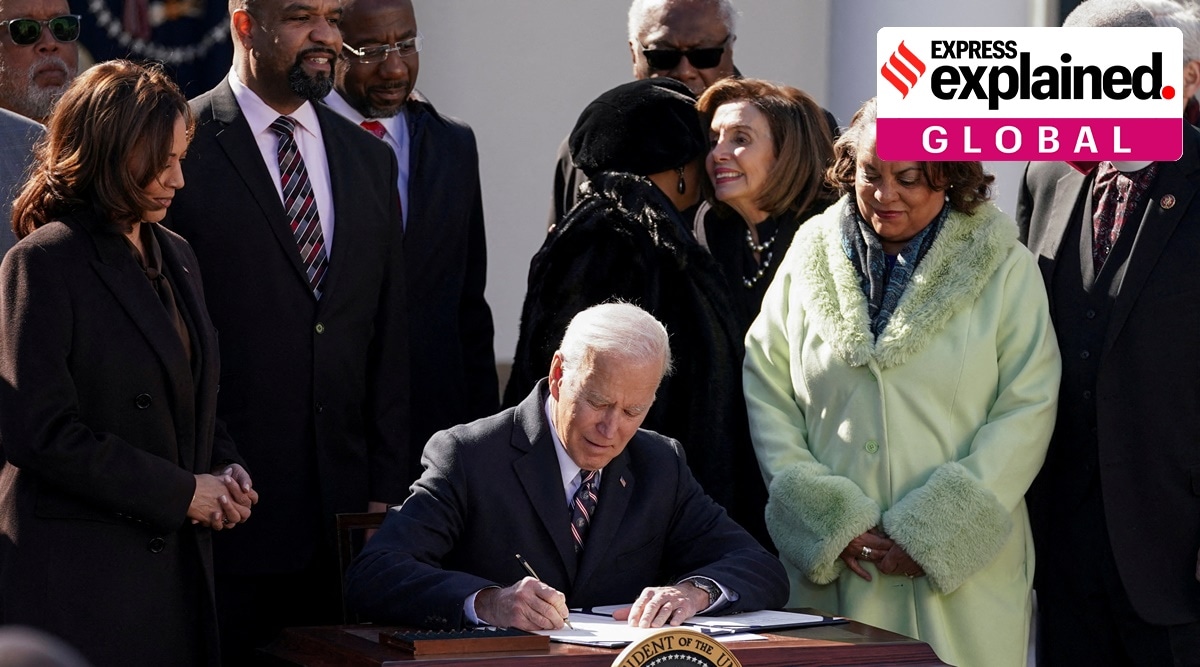 US President Joe Biden signs into law the Emmett Till Antil-ynching Act the White House on Tuesday. (Photo: Reuters)
After almost 100 years and 200 failed attempts by lawmakers, US President Joe Biden Tuesday (March 29) finally signed legislation that designates lynching as a federal hate crime, with perpetrators facing up to 30 years in jail.
“Lynching was pure terror to enforce the lie that not everyone…belongs in America, not everyone is created equal,” President Biden said during the historic signing ceremony at the White House Rose Garden. “Terror, to systematically undermine hard-fought civil rights. Terror, not just in the dark of the night but in broad daylight. Innocent men, women and children, hung by nooses, from trees, bodies burned and drowned, castrated,” the President added.
The legislation, officially known as the Emmett Till Anti-lynching Act, is named after a 14-year-old black teenager who was murdered in Mississippi in 1955. Emmett’s murder is said to have sparked an upsurge in activism and resistance, galvanising what came to be known as the US Civil Rights Movement.
The history of lynching in the United States
Lynching, which typically refers to when an illegal mob kills a person based on their race without due process for the victim, has a long history in the US — tracing back to the 1800s. Over the 19th and 20th centuries, thousands, mainly African Americans, were lynched across the United States. This was particularly prevalent in the southern part of the country after the Civil War.
“Their crimes? Trying to vote, trying to go to school, trying to own a business, or preach the gospel,” Biden said at the signing ceremony.
According to the Equal Justice Initiative, a non-profit that provides legal representation to those may have been denied a fair trial, around 4,400 African Americans were lynched between 1877 and 1950. The Bill itself notes that between 1882 and 1968, at least 4,700 people, predominantly African-Americans, were reportedly lynched in the US, and that 99 per cent of the perpetrators were not punished. While the victims were primarily black, people of Mexican and Asian descent have also been targeted.
There are also several recent examples — many activists have described the murders of George Floyd in Minneapolis and Ahmaud Arbery in Georgia as modern-day lynching. Another often-cited instance is the fatal shooting of a black pastor and eight black members of his congregation at a church in Charleston, South Carolina, in 2015.
What is the US’ anti-lynching law?
Under the Emmett Till Anti-lynching act, an action can be prosecuted as a lynching when a person conspires to commit a hate crime that results in death or serious injury. This will serve as a useful tool for federal prosecutors to prosecute brutal hate crimes.
It essentially amends the US’ existing federal hate crime laws, enshrined in the Matthew Shepard and James Byrd Jr. Hate Crimes Prevention Act, which was signed into law by former President Barack Obama in 2009.

After over 200 failed attempts by the Congress, the Bill was finally passed unanimously in the Senate earlier this month. Only three Republican lawmakers voted against its passage — Thomas Massie of Kentucky, Chip Roy of Texas and Andrew Clyde of Georgia — as they believed that lynching was already a hate crime in the US.
In 1900, the first anti-lynching Bill was introduced by George Henry White, who was then the only black man in the Congress. Later in the 1920s, the US-based civil rights organisation National Association for the Advancement of Colored People (NAACP) attempted to pass an anti-lynching Bill, which ultimately led to a federal hate crime legislation being passed.
In 2020, following the death of George Floyd, the Senate came close to passing an anti-lynching bill with bipartisan support, but was blocked by Republican Senator Rand Paul. However, he later signed the legislation after his concerns about it being too expansive were addressed.
What’s behind the name of the legislation?
Emmett Till was 14 years old when he was lynched in Mississippi in 1955. He had gone to a grocery store with a group of his cousins where he is said to have whistled at a white woman named Carolyn Bryant. Later, Bryant’s husband and brother-in-law kidnapped Till, beat him up and shot him.
NAACP issued a statement saying that it found Till’s “mangled corpse, with a seventy-five-pound cotton gin fan tied to the neck” from the bottom of the Tallahatchie river on August 31, 1955. His death resulted in an uproar for change and an end to discrimination.
Later, Bryant’s husband and brother-in-law were acquitted of the charges. The jury was all-white. Till’s mother had famously held an open-casket funeral to show the world the gruesome effect of racism in the country.
Newsletter | Click to get the day’s best explainers in your inbox